Introduction
Picture a distributor sales rep who just lost a longtime account to a competitor offering the same product for two percent less. It happens every day in HVAC, electrical, plumbing, and tire distribution, where buyers now compare suppliers with a few clicks instead of a phone call.
Without a structured strategy, businesses lose customers and channel partners to whoever quotes the lowest price, not whoever delivers the most value. That's a losing game for margins.
This guide breaks down what B2B loyalty programs are, how they differ from consumer programs, the main types, and how to build one step by step.
We'll also cover how a full-service partner like Calusa Marketing can manage the entire program lifecycle, so your team isn't stuck running it alone.
Key Takeaways
- B2B loyalty programs reward long-term behaviors like volume and tenure, not single purchases
- Longer sales cycles and multiple stakeholders set B2B programs apart from B2C rewards
- Points, tiers, rebates, and SPIFFs often combine to fit complex account structures
- Data-driven incentives protect margin better than blanket discounting
- Full-service program management removes the operational burden from internal teams
What Is a B2B Loyalty Program?
A B2B loyalty program is a structured incentive strategy that manufacturers, distributors, and service providers use to reward customers, contractors, dealers, and channel partners for ongoing purchasing and engagement. Instead of a one-time discount, it's an ongoing relationship built on measurable behavior.
Here's how the mechanics typically work:
- Businesses track transaction and sales data across accounts
- They set purchasing milestones or performance targets
- Participants earn rewards, whether points, cash, merchandise, or travel, once they hit those targets
The concept shows up across a wide range of B2B verticals, from HVAC and electrical distribution to tire dealers and enterprise-level suppliers. Real-world programs illustrate how the mechanics play out:
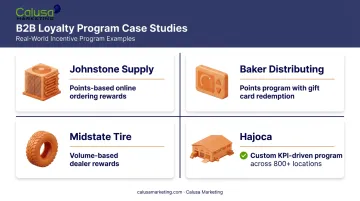
- Johnstone Supply, an HVAC parts distributor, runs a points-based program through Calusa Marketing that rewards online ordering and product training completion
- Baker Distributing (part of Watsco) uses a similar points program to shift HVAC contractors toward online ordering, paired with gift card redemption
- Midstate Tire rewards dealers for purchase volume and account growth, encouraging them to consolidate spend rather than split orders across competitors
- Hajoca, operating across 800+ locations and 20+ entities, uses a custom program built around its own KPIs to drive sales growth at scale
Media and vacation ownership companies rely on similar structures, just tuned to different behaviors like renewals or subscription engagement.
B2B vs. B2C Loyalty Programs: Key Differences
B2B loyalty isn't consumer loyalty with bigger invoices. The buying dynamics are genuinely different, and Gartner points out that complex buying structures are one reason B2B loyalty programs haven't been adopted as widely as B2C programs.
| Factor | B2B Programs | B2C Programs |
|---|---|---|
| Decision-makers | Multiple stakeholders (purchasing agent, department head, end user) | Single buyer |
| Transaction pattern | Larger dollar value, less frequent | Smaller dollar value, more frequent |
| Sales cycle | Longer, relationship-driven | Short, often impulse-driven |
| Reward focus | Rebates, tiered discounts, training, travel | Points, cashback, instant perks |
| Program goal | Long-term account growth | Repeat individual purchases |
Why Stakeholder Complexity Matters
A single B2B account might involve a purchasing manager who cares about price, an operations lead who cares about reliability, and a technician who actually uses the product. A program that only speaks to one of those people misses the other two entirely.
Why Reward Type Shifts
Forrester notes that B2B loyalty needs to coordinate customer information and interactions across organizational silos. That complexity is why rewards tend to skew toward business value, such as training credits, exclusive service tiers, and travel incentives, rather than pure impulse rewards.
Why B2B Loyalty Programs Matter: Key Benefits
Retention and Profitability
Retaining an existing account almost always beats chasing a new one. Forrester reports that customer-obsessed B2B firms grow 2.5 times faster and retain 2.2 times more customers than their less customer-focused peers. And Harvard Business Review, citing Bain research, found that acquiring a new customer can cost 5 to 25 times more than retaining an existing one.
Beyond retention, loyalty programs strengthen sales performance, competitive position, and data visibility:
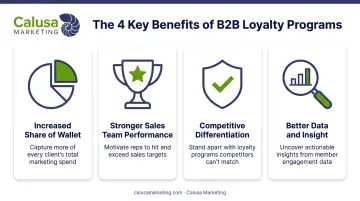
- Increased share of wallet: Growth-based rewards encourage customers to consolidate spend with one supplier instead of splitting orders across vendors chasing the lowest bid, as seen in Midstate Tire's dealer program.
- Stronger sales team performance: SPIFFs and layered incentives keep reps and channel partners motivated to prioritize specific product lines during launches or slow seasons.
- Competitive differentiation: Points, training credits, or travel toward a program tier give distributors a non-price reason to stay, since switching means starting over.
- Better data and insight: Program participation data surfaces purchasing gaps, flagging accounts before spending drops let competitors step in.
Types of B2B Loyalty Programs
Most high-performing B2B strategies don't rely on a single model. They blend two or three depending on the audience, whether that's end customers or channel partners, and the business goal at hand.
Points-Based Rewards Programs
Participants earn points for purchases, training completions, or referrals, then redeem them on their own timeline for merchandise, gift cards, or travel. This structure is simple and easy for busy buyers to understand.
Calusa Marketing's CM Rewards catalog, for example, includes over 10 million authentic branded items from names like Apple, Nike, Yeti, and Callaway, with fulfillment to more than 100 countries. A "Top Up" feature lets members pay the difference if they're short on points, so they're never stuck waiting to redeem.
Tiered Loyalty Programs
Programs classify customers or partners into levels, think Silver, Gold, Platinum, with escalating benefits tied to revenue, certifications, or engagement. Tiers give accounts a visible growth path, which motivates the jump from one level to the next.
Channel and Distributor Incentive Programs (Including SPIFFs)
These target dealers, distributors, contractors, and jobbers with rewards tied to sales performance and product mix. SPIFFs specifically motivate individual reps inside a partner's organization to push certain products, often during a limited-time window.
Rebate and Volume Discount Programs
Rebates reward purchase thresholds after the fact, unlike straight discounting, which cuts price upfront. That distinction matters. Rebates protect list price integrity because the discount only applies once the volume target is actually met.
Digital Punch Card and Gift Card Programs
For frequent, smaller B2B transactions, a digital punch card is a low-complexity entry point. Calusa Marketing's platform includes no-app digital punch cards and flexible "any-card" gift card options, so distributors can launch a rewards program without asking customers to download anything.
How to Build a Successful B2B Loyalty Program
Building a program that actually sticks takes more than picking a reward type. Follow this sequence:
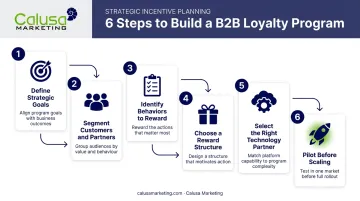
- Define strategic goals. Decide whether you're solving for retention, incremental sales, category expansion, or channel engagement. Each goal points to a different program design.
- Segment customers and partners. Group accounts by size, growth potential, and role in the value chain. A top-tier dealer and a small contractor shouldn't get identical incentives.
- Identify behaviors to reward. Use transaction data to decide whether you're rewarding total spend, product mix, training completion, or referrals.
- Choose a reward structure. Match points, tiers, rebates, travel, or merchandise to what actually motivates your specific audience, not what worked for a different industry.
- Select the right technology partner. Look for a platform that skips complex integrations and app downloads while handling analytics, transactions, and fulfillment for you. Calusa Marketing's cloud-based SaaS platform adds white glove support, available seven days a week.
- Pilot before scaling. Launch with a smaller group first, then refine based on real participation data before rolling out company-wide.
Common Challenges in B2B Loyalty Programs
Even well-intentioned programs run into predictable trouble spots.
- Overreliance on discounts and rebates. Blanket discounting erodes margin. Targeted, behavior-specific incentives protect price integrity while still driving volume.
- Generic, one-size-fits-all rewards. Busy buyers and channel partners tune out rewards that don't feel relevant to their role, which tanks participation.
- Weak ROI measurement. A 2021 IESP benchmark study found 90% of well-designed programs hit at least a 2:1 ROI, but only when results are tracked and optimized consistently.
- Underestimating ongoing management. Programs lose momentum fast without continuous communication, fresh incentives, and regular optimization after launch.
Frequently Asked Questions
What is a B2B loyalty program?
It's a structured incentive program that rewards business customers, distributors, and channel partners for ongoing purchasing and engagement, rather than one-off transactions. Rewards are typically tied to volume, tenure, or specific behaviors.
How do B2B loyalty programs differ from B2C loyalty programs?
B2B programs deal with longer sales cycles, multiple stakeholders per account, and larger transaction values. Rewards lean toward business value, like rebates and training, rather than the emotional, individual-focused perks common in B2C.
What types of rewards work best in a B2B loyalty program?
Rebates, tiered discounts, travel incentives, gift cards, and digital punch cards all perform well, depending on transaction frequency and audience. High-frequency, lower-dollar buyers often respond best to punch cards, while strategic accounts respond to tiers and travel.
How much does it cost to run a B2B loyalty program?
Cost depends on scale, reward type, and management model. SaaS-based platforms generally offer more budget-friendly, scalable options than custom-built systems, since pricing often scales with program size and participant activity.
What ROI can a B2B loyalty program generate?
IESP's 2021 research found that 90% of well-designed programs hit at least a 2:1 ROI. That's not guaranteed for every program, but it's a realistic benchmark for one that's properly structured and measured.
How long does it take to launch a B2B loyalty program?
Cloud-based platforms that don't require integration or app downloads can launch in weeks. Custom-built systems typically take months, since they need development, testing, and IT coordination.