](https://file-host.link/website/calusamarketing-rgieyw/assets/blog-images/442a55a9-5824-4b36-bd2d-05dd106724dd/1785061154245952_50148b0326ff4443b2be50b927714d85/360.webp)
Introduction
Walk into any hotel loyalty desk, sales kickoff meeting, or distributor conference this year, and you'll hear the same phrase: milestone rewards.
From IHG's night-based perks to B2B sales SPIFFs that pay out at specific revenue thresholds, tiered incentive structures have become the default model for serious loyalty and performance programs.
There's a reason for the shift. Flat, one-time bonuses spike behavior briefly, then fade.
Many businesses still default to simple point systems or single payouts that fail to sustain engagement with sales teams, distributors, or customers over the long haul.
This guide breaks down everything you need to know about milestone rewards programs:
- What milestone rewards programs actually are and how they work
- Why they outperform static, one-time incentives
- The reward formats top programs use today
- Best practices for building a program that delivers results
Key Takeaways
- Milestone rewards escalate at specific thresholds, not a single flat payout
- They keep participants engaged by making the "next reward" always feel within reach
- Common formats span bonus points, gift cards, travel credits, and exclusive perks
- Strong programs require clear thresholds, flexible reward choices, and dependable fulfillment
- An incentive partner simplifies design, tracking, and reward delivery at scale
What Are Milestone Rewards Programs?
Milestone rewards programs change the reward's value or type as a participant hits defined targets. That's structurally different from flat-rate incentive logic, where every action earns the same fixed payout regardless of how much someone has already accomplished.
Instead of "sell 10 units, get $50 every time," a milestone structure says: hit 10 units and earn $50, hit 25 units and unlock $150 plus a bonus perk, hit 50 units and earn a travel credit. The reward grows with the achievement.
How Hotel Loyalty Programs Illustrate the Model
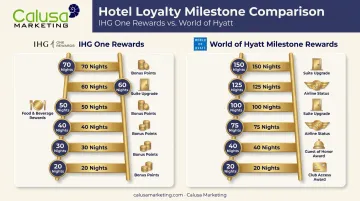
Two of the clearest real-world examples come from hospitality. IHG One Rewards unlocks a new milestone every 10 qualifying nights starting at 20 nights, letting members choose bonus points, Food & Beverage Rewards, or a Confirmable Suite Upgrade at each tier.
World of Hyatt Milestone Rewards takes a similar approach, starting at 20 qualifying nights and running through 150, escalating from Club Access Awards at the entry tier to Guest of Honor Awards, Suite Upgrades, and elite airline status at the top.
Both programs give members choices at each threshold rather than forcing one fixed reward, a design detail that matters more than most businesses realize.
It's Not Just Travel
Milestone structures aren't confined to hotel points. The same framework drives sales SPIFFs, distributor loyalty programs, customer purchase milestones, and employee service-anniversary awards.
Calusa Marketing has built milestone-style structures for clients across HVAC and electrical distribution, timeshare and vacation ownership, media and broadcasting, and call center operations — industries where recurring purchase or performance behavior needs sustained reinforcement, not a one-time nudge.
That sustained reinforcement pays off in measurable ways. The Incentive Research Foundation's predictive ROI framework for long-term channel programs uses planning benchmarks of 8%-12% participant lift in conservative scenarios, 15%-20% in moderate scenarios, and up to 25%-30% in optimistic ones for well-structured tiered channel incentive programs.
These are modeling benchmarks for program design, not guaranteed outcomes, but they show why tiered structures get budget approval that flat bonuses often don't.
How Milestone Rewards Programs Work
Every milestone program runs on the same basic architecture, regardless of industry.
Core Mechanics
Program managers start by choosing a measurable trigger, then building thresholds around it:
- Pick the trigger: referrals, sales dollars, nights stayed, purchases made, or tenure achieved
- Set milestone thresholds: the specific points where a new reward level activates
- Assign reward type and value: what unlocks at each threshold, and how it scales
Why Reward Choice Matters
The strongest programs don't lock participants into one fixed reward per tier. Instead, they offer a menu — points, gift cards, or an experience — at each milestone. This flexibility isn't a nice-to-have; it directly affects how much effort people put in.
Participants decide how deeply to engage based partly on the rewards available to them at each level. Giving them options, rather than a single fixed prize, increases the perceived value of the entire program.
The Participant Journey
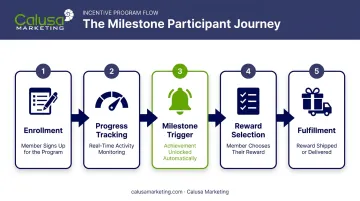
A typical milestone program follows five stages:
- Enrollment: participant joins and understands the earning structure
- Progress tracking: dashboard or notifications show status toward the next tier
- Milestone trigger: the system flags when a threshold is hit
- Reward selection: participant chooses from available options
- Fulfillment: reward is delivered, shipped, or booked
Technology carries the weight here. Cloud-based platforms automate tracking and instant redemption, removing the manual math and spreadsheet-chasing that used to fall on program administrators.
Calusa Marketing's client dashboards, for example, show members their point balances, year-to-date activity, and pending rewards in real time. That visibility keeps a Johnstone Supply distributor or an Alorica agent focused on the next tier instead of wondering where they stand.
One caution: poorly explained milestone rules erode trust fast. If participants don't understand what triggers a reward or how long they have to claim it, confusion sets in and engagement drops before the first milestone is even reached.
Why Milestone Rewards Programs Benefit Businesses
Flat, one-time incentives lose their pull the moment they're paid out. Milestone structures solve that by giving participants a reason to keep performing or purchasing over months or years — there's always a next level to reach.
Sales Teams and Channel Partners
Tiered programs move partners up the performance ladder in measurable ways. IRF benchmarks for healthy channel programs show:
- 8%-15% of eligible partners advance from the bottom tier to the middle tier annually
- 80%-85% top-tier retention when the benefits stay meaningful
- 32% revenue increases and 30% market share gains among participating distributors, per earlier IRF case studies
Customer-Facing Programs
When customers can see exactly how close they are to the next reward tier, they spend more to get there and return more often to keep their streak alive. That's the mechanic behind purchase-frequency milestones at HVAC distributors like Baker Distributing and Johnstone Supply, where points accumulate toward escalating rewards tied to online ordering.
Employee Retention
Recognition tied to milestones carries real financial weight beyond morale. A Gallup study tracking nearly 3,500 employees over two years found that well-recognized employees were 45% less likely to have left their organization, according to Gallup's 2024 research on employee retention and recognition.
Gallup also estimates replacement costs at roughly 200% of salary for managers and 40%-80% for frontline and technical staff. Even modest retention gains from milestone recognition can offset program costs quickly.
Cost Efficiency at Scale
Because thresholds and rewards are pre-set and automated, businesses avoid rebuilding bonus structures every quarter. A program built once can scale to thousands of participants without constant redesign. That scalability is part of why Calusa Marketing's platform supports client rollouts spanning hundreds of locations without adding administrative headcount.
Types of Milestone Rewards Businesses Can Offer
Reward format matters as much as the threshold itself. The most successful programs give participants options rather than a single fixed prize.
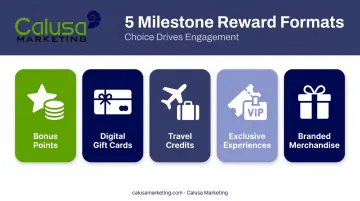
Common milestone reward formats include:
- Bonus points redeemable across a catalog
- Digital gift cards from major retailers and restaurants
- Travel credits or fully-booked trips
- Exclusive experiences, such as event access or lounge memberships
- Branded merchandise
This isn't just intuition. In an Incentive Marketing Association survey of industry professionals, agreement that offering multiple reward types increases program desirability averaged 4.18 out of 5. A single fixed reward option scored just 2.87 out of 5 for effectiveness.
Travel as the Top-Tier Reward
Group travel remains the most memorable milestone reward for a reason — it's rare, aspirational, and hard to forget.
Calusa Marketing's group travel incentives scale from 10 people to 10,000, with full white-glove booking for flights, hotels, and even hard-to-get event access. Hotel and cruise certificates, including a Royal Caribbean partnership, give businesses a lower-lift alternative that still feels like a premium reward.
Accessible Entry Points
Mid-sized businesses don't need a full travel budget to launch a milestone program. Digital punch cards and multi-brand gift card tools, like Calusa's ANY-Card option with 100+ digital gift card choices, let smaller organizations start milestone-style rewards without heavy operational lift.
Best Practices for Launching a Milestone Rewards Program
Getting a milestone program right comes down to three fundamentals.
Clear, measurable milestones tied to business goals. Vague thresholds confuse participants, so tie each tier to a specific, trackable action, such as referral count, sales dollars, or purchase frequency.
A choice of rewards at every tier. As the research above shows, a menu of options consistently outperforms a single fixed prize in perceived value and engagement.
Clear, frequent communication about rules and expiration windows. Unclaimed rewards create frustration and erode trust, so set redemption deadlines upfront and remind participants before they lapse.
Building and running all of this internally takes real bandwidth: program design, tracking dashboards, reward fulfillment, and customer service, all at once. That's where a specialist partner earns its keep.
Calusa Marketing currently manages 1,000+ programs and 500,000+ members with white-glove fulfillment across merchandise, gift cards, and travel. This hands-on support means internal teams don't have to build tracking systems or fulfillment logistics from scratch.
Frequently Asked Questions
What are milestone rewards?
Milestone rewards are incentives tied to reaching specific achievement thresholds, where the reward type or value changes at each level. This differs from standard, flat-rate rewards that pay the same amount every time.
How do I claim a milestone reward?
Participants are typically notified once they hit a milestone and can then select their preferred reward through the program's dashboard or platform. Fulfillment follows shortly after selection, whether it's points, a gift card, or a travel booking.
Do milestone rewards expire?
Most milestone programs set a specific window, often around 90 days, for participants to select their reward once a threshold is hit. Businesses should define and clearly communicate their own expiration policy rather than assume a universal standard.
What's the difference between milestone rewards and standard rewards programs?
Milestone programs use a tiered, threshold-based structure where rewards escalate as participants achieve more. Standard programs offer the same consistent reward value regardless of how much someone has already accomplished.
How much does it cost to launch a milestone rewards program for my business?
Costs vary depending on program size, reward type, and audience. Working with an incentive marketing partner can help control expenses through group purchasing power and platform efficiency rather than building infrastructure from scratch.
Can milestone rewards work for both employees and customers?
Yes. Employee and sales-facing programs reward tenure, KPIs, or recruitment, as seen with call center clients like Alorica and Inktel. Customer-facing programs reward purchases or engagement, as with HVAC distributors like Johnstone Supply and Baker Distributing.