That's the uncomfortable truth retailers face today. The industry carries some of the highest turnover and lowest engagement scores of any sector, and disengagement doesn't announce itself with a resignation letter. It shows up quietly, in slower service, shorter tenures, and shoppers who don't come back.
This guide breaks down why engagement matters specifically in retail, the challenges that make this industry harder to manage than most, proven strategies (recognition included) that actually move the needle, and how to measure whether your efforts are working.
Key Takeaways
- Shift work, seasonal staffing, and constant customer contact set retail engagement apart from office-based industries.
- Recognition, communication, training, and wellness must work together, since no single fix works alone.
- Recognition and incentive programs deliver some of the fastest, most measurable engagement gains available.
- Turnover rate, pulse survey scores, and customer satisfaction correlation are the metrics that prove ROI.
Why Employee Engagement Matters in Retail
Frontline retail staff are brand ambassadors whether they signed up for the role or not. A shopper's entire impression of a company often comes down to one interaction with one associate. That's a lot of weight to put on someone earning hourly wages with little formal training.
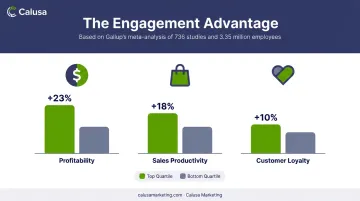
The data backs up the stakes. Gallup's 2024 Q12 meta-analysis, spanning 736 studies and roughly 3.35 million employees, found that business units in the top quartile of engagement outperformed the bottom quartile by 23% in profitability, 18% in sales productivity, and 10% in customer loyalty. Retail was part of that dataset.
The Financial Cost of Getting It Wrong
Disengagement carries a measurable financial cost that shows up directly on the balance sheet.
- Replacing one frontline retail employee costs retailers nearly $10,000 on average, according to McKinsey's 2024 frontline retail research.
- McKinsey's earlier 2022 study found employees at top-performing retail employers were twice as motivated and left their jobs half as often as those at low-performing retailers.
- Comparable-store sales growth at those top employers ran 3 percentage points higher than at their lower-engagement counterparts.
These numbers connect directly to daily behavior on the sales floor. Engaged associates upsell more confidently and resolve complaints faster, turning satisfied shoppers into repeat customers. Disengaged associates do the opposite, and the damage compounds store by store.
Common Challenges in Retail Employee Engagement
Retail doesn't struggle with engagement because managers don't care. It struggles because the operating conditions work against it.
High turnover, driven by structural issues. Seasonal hiring surges, limited full-time hours, and few visible paths upward all push retail turnover above the national average.
According to the Bureau of Labor Statistics' most recent JOLTS data, retail trade separations consistently run higher than total private employment, with quits also elevated compared to the broader labor market.
McKinsey's frontline survey found that 44% of retail workers were considering leaving within three to six months. Of those who had already left, 72% exited the retail industry entirely rather than switching employers.
Communication breakdowns between HQ and the floor. Corporate decisions get made in conference rooms and rarely reach the sales floor with context intact. Employees end up implementing changes they don't understand, which breeds resentment fast.
Physical and emotional burnout. Irregular shifts, back-to-back closing and opening schedules, and difficult customer interactions leave little room for recovery. Add the emotional labor of staying pleasant through a rough shift, and burnout builds quietly.
Inconsistent recognition. When effort goes unnoticed, employees start doing the minimum. This is quiet quitting in its most literal form: showing up, but checking out mentally.
Thin training and development. New hires often get a two-hour orientation and a nametag, then get thrown onto the floor. Without ongoing skill-building, confidence stays low and turnover intent climbs.
These challenges rarely show up one at a time. They stack, and that's exactly why single-tactic fixes tend to fall flat.
Proven Strategies to Boost Retail Employee Engagement
No one initiative solves retail engagement on its own. Retailers that see real movement combine recognition, communication, training, and wellness support into one connected effort.
Recognize and Reward Employees Consistently
Verbal praise feels good for about ten minutes. Tangible, timely recognition sticks. Gallup and Workhuman's longitudinal study, tracking nearly 3,500 workers from 2022 to 2024, found that employees who felt well recognized were 45% less likely to have changed employers two years later.
Retailers typically structure recognition through:
- Milestone bonuses tied to tenure (90 days, one year, five years)
- Gift card rewards for hitting sales or service targets
- Points-based systems employees redeem for merchandise
- Travel incentives reserved for top performers or store teams
Rolling this out across dozens or hundreds of locations is where most retailers stall. This is where a partner like Calusa Marketing fits in.
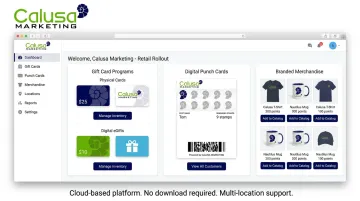
The company's cloud-based reward platforms let retailers launch gift card programs, digital punch cards, or merchandise catalogs (10 million-plus branded items) without app downloads or IT integration on the store level. A multi-location chain can stand up a consistent recognition program across every store without waiting on a systems rollout.
Strengthen Two-Way Communication
Employees who feel informed feel respected. That means regular manager check-ins, not just quarterly reviews, plus a real channel for feedback to travel upward.
Practical steps that work:
- Run short pulse surveys monthly, not annually, so you catch morale shifts early.
- Keep an open-door policy that managers actually use, not just post in a handbook.
- Share transparent updates on store performance and company decisions before rumors fill the gap.
None of this works if managers treat feedback as a formality. Employees need to see their input change something, even in small ways.
Invest in Continuous Training and Career Growth
Bite-sized, ongoing training beats a one-time onboarding session every time. Product knowledge refreshers, short customer service modules, and cross-training on new systems keep associates sharp and confident.
Career development matters just as much. McKinsey's 2024 retail case data found workers enrolled in employer-supported college courses or skill certification were four times more likely to stay. Retail doesn't have to feel like a dead end if there's a visible next step, even an informal mentorship track.
Support Work-Life Balance and Wellness
Scheduling might be the single biggest lever retailers underuse. The 2017 Stable Scheduling Study was a randomized trial across 28 Gap stores and more than 1,500 employees. Predictable scheduling with two-week advance notice and no on-call shifts produced a 7% sales increase and 5% labor-productivity gain, according to research published in Harvard Business Review.
Other initiatives worth building in:
- Shift-swap apps that give employees control without manager bottlenecks
- Wellness stipends for gym memberships or mental health apps
- Manageable shift patterns that avoid consecutive clopens
None of these require large budgets. They signal that the company values employees' time outside the store.
How to Measure Employee Engagement in Retail
You can't manage what you don't track. Retailers should watch four core metrics:
| Metric | What It Tells You |
|---|---|
| Turnover rate | Whether retention efforts are working |
| Absenteeism | Early warning sign of disengagement or burnout |
| eNPS / pulse survey scores | Real-time sentiment across store locations |
| Customer satisfaction correlation | Whether employee experience is reaching the customer |
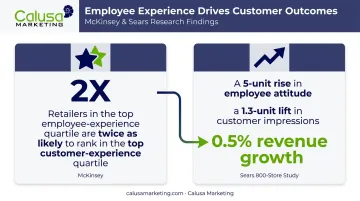
The connection between employee and customer experience isn't theoretical. McKinsey's 2024 analysis of more than 100 retailers found that companies in the top employee-experience quartile were more than twice as likely to also rank in the top customer-experience quartile.
A separate longitudinal study of 800 Sears stores reinforces this link: a 5-unit improvement in employee attitude correlated with a 1.3-unit lift in customer impressions and a 0.5% increase in revenue growth.
Modern reward platforms add another data layer. Calusa Marketing's cloud-based reward platform, for instance, tracks participation rates and redemption activity in real time, without requiring any app download or system integration on the retailer's part. If redemption rates climb after a program launch, that's a strong signal employees are noticing and responding, even before an official survey confirms it.
Quick-Start Checklist: Three Steps to Take Today
You don't need a six-month rollout plan to start moving the needle. Try this instead:
- Run a short pulse survey this week. Three to five questions on morale, motivation, and whether employees feel recognized. This gives you a baseline before you change anything.
- Launch one recognition gesture immediately. A public shout-out during a shift huddle or a small gift card for someone who went above and beyond. Momentum matters more than perfection at this stage.
- Talk to an incentive marketing specialist. A partner like Calusa Marketing can design a scalable rewards program for multi-location retail, growing this week's gesture into a consistent, store-wide program.
Frequently Asked Questions
How do you increase employee engagement in retail?
Focus on four levers: consistent recognition, open two-way communication, ongoing training, and manageable work-life balance. Start small: a pulse survey and a recognition gesture this week can build momentum before you formalize a full program.
What causes low employee engagement in retail?
High turnover from limited hours and unclear career paths, poor communication between HQ and stores, burnout from demanding and unpredictable shifts, and a lack of recognition or growth opportunities all contribute.
What are examples of employee recognition programs for retail employees?
Common formats include Employee of the Month awards, milestone bonuses for tenure, gift card rewards tied to performance, and points-based systems employees redeem for merchandise or travel.
How do you measure employee engagement in retail stores?
Track turnover rate, absenteeism, and eNPS or pulse survey scores. Then correlate that data with customer satisfaction and sales metrics to see whether engagement is translating into business results.
Why is employee engagement important in the retail industry?
Frontline employees directly shape customer experience, loyalty, and sales through every interaction they have. Disengagement, on the other hand, drives costly turnover that can run close to $10,000 per departed employee.
What is the best way to reward retail employees without breaking the budget?
Public recognition costs nothing and goes a long way. Beyond that, small gift cards and scalable point-based reward platforms let retailers control spending while still delivering rewards that feel meaningful to employees.