Many businesses make a costly mistake here: they confuse a satisfied customer with a loyal one. Then they're blindsided when a "happy" customer disappears the moment a competitor's app offers a better deal.
This guide breaks down loyalty versus retention, explains why digital commerce has rewritten the rules, and covers the metrics and strategies that actually keep customers engaged for the long haul.
Key Takeaways
- Retention keeps customers buying; loyalty keeps them choosing you over cheaper competitors
- New customer acquisition costs 5 to 25 times more than retention, per Harvard Business Review
- Digital-first customers face lower switching costs, making personalization and friction-free engagement essential
- Track CSAT and NPS alongside CLV and repeat purchase rate for the full picture
- No-download, no-integration platforms remove a major loyalty program adoption barrier
Customer Loyalty vs. Customer Retention: Untangling the Terms in a Digital-First World
Retention and loyalty get used interchangeably all the time. They shouldn't be.
Retention is largely rational. A customer keeps buying because of price, convenience, or the hassle of switching. Loyalty is emotional. It's the reason a customer stays even when a cheaper or more convenient alternative sits one click away.
Here's the trap: in digital markets, retention can be artificially inflated. High switching costs, contract lock-in, or simple lack of alternatives can make a business look like it has loyal customers when it really just has stuck ones.
True loyalty only reveals itself when the easy exit exists and the customer chooses to stay anyway.
What Is Customer Retention?
Retention measures a business's ability to keep customers transacting over a defined period. It's typically tracked through two core figures:
- Customer Retention Rate (CRR) – the percentage of customers a business keeps over time
- Churn rate – the percentage of customers lost over the same period
Both are functional and countable. Neither tells you why a customer stayed.
What Is Customer Loyalty?
Loyalty is the emotional bond that shows up in advocacy and a willingness to pay a premium rather than switch. It's measured less by transactions and more by attitude, through tools like Net Promoter Score (NPS) and Customer Lifetime Value (CLV).
A loyal customer doesn't just keep buying. They tell friends, defend the brand online, and shrug off a competitor's discount because the relationship matters more than the price difference.
How the Two Work Together
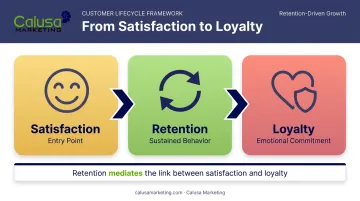
Satisfaction is usually the entry point. A satisfied customer sticks around (retention), and sustained retention paired with genuine emotional connection eventually produces loyalty.
A 2022 study of 376 restaurant customers, published in Uncertain Supply Chain Management, found that retention fully mediated the relationship between satisfaction and loyalty. In plain terms: satisfaction alone didn't create loyal customers. It had to translate into sustained retention first before loyalty took hold.
Businesses that treat satisfaction scores as the finish line, rather than the starting point, are missing this connective step.
Why Loyalty and Retention Are Harder to Win in the Digital Age
Digital commerce has eliminated the barriers that used to protect customer relationships. A comparison search or a five-minute app download is now the only thing standing between your customer and a competitor.
Three forces are driving this shift:
- Instant validation. Customers no longer take a competitor's claims on faith. Reviews, price comparisons, and social proof are seconds away, eroding the "default brand" status many companies once enjoyed without effort.
- Rising personalization expectations. According to McKinsey research, 71% of consumers expect personalized interactions, and 76% report frustration when they don't get them. Generic, one-size-fits-all outreach reads as a company that doesn't know its own customers.
- The retention mirage. Not every retained customer is a loyal one: subscription fatigue and "sticky" products can mask weak loyalty behind strong-looking retention numbers. A 2024 C+R Research survey found 42% of U.S. consumers had stopped using a subscription but forgot they were still paying for it — proof that active billing doesn't equal genuine preference.
That last point deserves a business's full attention. High CRR paired with low engagement or high cancellation friction functions like a countdown clock, not real loyalty. The moment cancellation gets easier, or a genuinely better alternative appears, that "retained" customer walks.
Metrics That Matter: Measuring Loyalty and Retention Success
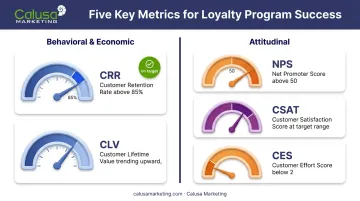
No single metric tells the whole story. Combining behavioral and attitudinal measures gives businesses a realistic view of where they stand.
| Metric | What It Measures | Why It Matters |
|---|---|---|
| CRR (Customer Retention Rate) | % of customers kept over a period | Shows how well you prevent defection |
| CLV (Customer Lifetime Value) | Total projected revenue per customer | Guides how much to invest in retention |
| NPS (Net Promoter Score) | Likelihood to recommend | Signals advocacy and emotional loyalty |
| CSAT | Satisfaction with a specific interaction | Captures short-term experience quality |
| CES (Customer Effort Score) | Ease of resolving an issue or completing a task | Predicts churn risk from friction |
Quick benchmarks help translate these scores into action:
- CRR above 85% indicates strong retention
- NPS above 50 signals advocacy
- CES below 2 (on a 1-5 scale) points to low friction
CRR and CLV are behavioral and economic, tracking what customers actually do, while NPS, CSAT, and CES are attitudinal, capturing how customers feel about that experience. Tracking only one side leaves blind spots: a business with strong CRR but weak NPS may be retaining customers who feel stuck, not satisfied.
The takeaway: Pair a behavioral metric with an attitudinal one before declaring a customer "loyal."
Proven Strategies to Build Loyalty and Retention in the Digital Age
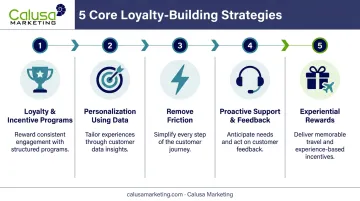
Strategy separates businesses that merely retain customers from those that build real loyalty. Five approaches consistently move the needle.
Launch Structured Loyalty and Incentive Programs
Points, tiers, and reward-based programs aren't just nice-to-haves. Accenture's research on U.S. retail found that loyalty program members generated 12% to 18% more revenue than non-members. Deloitte's more recent consumer survey backs this up: 72% of shoppers say loyalty programs make them more likely to keep spending with a preferred brand.
We've seen this play out across distribution clients. Johnstone Supply and Baker Distributing, both HVAC/R distributors, run points-based rewards programs that reward online ordering and product education — turning a routine purchase into an ongoing relationship rather than a one-off transaction.
Personalize Using Customer Data
Tailoring offers, communications, and rewards to individual preferences is what turns a transaction into a relationship. A distributor that segments rewards by purchase history and pushes targeted product education, instead of blanket discounts, typically sees far higher redemption rates. Generic blasts get ignored. Relevant, timely offers get opened, and they build the emotional connection that drives repeat choice.
Remove Friction From Engagement
Adoption barriers kill even the best-designed loyalty program. If customers need to download an app or your IT team needs weeks to integrate a new system, momentum dies before it starts.
This is where cloud-based, no-download reward platforms change the equation. Calusa Marketing, for example, provides SaaS loyalty and incentive solutions that require no app download and no system integration, letting businesses in distribution, media, and retail launch programs quickly without burdening customers or IT teams. Hajoca's custom incentive program, spanning 800+ locations and 20+ entities, is a good example of scaling a complex, multi-location loyalty structure without forcing every location through a heavy technical rollout.
Deliver Proactive Support and Show Customers Their Feedback Matters
Response speed and problem resolution directly shape both CSAT scores and long-term trust. A customer who gets a fast, thoughtful resolution to a complaint often becomes more loyal than one who never had a problem at all.
Feedback loops reinforce that trust when customers can see their input change something. A survey that goes nowhere trains customers to stop responding. Proactive support paired with visible follow-through, like Calusa Marketing's seven-day-a-week service team, keeps the relationship active between purchases.
Use Experiential Rewards for Top Customers
Generic discounts are forgettable. Tangible experiences aren't. Media companies like iHeart Media and Audacy use travel incentives to drive incremental advertising spend, while International Diamond Centers offers travel rewards to customers purchasing engagement rings, showing that experiential incentives work well beyond a single industry. Flexible options like gift card fulfillment (Calusa's ANY-Card program spans 100+ options, including U.S. and international cards) give businesses room to match reward value to customer tier without overcomplicating the program.
Common Challenges in Building Loyalty and Retention Online
Even well-designed programs run into predictable obstacles.
- Low switching costs mean even satisfied customers leave. A marginally better digital offer, one comparison search away, can pull a happy customer out the door.
- Data privacy concerns can undercut personalization efforts. Cisco's 2024 research found 75% of consumers won't buy from a brand they don't trust with their data, so transparency has to match personalization efforts.
- "Stuck" retention masquerades as loyalty. High CRR paired with cancellation friction or limited alternatives isn't the same as genuine preference. Regular voice-of-customer surveys catch this gap before it turns into sudden churn.
Frequently Asked Questions
What is the main difference between customer loyalty and customer retention?
Retention is about keeping customers transacting, driven by rational factors like price and convenience. Loyalty is the emotional commitment that makes a customer choose you even when better deals exist elsewhere.
Why is customer retention considered more cost-effective than acquiring new customers?
Acquiring new customers requires far more marketing and sales spend than maintaining existing relationships. Harvard Business Review has cited estimates of 5 to 25 times more expensive, depending on industry and study.
What metrics should businesses track to measure loyalty and retention?
Track CRR and CLV for behavioral and economic performance, alongside NPS and CSAT for attitudinal signals. Combining both gives a complete picture that no single metric provides alone.
How does digital technology impact customer loyalty programs today?
Cloud-based, frictionless platforms with no app downloads and instant redemption drive higher program adoption than legacy systems. Removing setup barriers directly increases how many customers actually participate.
Can a business have high retention but low customer loyalty?
Yes. High switching costs or limited competition can inflate retention numbers without any real emotional loyalty behind them. Marketers call this the "sticky product" phenomenon, and it tends to unravel once easier alternatives appear.
How can small or mid-sized businesses improve loyalty and retention with limited resources?
Focus on personalized service and a simple, well-run reward or incentive program rather than an overly complex one. Partnering with an experienced incentive marketing provider also reduces the operational lift of managing a program in-house.