Which one is your retention risk?
Many leaders assume "motivated" and "engaged" mean the same thing. They don't. This mix-up leads companies to pour money into perks and bonuses while their actual engagement problem — a lack of purpose, trust, or connection to leadership — goes untreated.
This article breaks down what separates motivation from engagement, why the difference matters for your bottom line, and what actually works to build both.
Key Takeaways
- Motivation drives action, while engagement sustains commitment over time.
- Top-quartile engaged business units show measurably better profitability, productivity, and retention than bottom-quartile units.
- Intrinsic motivators like purpose and autonomy pair with extrinsic motivators like pay and recognition to maximize results.
- Structured recognition programs turn extrinsic rewards into consistent habits while reinforcing purpose-driven engagement.
Engagement vs. Motivation: Understanding the Difference
These two words get used as synonyms in boardrooms everywhere. That's a mistake. They describe different psychological states, and confusing them leads to strategies that miss the mark entirely.
What Is Employee Engagement?
Employee engagement describes the emotional and psychological investment a person has in their organization's mission, values, and goals. The concept traces back to organizational behavior researcher William Kahn, who described engagement as employees expressing themselves physically, cognitively, and emotionally while performing their roles.
Engaged employees typically show:
- Discretionary effort — going beyond the minimum without being asked
- Brand advocacy — speaking positively about the company to outsiders
- A sense of belonging — feeling like their work matters within a larger context
This is different from job satisfaction. Satisfaction is a passive judgment ("I like my job"). Engagement is active investment ("I care what happens to this company").
What Is Employee Motivation?
Motivation is the energy that pushes someone to act, tackle a challenge, or push through a tough project. Unlike engagement, which tends to be a fairly stable state, motivation can swing day to day based on mood, workload, or a looming deadline.
An employee can be highly motivated but disengaged, and vice versa.
These mismatches show up often. A motivated, not engaged employee might be a salesperson chasing a big commission check while privately job-hunting because she doesn't trust leadership. An engaged, not motivated employee might be a longtime team member who believes deeply in the company's mission but is burned out and dragging through this week's tasks.
Both scenarios create risk. Understanding which one you're dealing with changes the fix entirely.
The Business Case: How Motivation Fuels Engagement and Success
Motivation and engagement feed each other. Motivated employees who see their efforts pay off tend to grow more engaged over time. Engaged employees, in turn, generate their own motivation because their work feels meaningful. It's a reinforcing loop — when it works.
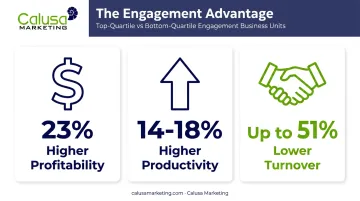
The financial case for getting this right is substantial. Gallup's 11th edition Q12 meta-analysis, covering more than 3.3 million employees across 90 countries, found that top-quartile engagement business units outperform bottom-quartile units on several key metrics:
- 23% higher profitability
- 14-18% higher productivity
- Up to 51% lower turnover in low-turnover organizations
Disengagement carries a real cost, too. Replacing an employee isn't cheap:
- Work Institute's 2024 Retention Report models turnover cost at roughly 33.3% of a departing employee's base salary.
- Gallup separately estimates replacement costs at 0.5 to 2 times annual salary, depending on the role.
Beyond internal costs, engagement affects customers directly. Research on hotel and restaurant service teams found that employee engagement predicted a stronger service climate, which in turn predicted better customer-rated performance. Engaged staff simply deliver better service.
One caveat worth stating plainly: this relationship is correlational as much as it is causal. Academic reviews of engagement-performance data consistently note that longitudinal studies can't fully rule out reverse effects, meaning strong performance sometimes drives engagement, not just the other way around.
Sustained business results require deliberate, ongoing investment in both motivation and engagement, not a one-time initiative and a pat on the back.
What Drives Motivation and Engagement in the Workplace
Both motivation and engagement have identifiable drivers. Understanding them lets you build programs that target the right lever instead of guessing.
Intrinsic Motivators: The Internal Drivers
Intrinsic motivation comes from within: doing something because it's inherently interesting or meaningful, not because someone's dangling a reward. Self-determination theory identifies three needs that fuel it:
- Autonomy: having a say in how work gets done
- Competence: building mastery and seeing skills improve
- Relatedness: feeling connected to teammates and the broader mission
Managers foster this by connecting daily tasks to the bigger organizational purpose and offering real skill-development opportunities, not just annual training modules nobody remembers.
There's a catch, though. Herzberg's two-factor theory reminds us that "hygiene factors" (fair pay, decent working conditions, reasonable policies) must be satisfied first. You can't inspire someone with purpose if they feel treated unfairly on basics.
Maslow's hierarchy makes a similar point: higher-order motivators rarely take hold when foundational needs go unmet.
Extrinsic Motivators: The External Drivers
Extrinsic motivation comes from outside rewards: pay, bonuses, recognition, promotions. These work, but the effect tends to fade faster than intrinsic drivers. A bonus feels great on payday and forgotten by next quarter.
Well-designed recognition and incentive programs can extend that lifespan. The key word is well-designed. Programs with clear, consistent criteria outperform random, one-off perks because employees know exactly what behavior gets rewarded, and can count on it happening again.
Leadership plays a bigger role here than most people realize. Gallup research found managers account for a substantial share of the variance in team engagement scores, touching both intrinsic factors (how supported someone feels) and extrinsic ones (whether recognition actually happens). A great incentive program under a bad manager still underperforms.
Practical Strategies to Build a Motivated, Engaged Workforce
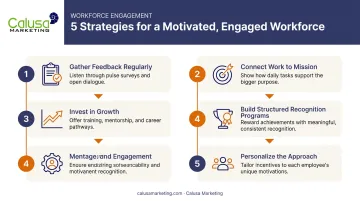
Knowing the theory is one thing. Building a program that actually moves the needle is another. Here's where to start:
- Gather feedback regularly. Surveys and pulse checks reveal what's driving or killing motivation on specific teams, not just company-wide averages that hide problems.
- Connect work to the mission. Show employees, specifically, how their role contributes to a result they care about. Vague mission statements on a wall don't count.
- Invest in growth. Training, mentorship, and stretch projects sustain intrinsic motivation far longer than a single engagement survey ever will.
- Build structured recognition programs. Digital rewards, gift cards, merchandise, and travel incentives reinforce extrinsic motivation without leaning entirely on base pay. Designing these well, with clear criteria and rewards people actually want, is where many companies get stuck.
- Personalize the approach. A single incentive strategy rarely lands the same way across a diverse workforce. What excites a 25-year-old new hire probably doesn't excite a 20-year veteran.
This is exactly where a dedicated incentive marketing partner earns its keep. Calusa Marketing builds custom recognition and rewards programs by first identifying the specific behavior a client wants to encourage.
That could be getting new hires through their 90-day window, retaining institutional knowledge, or hitting the next sales tier. The reward structure gets built around that specific goal, not the other way around.
Programs run on a cloud-based platform offering merchandise, gift cards, and incentive travel. Options range from weekend hotel certificates to group trips accommodating up to 10,000 people, letting companies scale recognition without building the infrastructure themselves.
Common Mistakes That Undermine Motivation and Engagement
Even well-intentioned programs backfire when they hit these traps:
- Over-relying on pay: compensation matters, but once expectations are met, more money alone won't sustain long-term engagement since employees adapt to raises quickly.
- Generic, delayed recognition: a gift card that arrives three months after an achievement, or a "great job" email sent department-wide, loses its motivational punch fast.
- Inconsistent leadership: a manager who praises effort one week and ignores it the next erodes trust quickly; no incentive program survives a bad manager relationship for long.
None of these mistakes are fatal on their own. But left unaddressed, they erode the effectiveness of every other initiative you're funding.
Frequently Asked Questions
How is employee engagement tied to motivation?
Motivation supplies the energy and drive behind action, while engagement reflects the emotional commitment that sustains that drive over time. The two continuously reinforce each other in healthy workplaces.
What is the main difference between engagement and motivation?
Motivation is the day-to-day drive to complete tasks and can fluctuate. Engagement is a broader, more stable emotional investment in the organization's mission and success.
What are examples of intrinsic and extrinsic motivators in the workplace?
Intrinsic examples include purpose, autonomy, and skill growth. Extrinsic examples include pay, bonuses, recognition, and incentive rewards like gift cards or travel.
How can companies measure employee motivation and engagement?
Employee surveys, pulse checks, and established scales like Gallup's Q12 or the Utrecht Work Engagement Scale are common tools. Each measures a slightly different construct, so choosing the right one matters.
Can an employee be motivated but not engaged, or engaged but not motivated?
Yes, both happen regularly. A commission-driven salesperson may be motivated but ready to quit, while a burned-out veteran may believe in the mission yet lack energy that day.
How do incentive programs help boost employee motivation?
Structured incentive and recognition programs give employees tangible extrinsic motivators that complement intrinsic drivers like purpose and growth. Companies like Calusa Marketing help design these programs so rewards stay consistent and relevant.