For an agency that's remained on the Government Accountability Office's High-Risk List since April 2023 over chronic understaffing, this isn't a new strategy. It's the latest attempt at a problem that has outlasted several directors and multiple budget cycles.
Many correctional officers work mandatory overtime just to keep facilities staffed. Common frustrations include watching colleagues leave for better-paying federal agencies and seeing incentive programs get cut, then restored, then cut again.
This post breaks down how the 2026 tier system works, what happened the last time BOP tried this, and what any employer battling turnover in a hard-to-fill role can take from it.
Key Takeaways
- New 2026 incentives range from 5% to 25% of base pay, depending on institution tier and occupation
- BOP's correctional officer vacancy rate hit 24% in FY2024, with overtime costs topping $436.9 million
- Incentives require annual review and can be cut, as happened in March 2025
- AFGE backs a proposed 35% permanent base pay increase over temporary bonuses
- Employers facing similar turnover can pair pay with structured recognition programs
What Is a BOP Retention Incentive?
A retention incentive is a temporary, percentage-based pay bump authorized under federal law to keep current employees from leaving their position, or leaving federal service altogether. It's not a raise. It's not permanent. It's a targeted tool for a specific problem: an agency about to lose people it can't afford to lose.
That distinction matters. Recruitment and relocation incentives target new hires or employees moving to a new duty station. A retention incentive only applies to someone already on the payroll, in a role the agency has determined is critical or genuinely hard to fill.
To qualify, an agency must establish three things:
- A special need for that employee's continued service in the position
- Evidence the employee would likely leave without the incentive
- A performance rating of at least "Fully Successful"
That last requirement excludes underperformers from benefiting. It directly counters a common criticism of incentive programs: rewarding tenure over performance.
The Legal Authority Behind Retention Incentives
The program runs on 5 U.S.C. 5754 and 5 CFR Part 575, Subpart C. Standard caps are 25% of basic pay for an individual employee and 10% for a group authorization, though the Office of Personnel Management can approve up to 50% for a critical agency need.
BOP has used this authority before. In November 2022, it rolled out a sliding-scale incentive for retirement-eligible staff:
| Retirement Eligibility | Rate |
|---|---|
| Eligible before 2019 | 8% |
| Eligible in 2020 | 7% |
| Eligible in 2021 | 6% |
| Eligible in 2022 | 5% |
That program ran through the end of 2023. The 2026 plan follows the same legal playbook, just with a different trigger and a broader occupational reach.
Why BOP Is Facing a Staffing Crisis
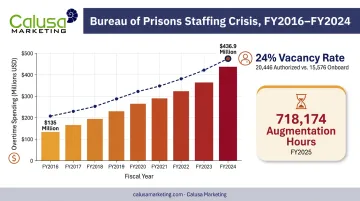
BOP's staffing problem isn't new, and it isn't subtle. The Congressional Research Service reported 20,446 authorized correctional officer positions against just 15,576 onboard officers in FY2024 — a 24% vacancy rate. To keep facilities running, BOP leaned hard on overtime and staff augmentation, pulling non-custody employees like teachers and counselors into correctional duty.
The cost of that overtime tells its own story. BOP correctional officer overtime spending climbed from $135 million in FY2016 to $436.9 million in FY2024, according to CRS. Augmentation hours hit a ten-year high of 718,174 hours in FY2025.
This isn't a straight line of progress, either. In March 2025, BOP cut or eliminated most existing incentives because of a budget shortfall, slashing 10%-25% retention incentives in half for some employees and eliminating them entirely for others. Reports surfaced of doctors and physician assistants at Federal Medical Center Lexington submitting resignations shortly after.
Layer onto that a harder truth: BOP competes for talent against other federal law enforcement agencies offering:
- More modern, streamlined pay structures
- Less mandatory overtime
- Lower daily physical and psychological risk
That's a tough market to win when your primary lever is a bonus that Congress can shrink with the next budget fight.
Inside the 2026 BOP Retention Incentive Plan: Tiers, Percentages & Eligible Positions
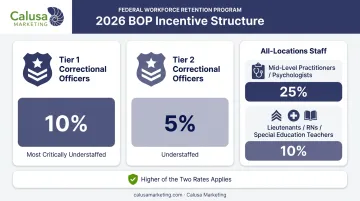
The February 2026 incentives, detailed in Marshall's internal email, apply to correctional officers and several other frontline occupations. BOP sorted institutions into three staffing tiers based on how critically understaffed each one is, then assigned incentive rates accordingly.
Here's how the reported rates break down:
| Position | Rate | Location Basis |
|---|---|---|
| Correctional officers, Tier 1 | 10% | Most critically understaffed institutions |
| Correctional officers, Tier 2 | 5% | Critically understaffed, below Tier 1 |
| Mid-level practitioners & psychologists | 25% | All locations |
| Lieutenants, RNs, special education teachers | 10% | All locations |
A few details stand out:
- Highest rate in the plan: Mid-level practitioners and psychologists get 25% regardless of location, signaling that clinical staffing gaps may be as severe as custody staffing gaps.
- "Higher of the two" rule: Employees already receiving an incentive who qualify for a new one keep whichever rate is larger through September 2026, protecting them from a pay cut.
- Stacked pay actions: These incentives land alongside a separate 3.8% federal pay raise for law enforcement personnel in 2026, so some correctional officers see two increases in the same year.
How Retention Incentive Payments Work — and When They Can Be Taken Away
Retention incentives aren't paid however an agency feels like paying them. Federal rules set specific structures:
- Biweekly installments based on a percentage of basic pay
- Lump sum after completing a full service period
- A combination of both
Regardless of format, agencies must review every retention incentive at least annually, and if the underlying staffing need disappears, the incentive has to shrink or end under federal regulation.
That review cycle is precisely why the March 2025 cuts happened. Once BOP determined budget constraints changed the calculus, it had legal grounds to reduce or eliminate payments already in place.
There's a catch for employees, too: anyone who leaves or is terminated before completing their service agreement only keeps the portion of the incentive tied to completed service, with no full payout for a partial commitment.
These are conditional benefits, contingent on continued need and completed service, rather than guaranteed income. That distinction makes them a fundamentally different value proposition than a guaranteed base pay increase, and it's precisely what critics have targeted.
Pushback From Unions and the Push for Permanent Pay Reform
The American Federation of Government Employees has been direct about its read on the 2026 plan: appreciated, but not enough. Retention incentives are still tied to service agreements. Once an employee's obligation period ends, nothing stops them from leaving anyway.
That's the core argument behind the Federal Correctional Officer Paycheck Protection Act (H.R. 7033), introduced in Congress in January 2026. Rather than a temporary bonus, the bill proposes a 35% base pay increase across the GS, GL, and WG pay systems for qualifying BOP correctional staff — a structural fix instead of an annually reviewed patch.
AFGE has also flagged a workforce tension the 2026 plan may be creating:
- Correctional officers are set to receive roughly 3.8% through the combined pay raise
- Psychologists, nurses, and other staff outside special-rate coverage are getting the general 1% adjustment
That gap, layered on top of an incentive plan that already treats occupations differently, has the union warning of internal resentment building between staff groups that all consider themselves understaffed and undervalued.
Beyond Federal Pay: What Private Employers Can Learn From BOP's Retention Struggle
BOP's situation is extreme, but the underlying dynamic isn't unique to federal prisons. Call centers, distribution warehouses, and healthcare frontline roles all face the same pattern: high stress, hard-to-fill positions, and turnover that keeps compounding. Work Institute's 2025 Retention Report estimates turnover costs at 33% of a departing employee's base pay — a benchmark that applies well beyond government payrolls.
AFGE's sharpest criticism of the BOP plan is one every employer should sit with: "you're attracting them, but you're not retaining them." A bonus tied to a service agreement gets someone through the door, or through a rough patch. It doesn't automatically build loyalty once the obligation period ends.
That's the gap structured incentive programs are built to close. Pay solves the recruitment math. Recognition, rewards, and ongoing engagement solve the loyalty math.
We've seen this play out with clients in comparably high-stress, high-turnover frontline sectors.
Alorica and Inktel, both call center operations, run rewards programs tied to agent recruitment, retention, and KPI achievement, addressing the same attrition curve that plagues correctional staffing. Memorial Blood Centers uses gift card incentives to sustain participation in a mission-critical, frontline healthcare environment.
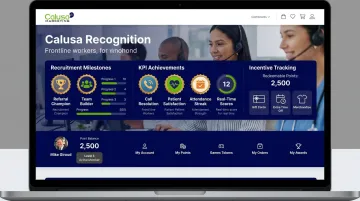
What ties these programs together is designing around behavior first: identify what you need people to do, determine what that behavior is worth, then build the program around that specific audience. A plan built to get new hires through their first 90 days looks nothing like one built to retain long-tenured staff with irreplaceable institutional knowledge.
If you're watching turnover climb in a hard-to-fill role, a pay adjustment alone probably won't fix it. Worth evaluating instead:
- Tiered rewards tied to tenure or performance milestones
- Recognition programs that reinforce culture, not just compensation
- Non-cash incentives like gift cards or travel certificates layered on top of pay
That combination tends to deliver more durable retention ROI than a bonus cycle that ends the moment a service agreement expires.
Frequently Asked Questions
What is a BOP retention incentive?
It's a temporary, percentage-based pay incentive used to retain current employees in hard-to-fill BOP positions who might otherwise leave. The incentive is authorized under federal law and reviewed annually.
What is a typical BOP retention bonus amount?
Reported 2026 rates range from 5% to 10% for correctional officers, depending on facility tier, up to 25% for positions like psychologists and mid-level practitioners.
Who is eligible for a BOP retention bonus?
Eligibility depends on occupation, the facility's staffing tier, and maintaining at least a "Fully Successful" performance rating. The agency must also show a special need for that employee's continued service.
How long do BOP retention incentives last?
They're tied to service agreements and reviewed at least annually. Depending on continued need, they can be extended, reduced, or ended entirely.
Can the BOP revoke retention incentives once granted?
Yes. Federal regulations require termination once the staffing need no longer applies, which is exactly what happened during the March 2025 incentive cuts.
How are retention incentives different from recruitment or relocation incentives?
Retention incentives target current employees at risk of leaving. Recruitment and relocation incentives are used to attract new hires or support employees relocating to a new duty station.