The answer matters more than most businesses realize. The Incentive Research Foundation found that 53% of employees clearly prefer tangible rewards over intangible recognition, while another 39% value both equally, according to IRF's 2020 Reward Preferences Study. Choosing the wrong reward type wastes budget and undercuts motivation.
This guide breaks down what tangible rewards actually are, how they differ from intangible recognition, the four main categories businesses use, and how to build a program that gets results.
Key Takeaways
- Tangible rewards offer real, spendable value—cash, gift cards, merchandise, or travel
- Intangible rewards provide psychological recognition, like praise or flexible schedules
- These four categories—monetary, gift cards, merchandise, and experiential—help match rewards to specific goals
- Pairing tangible rewards with genuine recognition builds lasting motivation for employees and customers
What Are Tangible Rewards?
Tangible rewards are physical, material, or monetary incentives a recipient can see, hold, spend, or use. They stand in contrast to abstract forms of recognition like a compliment or a handshake. If you can put a dollar figure or a physical object behind it, it's tangible.
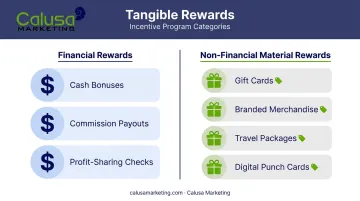
These rewards split into two broad buckets: financial rewards like cash bonuses, commission payouts, and profit-sharing checks, and non-financial but material rewards like gift cards, branded merchandise, travel packages, and membership perks.
Common examples across workplace and customer programs include:
- Cash bonuses or spot awards
- Gift cards (single-retailer or flexible "any-brand" formats)
- Branded merchandise and electronics
- Travel packages and event tickets
- Digital punch card credit toward a future purchase
Employers use tangible rewards to motivate sales teams, boost employee retention, and recognize milestones. Businesses use them just as often on the customer side, building loyalty programs that keep shoppers coming back and increasing average spend per visit. The mechanism is the same either way: give someone something real in exchange for the behavior you want to reinforce.
Tangible vs. Intangible Rewards
Intangible rewards are the psychological and social side of recognition. Think verbal praise in a team meeting, flexible work hours, a mentorship opportunity, or public acknowledgment on a company newsletter. None of these have a direct cash value, but they still shape how valued someone feels.
Here's how the two compare side by side:
| Factor | Tangible Rewards | Intangible Rewards |
|---|---|---|
| Value type | Material or monetary | Psychological or social |
| Duration of impact | Immediate, often short-term spike | Can build long-term loyalty over time |
| Cost | Direct budget line item | Low or no direct cost |
| Measurability | Easy to track (dollars spent, items shipped) | Harder to quantify |
Recipients notice the difference. A 2025 IRF study on recognition culture found that nearly 75% of respondents said tangible rewards enhance recognition. Yet 47% said an award under $50 felt sufficient when paired with sincere acknowledgment.
In other words, size isn't the deciding factor. What matters is combining something real with a genuine moment of recognition, like handing over that gift card in front of the team rather than mailing it quietly.
Types of Tangible Rewards
Tangible rewards generally fall into four categories. Each suits a different budget, audience, and program goal.
Monetary Rewards
The most straightforward category. This includes:
- Cash bonuses tied to performance milestones
- Pay raises for sustained achievement
- Commission incentives for sales teams
- Profit-sharing payouts distributed company-wide
Monetary rewards are common. WorldatWork found short-term incentive programs exist at 99% of public companies and 92% of private companies. Adoption doesn't guarantee effectiveness, though, and cash can start to feel like an extension of salary rather than a distinct reward.
Gift Cards & Digital Rewards
Gift cards remain a workhorse of incentive programs because they're flexible and deliver instant gratification. The catch with a single-brand card is obvious: not everyone wants to shop at the same store.
Modern platforms solve this with "any-retailer" digital gift card models. Instead of forcing a recipient into one brand, they receive a redemption code usable across a wide catalog.
Calusa Marketing's ANY-Card program, for example, gives recipients a choice across 100+ retailer options spanning national chains, restaurants, grocery stores, and specialty shops. There's also a Visa card alternative for anyone who'd rather spend it anywhere. That flexibility removes the guesswork for the business issuing the reward and puts the decision in the recipient's hands.
Merchandise & Physical Items
Branded merchandise, electronics, apparel, and gift baskets serve a different purpose than cash or cards. They stick around. A jacket, a cooler, or a set of headphones sits on a desk or in a closet as a visible reminder of an achievement.
There's research behind this "trophy value" concept. Earned noncash items are often perceived as worth more than an equivalent amount of cash, largely because they're visible and discussable long after the moment of receipt.
Platforms offering large catalogs, such as Calusa Marketing's 10 million-plus item merchandise selection with drop-ship fulfillment across 100+ countries, let businesses offer name-brand products without warehousing a single item themselves.
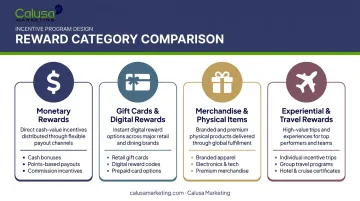
Experiential & Travel Rewards
Trips, event tickets, and travel packages carry the highest perceived value of any tangible reward category. They create memories, not just possessions.
The numbers back this up. Average incentive travel spend hit $5,100 per participant in 2025, up 4% year over year, with North American programs averaging $6,000, according to the 2025 Incentive Travel Index. Travel isn't cheap, but 75% of industry professionals say its motivational value remains strong even as budgets tighten.
The operational hurdle is real: booking flights, hotels, and event tickets for a group takes time most businesses don't have. Full-service incentive travel providers handle that entire burden.
Calusa Marketing, for instance, manages bookings, confirmations, guest communication, and customer service for everything from individual luxury trips ranging from $500 to $25,000, to group programs accommodating up to 10,000 travelers worldwide. Rewards are also fully transferable, so a recipient who can't travel can gift the trip to a family member instead of losing the value entirely.
Benefits and Challenges of Tangible Rewards Programs
Tangible rewards deliver real advantages, but they come with trade-offs worth planning for.
Benefits:
- Stronger short-term motivation, particularly around specific goals or contests
- Improved retention, both for employees who feel recognized and customers who keep coming back
- Clear ROI tracking since dollars spent and items delivered are measurable, unlike vague recognition efforts
Challenges:
- Higher upfront cost compared to verbal recognition or flexible scheduling
- Time investment needed to plan, source, and administer rewards consistently
- Risk of perceived favoritism if distribution criteria aren't applied evenly across the team or customer base
These cost and consistency challenges apply well beyond HR, too. Businesses rely on the same tangible rewards for external audiences, from customer loyalty programs to dealer and channel incentive programs, extending their value far beyond the employee break room.
Best Practices for Implementing a Tangible Rewards Program
A tangible rewards program works best when it's built around a few core principles rather than just picking an expensive gift.
- Involve recipients in reward selection. Employees and customers who help choose the reward catalog feel genuinely motivated by the options, rather than settling for whatever was picked for them.
- Set clear, attainable criteria. Participants need to know exactly what earns a reward. Vague or shifting rules breed resentment faster than a small reward ever will.
- Pair every reward with a moment of recognition. Presenting a gift card publicly, or announcing a trip winner at a team meeting, multiplies the psychological impact of the reward itself.
- Use a cloud-based incentive platform. Manually sourcing gift cards, ordering merchandise, and booking travel for a large group eats up staff time fast. A configurable SaaS platform, such as Calusa Marketing's, requires no integration or app download, keeping reward selection, delivery, and tracking manageable as programs scale.
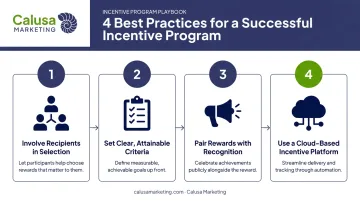
Programs built on these four practices tend to outperform those that simply throw money at the problem. Transparency and genuine recognition build stronger engagement than reward size alone.
Frequently Asked Questions
What is a tangible reward?
A tangible reward is a physical or monetary incentive with real, usable value, such as cash, a gift card, merchandise, or a trip. It's given to recognize performance, loyalty, or achievement in a way the recipient can directly see or spend.
What is the difference between tangible and intangible rewards?
Tangible rewards carry material or financial value, like cash or merchandise. Intangible rewards are psychological or social, such as verbal praise, flexible hours, or professional development opportunities.
What are examples of tangible rewards?
Common examples include cash bonuses, gift cards, branded merchandise, electronics, and travel packages. Digital punch card credit and profit-sharing payouts also fall into this category.
What are the 4 types of rewards?
The four practical categories are monetary rewards (cash, bonuses), gift cards and digital rewards, merchandise and physical items, and experiential or travel rewards. Each suits different budgets and program goals.
Are tangible rewards more effective than points-based reward systems?
Tangible rewards offer immediate, clear value, while points systems require accumulation before redemption. The best approach often blends both, using points as a path toward tangible rewards like gift cards or merchandise.
Can tangible rewards be used for customer loyalty programs, not just employees?
Yes. Gift cards, merchandise, and travel rewards are widely used to boost customer retention and increase spending, not just to motivate employees. Many businesses run both types of programs simultaneously.