That disconnect is why engagement scores stay flat year after year, even at companies that spend real money trying to fix the problem. Activities without targets rarely move the needle.
The data backs this up. U.S. employee engagement fell to just 31% in 2024, according to Gallup's analysis, the lowest level in a decade. That means roughly seven in ten employees are showing up without real investment in their work.
This guide breaks down the difference between engagement goals and objectives, walks through the SMART framework, gives you eight objectives with real goal examples, and shows how recognition programs turn plans into measurable results.
Key Takeaways
- Objectives are outcomes like retention and productivity; goals are how you get there
- SMART goals turn vague ambitions into initiatives with clear owners and deadlines
- Recognition programs are one of the fastest-moving levers for engagement and retention
- Pair leading indicators like eNPS with lagging ones like turnover to prove ROI
- Three to five priority objectives at a time beats spreading resources across ten
What Are Employee Engagement Goals and Objectives?
Employee engagement is the emotional and psychological investment an employee brings to their work. It's not the same as satisfaction. An employee can have a comfortable paycheck, decent hours, and every reason to feel satisfied, yet still be checked out mentally.
Gallup's research draws this distinction clearly: satisfaction measures contentment, while engagement captures involvement, enthusiasm, and discretionary effort. That gap explains why some "satisfied" teams still underperform.
Goals vs. Objectives: What's the Difference?
Objectives are the broad business outcomes you're chasing, things like reducing turnover or improving productivity. Goals are the specific, measurable actions you take to get there.
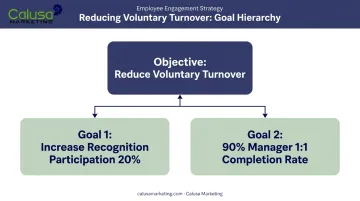
Think of it as a hierarchy:
- Objective: Reduce voluntary turnover
- Goal 1: Increase recognition program participation by 20% in Q2
- Goal 2: Achieve a 90% completion rate on manager 1:1 check-ins by Q3
Neither goal mentions turnover directly, but both feed the objective. That's the point. Get this hierarchy wrong, and engagement work turns into activity for its own sake: busy, well-intentioned, and disconnected from the outcomes leadership actually cares about.
Why Setting Clear Objectives Matters
Undefined engagement efforts stay disconnected from results. Leadership sees survey scores and event photos but can't tie either to revenue, retention, or performance.
The cost of skipping this step is real. According to Gallup's State of the Global Workplace report, low engagement drains $8.9 trillion from the global economy annually, roughly 9% of global GDP, through lost productivity. At the individual company level, that shows up as higher turnover, more absenteeism, and slower execution.
Clear objectives fix this by creating accountability. When a specific goal has an owner and a benchmark, HR and department leaders can't shrug off responsibility. Someone is on the hook.
How to Set SMART Employee Engagement Goals
Vague goals produce vague results. "Improve engagement" describes a hope, not an actionable target. The SMART framework forces specificity:
- Specific: Name the exact behavior, team, or metric you're targeting
- Measurable: Attach a number and a data source
- Achievable: Set a target your resources can actually support
- Relevant: Tie it to a real business outcome
- Time-bound: Give it a deadline
Before: "Improve engagement." After: "Increase employee recognition program participation by 20% within 6 months, measured via platform usage data."
That second version tells you what to build, how to track it, and when to check in.
Start With a Baseline
A SMART goal needs a real starting number. You can't set a meaningful target without knowing where you stand. Before writing any goal, pull:
- Recent engagement or pulse survey scores
- Current voluntary turnover rate
- Recognition or program participation data
If your baseline recognition participation is 15%, a jump to 20% is realistic. A jump to 80% is fantasy, and everyone on your team will know it.
Limit Focus to 3-5 Priority Goals
Those baseline numbers can tempt you to chase every metric at once. Over-committing is one of the most common reasons engagement plans fail. When every department owns a dozen initiatives, none get the attention or budget needed to actually move.
Pick three to five goals per quarter or year. Assign a specific owner (a manager, an engagement committee lead, or a department head) to each one. Ownership without a name attached rarely gets done.
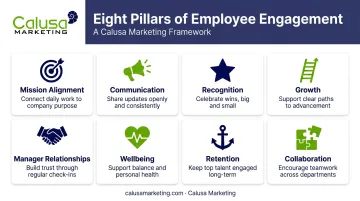
8 Employee Engagement Goals and Objectives to Set This Year
These eight objectives span communication, recognition, growth, wellbeing, and retention. Adapt the specific targets to your company size and industry, but the underlying structure works across the board.
Align Employees With Company Mission and Values
Employees who understand why their work matters give more discretionary effort. When purpose is fuzzy, so is motivation.
SMART goal example: 90% of employees can articulate the company's top three annual goals in a year-end pulse survey.
Improve Internal Communication and Transparency
Uncertainty breeds disengagement. Consistent updates through newsletters, town halls, and manager check-ins close the information gap before rumors fill it.
SMART goal example: Increase town hall attendance to 85% and newsletter open rates to 60% by end of Q3.
Boost Employee Recognition and Appreciation
Recognition (peer-to-peer, milestone-based, or performance-driven) is consistently cited as a top engagement driver. It's also one of the fastest to implement.
SMART goal example: Increase monthly recognition program participation by 25% within two quarters, tracked through platform redemption data.
Support Professional Growth and Leadership Development
Career stagnation is one of the top reasons employees leave. Growth opportunities correlate directly with retention, especially among younger employees.
SMART goal example: Increase internal promotion rate by 15% and training-module completion by 30% within the fiscal year.
Strengthen Manager-Employee Relationships
Team-level engagement swings heavily based on manager quality, more than almost any other single factor. Coaching, clarity, and consistent feedback matter more than perks.
SMART goal example: Achieve a 95% completion rate on biweekly 1:1 meetings, with manager feedback scores averaging 4.2/5 by year-end.
Prioritize Employee Wellbeing and Work-Life Balance
Burnout erodes every other engagement gain you make. In an APA survey, 77% of employees reported work-related stress, with a meaningful share saying it made them want to quit.
SMART goal example: Increase flexible work adoption to 70% of eligible roles and wellness program participation by 20% within six months.
Reduce Voluntary Turnover and Improve Retention
Disengagement and turnover are directly linked, and turnover is expensive. The Work Institute's 2025 Retention Report pegs average replacement cost at 33% of an employee's base wages, based on more than 123,000 exit interviews.
SMART goal example: Reduce voluntary turnover by 10% year-over-year, tracked quarterly against current baseline.
Foster Cross-Department Collaboration and Trust
Silos slow execution and damage morale. Cross-functional visibility helps employees see how their work connects to the bigger picture.
SMART goal example: Increase cross-functional project completion rate to 80% and team-building event participation by 25% within the year.
How to Measure and Track Progress Toward Your Goals
Tracking engagement goals requires two types of data working together.
| Indicator type | Examples | What it tells you |
|---|---|---|
| Leading | eNPS, pulse survey sentiment, participation rates | Early signals of change before outcomes shift |
| Lagging | Turnover, absenteeism, productivity, performance | Confirms whether initiatives actually worked |
Leading indicators move fast, giving you room to course-correct before problems compound. Lagging indicators take longer to shift, but they prove real business impact to leadership. Knowing when to check each type keeps your tracking system useful instead of just informative.
Recommended cadence:
- Quarterly pulse checks – short surveys on specific drivers like recognition or workload
- Semi-annual deeper analysis – a fuller review connecting survey data to turnover and performance
- Annual benchmark survey – your comprehensive comparison point year over year
Review goals against baseline data every quarter, not just at year-end. If a goal is off track in month three, adjust the target or tactic then. Waiting twelve months to notice a problem wastes an entire budget cycle.
Turning Recognition Goals Into Results With Incentive Programs
Recognition consistently ranks as a top engagement driver, yet many companies struggle to execute it well. The real problem is friction: clunky rollout requirements kill good programs before they gain traction. Programs that require app downloads, manual tracking, or IT integration die within months because nobody wants to maintain them.
This is where a structured incentive program earns its keep. At Calusa Marketing, we help companies build recognition and reward programs, digital punch cards, gift cards, and incentive travel, without requiring an app download or an IT integration on the client side.
Programs typically launch in under a week because there's no development cycle to wait on.
We've managed this kind of execution across 1,000+ engagement and incentive programs serving more than 500,000 members, with a 99% client retention rate. That track record exists because programs that are easy to launch tend to actually get used.
Applying the Framework to a Recognition Goal
Here's how this plays out against a goal like the one above:
- Goal: Increase recognition frequency by 25% within two quarters
- Mechanism: A digital punch card or points-based rewards platform tied to manager-issued recognition
- Tracking: Built-in reporting shows who issued recognition, when, and why, giving HR real participation data instead of guesswork
- Redemption data: Gift card or merchandise redemption rates show whether recognition is landing, not just being announced
Tying a specific, measurable goal to a program that's genuinely simple to run often determines whether a recognition initiative sticks past Q3 or fades out quietly.

Frequently Asked Questions
What are SMART goals for employee engagement?
SMART engagement goals apply Specific, Measurable, Achievable, Relevant, and Time-bound criteria to a target. Example: "Increase recognition program participation by 20% within six months, tracked via platform data."
What is the difference between employee engagement goals and objectives?
Objectives are broad outcomes like improved retention or productivity. Goals are the specific, measurable steps, like a participation percentage or completion rate, used to reach those outcomes.
How many employee engagement goals should a company focus on at once?
Three to five core goals per quarter or year, prioritized around your most pressing business needs. Spreading effort across ten initiatives usually means none get done well.
What are the main drivers of employee engagement?
Leadership and manager quality, recognition, internal communication, growth opportunities, and compensation consistently rank as the top engagement drivers across employee experience surveys.
How often should employee engagement goals be reviewed?
Quarterly pulse reviews, a deeper semi-annual analysis, and one annual benchmark survey. Waiting until year-end to review progress means missing chances to course-correct.
What role do rewards and recognition play in achieving engagement goals?
Well-structured recognition programs are one of the fastest ways to move engagement metrics, particularly retention. Gallup and Workhuman found well-recognized employees were 45% less likely to leave within two years.