That means brand loyalty in the channel isn't a given. It has to be earned, transaction by transaction.
Without a structured program, partners default to whatever vendor makes the sale easiest or pays the fattest immediate margin. That puts your mindshare, your repeat business, and your long-term growth at risk every single day.
This guide breaks down what a channel partner loyalty program actually is, why it's become a strategic necessity rather than a nice-to-have, and how to build one step-by-step. We'll also cover reward selection, the technology that keeps programs running, and the pitfalls that sink even well-intentioned launches.
Key Takeaways
- Channel partners typically juggle multiple vendor programs but engage seriously with only about half
- Loyalty programs work best for frequent, recurring transactions; incentive programs suit bigger, less frequent deals
- Non-cash rewards often drive stronger, longer-lasting behavior change than cash of equal value
- Simple, easy-to-explain point structures outperform complicated tier systems
- Cloud-based platforms with no integration requirements dramatically speed up program launch
What Is a Channel Partner Loyalty Program?
A channel partner loyalty program is a structured system that rewards distributors, dealers, resellers, or agents for behaviors that build ongoing brand preference, not just one-time sales. It's the difference between a partner who buys from you this quarter and one who defaults to your catalog first, every quarter, without being asked.
Loyalty programs and incentive programs get lumped together constantly, but they solve different problems.
| Program Type | Best Fit | Example Behavior Rewarded |
|---|---|---|
| Loyalty program | Frequent, recurring transactions | Every purchase, restock, or reorder |
| Incentive program | Fewer, higher-ticket sales | Deal registration, new account wins, training completion |
If you sell HVAC parts, electrical supplies, plumbing fixtures, or tires, your partners are placing orders weekly, sometimes daily. That volume and frequency are exactly why loyalty structures fit these verticals so well.
Who needs one? Any manufacturer or supplier selling through an indirect channel where partners can and do carry competing lines. If your partners have options, you need a reason for them to choose you first.
Why Channel Partner Loyalty Programs Are a Strategic Necessity
Here's the uncomfortable truth: your share of a partner's total business, often called quota share, is usually smaller than you'd like. Channel partners typically navigate 10 to 50 different incentive programs at once, but actively participate in only about half, according to research from the Incentive Research Foundation. That's a lot of competition for a partner's attention, and low quota share means less inherent reason for them to prioritize your brand over the next one.
From Wallet Share to Mindshare
Chasing wallet share, the raw dollar amount a partner spends with you, is a losing long-term game if it's built purely on price. The smarter play is capturing mindshare: getting partners to actively choose and promote your brand over comparable alternatives.
This isn't just theory. 86% of business buyers say they're more likely to buy when a company understands their goals, while 59% say most sales reps never bother to find out what those goals actually are, according to Salesforce research. Partners notice when a vendor understands their business, not just their order volume.
The Measurable Business Impact
That mindshare doesn't stay abstract; it shows up directly in performance data. In one documented case, a Fortune 500 hardware manufacturer's reseller incentive program delivered these results over nine months:
- 32% increase in total revenue
- Market share gains of 30%+ in 9 of 12 markets
- Net operating income reaching 19% of revenue
- Key reseller turnover dropping 2% year over year
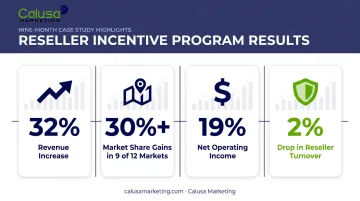
That's one company's case, not an industry average, but it illustrates what's possible when structure replaces guesswork.
Beyond the numbers, there's a human factor at play. Partners who feel genuinely valued advocate for your brand, refer new business, and prioritize your allocation when supply gets tight. In commoditized categories like tire, plumbing, or electrical supply, where competing products are nearly identical on paper, the loyalty program itself becomes your differentiator.
How to Build a High-Impact Channel Partner Loyalty Program
Building a program that actually changes behavior takes more than picking a reward catalog; it starts with clarity on what you're trying to achieve.
Define Clear Goals and KPIs
Vague goals like "increase sales" produce vague results. Set S.M.A.R.T. goals tied to specific outcomes instead, something like "increase HVAC vertical sales 15% over six months."
Common goal categories to choose from:
- Sales growth in a target vertical or region
- New product adoption
- Market penetration into underserved segments
- Training or certification completion
- Partner retention and reduced attrition
Pick one or two, since trying to optimize for everything at once dilutes your program's focus.
Segment Your Partner Base
Not every partner needs the same rewards or messaging. Segment by tier and revenue contribution, product specialization, and partner type (dealer, distributor, retailer, or agent).
The 20-60-20 principle is a useful lens here:
- Top 20% need recognition and exclusive perks to stay engaged
- Middle 60% respond best to consistent engagement efforts and achievable milestones
- Bottom 20% may need a fundamentally different approach, or may not be worth heavy investment at all
Design a Flexible Points and Tier Structure
A points-based model tied to purchase volume, certifications, and training completions gives partners multiple paths to earn. Tier multipliers, where advancing a level unlocks bigger rewards, keep top performers climbing.
Here's the test for simplicity: if a partner can't explain how they earn rewards in one sentence, simplify the structure until they can.
Choosing Rewards That Actually Drive Partner Behavior
The cash versus non-cash debate matters more than most program owners realize. A field experiment comparing cash rewards with tangible non-cash rewards of equal value found that participants receiving tangible rewards exerted significantly more sales effort than those receiving cash, according to research published in The Accounting Review.
Participants often said they preferred cash, even though it produced weaker results. Cash tends to blend into paychecks and disappear into monthly expenses; a trip, gadget, or gift card sticks around as a reminder of who gave it.
A well-rounded reward mix typically includes:
- Travel incentives, both individual trips and group experiences
- Gift cards, ideally with flexible redemption options
- Digital rewards and punch cards for frequent, lower-value transactions
- Branded merchandise from recognizable brands
- Co-op or MDF funds for marketing support
- Training and certification sponsorships
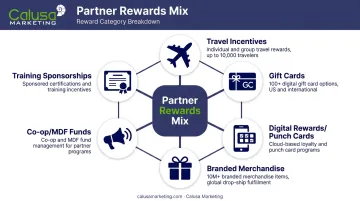
Flexibility matters here. ANY-Card style gift card programs, digital punch cards, and fully transferable travel incentives, like those Calusa Marketing structures for its clients, give partners freedom to choose rewards that fit their lives while keeping fulfillment simple on the sponsor's end.
For partner networks spanning multiple regions, scale matters too. Calusa's merchandise catalog alone spans over 10 million authentic branded items from names like Nike, Yeti, and Apple, shipped to more than 100 countries.
Don't guess at preferences. Survey partners directly, and account for regional or cultural differences if your network spans multiple markets. Finally, tie rewards to more than sales alone. Training completion, certifications, referrals, and marketing participation all deserve recognition, broadening engagement beyond the purchase order.
Technology: The Backbone of a Scalable Loyalty Program
Spreadsheets and email chains work fine for a dozen partners. They fall apart at a hundred. Manual tracking creates errors in point calculations, delayed reward fulfillment, and partners who stop trusting the program because their balance never seems right.
The platform capabilities worth prioritizing:
- Real-time dashboards so both sponsors and partners can see standings instantly
- Automated point allocation and redemption to eliminate manual entry errors
- Built-in reporting showing where, when, and why points were earned
One detail that gets overlooked: whether the platform requires integration with your existing ERP or CRM system. Programs that skip this step launch faster. Calusa Marketing's cloud-based SaaS platform requires no integration and no app download, which means most programs go live in under a week rather than the months typical of custom-built systems.
That matters most for large, geographically dispersed networks. Hajoca, a plumbing distributor with more than 800 locations across 20+ entities, and electrical distributors like Baker Distributing run points-based rewards programs on this kind of infrastructure precisely because it scales without location-by-location technical setup.
Modern partner networks now expect the same real-time, mobile-friendly experience they get from consumer loyalty apps. A program that still runs on spreadsheets signals to partners that it isn't a priority, and they'll treat it accordingly.
Common Pitfalls to Avoid When Launching a Partner Loyalty Program
Even well-funded programs fail for predictable, avoidable reasons.
- Overcomplicating the mechanics. Partners disengage fast when they can't figure out how points are earned or redeemed. If your FAQ document runs three pages, simplify before launch.
- Underestimating ramp-up time. Programs need a phased rollout, not an overnight launch. Start with executive buy-in, follow with manager communication, then run a short "fast start" promotion to build momentum.
- Neglecting ongoing communication. A program isn't a one-time announcement. It needs refreshed rewards, periodic contests, and continuous promotion, or it fades from partner attention within months.
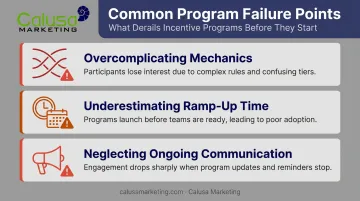
Budget time for all three. A program that launches quietly and never gets mentioned again will underperform no matter how generous the rewards are.
Frequently Asked Questions
What is a channel partner reward program?
It's a structured system that rewards distributors, dealers, or resellers for specific behaviors, such as sales volume, training completion, or product adoption. The goal is to build long-term brand preference rather than reward one-off transactions.
What are some good loyalty programs?
Effective models include tiered points programs, travel incentive programs, and digital punch card or gift card programs. The best ones combine flexibility in redemption with genuine recognition for top performers.
What's the difference between a channel incentive program and a channel loyalty program?
Incentive programs motivate specific, short-term behaviors on higher-ticket, less frequent sales. Loyalty programs maintain ongoing engagement for frequent, recurring transactions, like regular restocking or reorders.
How much should a company budget for a channel partner loyalty program?
Budgets are typically set as a percentage of sales or incremental gross profit. Most of that budget goes toward rewards, with the remainder split across platform technology, communications, and administration.
How do you measure the ROI of a channel partner loyalty program?
Track incremental sales, partner retention rates, redemption rates, and participation levels, then weigh those gains against total program cost. Retention and repeat purchasing are often the clearest long-term signals.
What technology is needed to run a channel partner loyalty program?
A cloud-based platform with automated point tracking, reward fulfillment, and reporting is the baseline. Look for one that requires no integration or app download so partners can participate without added friction.