Intermittent rewards are reinforcements delivered unpredictably rather than every single time a behavior happens. First studied by psychologist B.F. Skinner in the 1930s, this principle now shapes everything from romantic relationships and social media feeds to casino floors and corporate loyalty programs.
This article breaks down the psychology behind intermittent rewards, the four reinforcement schedules Skinner identified, why your brain responds so strongly to unpredictability, and how businesses can apply this principle responsibly instead of manipulatively.
Key Takeaways
- Unpredictable rewards create stronger, longer-lasting behaviors than consistent ones
- Four schedules exist: fixed-ratio, variable-ratio, fixed-interval, and variable-interval
- Dopamine surges highest during uncertainty, not at the moment of reward
- Businesses can ethically pair guaranteed value with occasional surprises
- Transparency separates a motivating loyalty program from a manipulative one
What Is Intermittent Reinforcement? The Psychology Explained
Intermittent reinforcement means a reward doesn't show up every time a behavior occurs. It arrives sometimes, unpredictably, which is exactly what makes it so effective at shaping habits. This sits in contrast to continuous reinforcement, where every single action gets rewarded, like a vending machine that always delivers a snack when you insert money.
B.F. Skinner tested this with rats in a now-famous operant conditioning chamber. In his 1938 book The Behavior of Organisms, Skinner documented how a rat pressing a lever would trigger food delivery, and he tracked response rates as the core measurement of learning. Pigeons appeared in his later schedule experiments; the original chamber studies used rats.
What Is the Meaning of Intermittent Rewards? (Direct Answer)
Intermittent rewards are reinforcements given unpredictably rather than after every occurrence of a behavior. Because the brain can't predict exactly when the next reward will land, it stays engaged and keeps repeating the behavior far longer than it would under a guaranteed reward system.
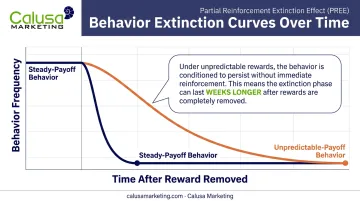
This unpredictability explains something psychologists call the Partial Reinforcement Extinction Effect (PREE): behaviors learned under intermittent rewards resist extinction far longer than those learned under constant rewards. The effect plays out in three ways:
- Steady-payoff behavior stops quickly once the reward disappears, since the pattern break is obvious
- Unpredictable-payoff behavior keeps going, sometimes for weeks, because a missed reward doesn't clearly signal that rewards have stopped
- Real-world result: habits built on random rewards, like checking a phone for notifications, become notoriously hard to break
Modern research backs this up. A controlled human operant study involving 128 participants found that behavior trained under partial reinforcement declined measurably slower during extinction compared to continuously reinforced behavior. The effect size wasn't massive, but it was consistent, confirming what Skinner observed decades earlier: uncertainty makes behavior stickier.
The 4 Types of Intermittent Reinforcement Schedules
Skinner mapped reinforcement schedules along two axes: ratio (based on number of responses) versus interval (based on time), and fixed versus variable. He identified these patterns during operant conditioning experiments with pigeons and rats throughout the 1950s. Combine those, and you get four distinct patterns of reward delivery, each producing a different behavioral signature.
| Schedule | How Rewards Arrive | Real-World Example |
|---|---|---|
| Fixed-Ratio | After a set number of actions | Buy 9 coffees, get the 10th free |
| Variable-Ratio | After an unpredictable number of actions | Slot machines |
| Fixed-Interval | After a consistent time period | Weekly paycheck |
| Variable-Interval | After unpredictable time gaps | Random app notifications |
Fixed-Ratio Schedule
Rewards come after a specific, known number of responses. A classic punch card, buy nine sandwiches and get the tenth free, is a textbook example. People tend to work steadily toward the goal, then pause briefly right after claiming the reward. This same mechanic powers modern digital loyalty punch cards, automating a reward pattern that once lived only on paper.
Variable-Ratio Schedule
Rewards arrive after an unpredictable number of responses, centered around an average. This is the schedule behind slot machines, and it's the most resistant to extinction of the four types. Because any given pull could be the winning one, players keep going even through long losing streaks. There's no clear signal telling them the reward well has run dry.
Fixed-Interval Schedule
Rewards show up after a set amount of time has passed, regardless of how many times the behavior occurred in between. A weekly paycheck or a scheduled quarterly bonus fits this pattern. Response rates typically spike right before the reward is due and drop off right after.
Variable-Interval Schedule
Rewards arrive at unpredictable time intervals. Think of checking social media for new comments, or a radio station announcing a surprise giveaway at random points during the broadcast. This produces steady, moderate engagement since you never know exactly when to check.
Why Intermittent Rewards Are So Powerful: The Neuroscience
Here's the part most people get wrong: dopamine isn't a "reward chemical" that spikes when you get something good. Neuroscience research shows dopamine neurons respond most to the prediction of a reward, and to the gap between what you expected and what actually happened. Once a cue reliably predicts an outcome, the dopamine response shifts away from the reward itself and toward the anticipation.
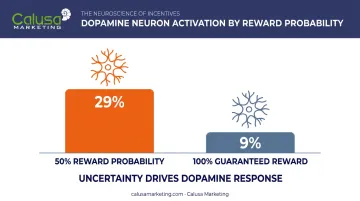
Uncertainty amplifies this even further. In a landmark study, researchers recorded dopamine activity in monkeys while a cue signaled varying probabilities of a liquid reward. Sustained dopamine activation was highest when the reward probability sat at exactly 50%, the point of maximum uncertainty, and nearly absent when the outcome was fully predictable.
Roughly 29% of neurons showed significant pre-reward activity at 50% odds, compared to just 9% when the reward was guaranteed.
That single finding explains a lot:
- Why gambling built on random-ratio payouts (a subtype of variable-ratio schedules) keeps players seated long after they've stopped winning
- "Almost winning" feels just as compelling as winning, even though it's still a loss
- Repeated exposure to this cycle carves durable neural pathways, shifting behavior from a deliberate choice into an automatic habit over time
This isn't just gambling trivia. The same neurochemical mechanism, when applied transparently, is the exact foundation that makes loyalty and incentive programs effective at driving repeat engagement.
Everyday Examples: Where Intermittent Rewards Show Up
You don't need a casino to encounter this pattern. It's built into daily life.
- Slot machines and gambling run on random-ratio schedules by design. Wins arrive after an unpredictable number of wagers, keeping players in anticipation between spins.
- Social media notifications work similarly. A study of over one million posts from 4,000+ users found that unpredictable rewards, like likes and comments, directly influenced how quickly people posted again.
- Video games and loot boxes use randomized rewards to build what designers call a compulsion loop. Studies measuring physical arousal found that rarer rewards triggered a stronger urge to keep playing than common ones.
- Relationships and workplaces can fall into the same trap: inconsistent praise or affection, warm one day and cold the next, taps the same psychological mechanism. If this pattern feels unhealthy, consider talking to a professional.
Turning Psychology Into Strategy: Intermittent Rewards in Business & Loyalty Programs
Businesses don't need to gamble with customer trust to use this psychology well. The most effective loyalty and incentive programs blend predictable recognition, points, punch cards, guaranteed tiers, with occasional surprise rewards layered on top.
The data backs this approach. In a field experiment with 82 university running-club members, one group earned a guaranteed 5 points per lap while another earned an uncertain 3 or 5 points per lap. Despite the lower expected value, the uncertain-reward group completed nearly double the laps, averaging 13.93 laps versus 7.45. Uncertainty, resolved quickly, motivated more repetition than a bigger guaranteed payout.
This is where firms like Calusa Marketing apply the principle in practice. Their programs typically build in predictable structure first:
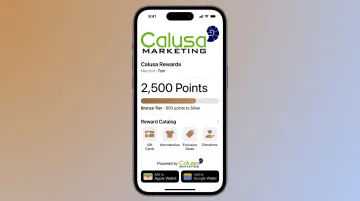
- Digital loyalty cards that track punches and points through Apple Wallet or Google Wallet, no app download required
- Points-based earning, customized per client, tied to purchases or account activity
- Tiered reward catalogs spanning gift cards, branded merchandise, and travel certificates from $500 to $25,000
On top of that foundation, programs can layer in variable elements to keep engagement fresh without abandoning the guaranteed value members count on:
- Bonus point multipliers during specific campaigns
- Surprise gift card drops tied to milestones
- Randomized draws linked to account activity
The predictability builds trust. The occasional surprise keeps people checking back.
The Risks: When Intermittent Rewards Cross Into Manipulation
Unpredictability is a tool. Like most tools, it can build something useful or cause real harm, depending on how it's handled.
The ethical line comes down to transparency and consent. The same unpredictability that motivates in one context can manipulate in another, depending on what's disclosed and what's hidden.
| Ethical Use | Manipulative Use |
|---|---|
| Loyalty program states terms clearly and lets members opt in or out freely | Slot machine obscures true odds to keep players engaged |
| Rewards disclosed as probabilistic, not guaranteed | Relationship withholds affection unpredictably to control behavior |
| Exit process stays simple and voluntary | Cancellation or exit made deliberately difficult |
Regulatory bodies have started drawing sharper lines here. The FTC identifies warning signs of manipulative design, including disguised advertising, false urgency, and deliberately difficult cancellation processes. The OECD similarly defines "dark patterns" as interface tactics that steer or coerce people into decisions that aren't in their own best interest.
Three safeguards separate ethical incentive design from manipulative reinforcement:
- Disclose the variability: tell participants when rewards are probabilistic, not guaranteed
- Keep exit easy: no forced continuity, no hidden cancellation hurdles
- Deliver genuine value: surprises should add delight, not compensate for a program that's hollow without them
Psychological dependency risk rises when unpredictable rewards operate without any of these guardrails. Used with transparency, the same mechanism that makes slot machines sticky can make a loyalty program genuinely rewarding.
Frequently Asked Questions
What is the meaning of intermittent rewards?
Intermittent rewards are reinforcements delivered unpredictably rather than every time a behavior occurs. This unpredictability makes the resulting behavior stronger and more resistant to stopping than behavior built on constant, guaranteed rewards.
What are the 4 types of intermittent reinforcement?
The four types are fixed-ratio (punch card), variable-ratio (slot machine), fixed-interval (weekly paycheck), and variable-interval (random notifications). Each combines a ratio-or-interval basis with either a fixed or unpredictable timing pattern.
Is intermittent reinforcement good or bad?
It's neutral as a psychological principle. Its impact depends on the application: transparent, opt-in programs like loyalty rewards use it ethically, while manipulative, concealed tactics, such as predatory gambling design, cross into harmful territory.
What is an example of intermittent reinforcement in everyday life?
Slot machines and social media notifications are the two most common examples. Both deliver rewards after an unpredictable number of actions or time intervals, keeping people engaged far longer than a guaranteed payoff would.
How is intermittent reinforcement used in marketing or loyalty programs?
Businesses combine guaranteed rewards, like points or punch cards, with occasional surprise bonuses, such as bonus multipliers or surprise draws. This blend increases customer and employee engagement beyond what fixed rewards alone typically achieve.
What's the difference between intermittent and continuous reinforcement?
Continuous reinforcement rewards every single instance of a behavior. Intermittent reinforcement rewards only some instances, unpredictably, which research shows produces more persistent, harder-to-extinguish behavior over time.