At enterprise scale, loyalty isn't a punch card or a points app bolted onto checkout. It's a system spanning thousands of customers, dealers, employees, and locations, each with different motivations and different reward expectations. A distributor rewarding 800 contractor locations has almost nothing in common operationally with a coffee chain rewarding app users, even though both call it "loyalty."
Most articles on this topic skip the B2B side entirely. They ignore how distributors, media companies, timeshare operators, and call centers build loyalty at scale. This article covers both: the familiar consumer giants and the less-discussed enterprise incentive programs running behind the scenes in wholesale, media, hospitality, and customer service industries.
Key Takeaways
- Enterprise loyalty programs manage far more complexity than simple rewards cards, spanning multiple stakeholders
- Starbucks and Marriott win by removing friction, not offering discounts
- B2B and channel programs in distribution, media, and timeshare thrive on simple, flexible rules
- Real ROI tracking (retention, incremental sales, reduced turnover) matters more than enrollment counts
What Makes an Enterprise Loyalty Program Different From a Small Business Rewards Card
A small business rewards card usually serves one type of customer at one or two locations. Enterprise programs operate at a different order of magnitude entirely.
Consider the scale consumer brands reach. Marriott Bonvoy closed 2025 with nearly 271 million members worldwide after adding roughly 43 million in a single year, according to Marriott International's 2025 Annual Report. At that scale, the program functions as core business infrastructure.
But scale isn't only about consumer counts. Enterprise loyalty also means serving multiple audiences under one program umbrella:
- End customers who need simple, mobile-friendly earning
- Channel partners or dealers who need purchase-based incentive tracking
- Internal sales or service teams who need performance-based recognition
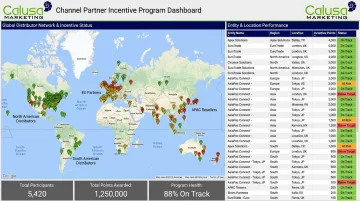
Calusa Marketing's own client work illustrates this well. Its partnership with Hajoca, a distributor founded in 1858, involves a custom incentive program spanning 800-plus locations across 20-plus entities, all managed through a single coordinated platform.
Why Fulfillment Becomes the Hard Part
Platform coordination solves visibility, but it doesn't ship a single package.
Once a program hits enterprise scale, the real challenge shifts from design to execution. Someone has to ship merchandise, activate gift cards, or book travel for thousands of geographically scattered participants — accurately, on time, every time. That requires dedicated fulfillment staff, compliance tracking, and customer support that most internal marketing teams simply aren't built to run in-house.
Enterprise Loyalty Program Case Studies by Industry
Starbucks Rewards, Amazon Prime, Marriott Bonvoy, and Sephora Beauty Insider are the programs most articles lean on, and for good reason: mobile-first design, tiered status, and ecosystem integration made each of them category leaders. But those consumer examples are well covered elsewhere. The more interesting story is what's happening in B2B verticals that rarely get written about.
Wholesale & Trade Distribution
HVAC, electrical, and tire distributors (companies like Hajoca, Johnstone Supply, Baker Distributing, and Midstate Tire) use incentive programs to drive dealer and contractor purchasing loyalty while rewarding top-performing sales reps.
The mechanism is usually straightforward: points earned on purchases, redeemable for merchandise, gift cards, or travel, often layered with sales contests for distributor reps chasing a leaderboard.
Does it work? One documented case from the Incentive Research Foundation offers a clear answer. A hand-tool manufacturer's first-ever incentive program generated $1.44 million in incremental net sales over nine months against a $1 million goal, while gross margin climbed from 30.4% to 35%, according to the IRF's ROI case study on key distributor incentives.
That's one company's result, not a universal guarantee, but it shows what's possible when incentive design targets the right behavior.
Media, Broadcasting & Publishing
Media companies, including iHeart Media, Audacy, Houston Chronicle, McClatchy, Postmedia, and Lee Enterprises, use loyalty and incentive programs on two fronts at once.
- Subscriber-facing programs use gift cards to drive both acquisition and retention
- Ad-sales incentive programs use travel rewards to motivate advertisers to increase spend
Some clients run both tracks simultaneously. Postmedia's structure blends employee incentives, subscriber gift card rewards, and advertiser travel incentives into one integrated program, the most complex setup in this list.
Regional media leadership has credited this kind of layered approach with generating millions of dollars in incremental ad revenue, since it aligns the sales team's motivation with the advertiser's reward at the same time.
Vacation Ownership & Timeshare
Timeshare and vacation ownership companies, including Capital Vacations, Travel Resorts of America, and InnSeason Resorts, depend heavily on owner loyalty to drive repeat bookings, referrals, and upgrade sales.
This vertical leans on transferable travel rewards and tiered owner benefits for a simple reason: purchases here are high-value and infrequent. An owner isn't buying weekly like a retail shopper.
They're buying once every few years, so the loyalty mechanics need to reward long-term relationship value, not transaction frequency. Partnerships with established travel brands add credibility and expand where owners can actually use their rewards.
Call Centers & Customer Service Operations
Call center and BPO operators, including Alorica and Inktel, use employee incentive and recognition programs to fight one of the industry's most persistent problems: turnover.
The scope of that problem is bigger than most people assume. A 2025 ICMI analysis, citing the 2024 U.S. Contact Center Decision-Maker's Guide, found that 54% of centers report annual attrition between 21% and more than 50%, with nearly 80% saying attrition has either increased or stayed flat, according to ICMI's 2025 report on the contact center attrition crisis.
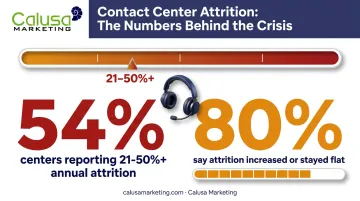
That's a workforce churning through a quarter to half its staff every single year.
Incentive and recognition programs in this space typically target three objectives:
- Agent recruitment — filling seats faster
- Agent retention — keeping trained staff longer
- KPI achievement — motivating performance against metrics each client defines for their own operation
Blood & Plasma Donation Centers
Donation centers like Memorial Blood Centers use incentive programs, such as gift cards and digital rewards, to motivate repeat donations, especially during low-supply periods when donor fatigue sets in. Because donating isn't a purchase, the reward has to work as pure appreciation: something that feels worth the time and discomfort, delivered fast enough that donors associate the gesture with the act itself.
Key Success Factors Behind High-Performing Enterprise Loyalty Programs
Across every industry above, the same patterns separate programs that thrive from ones that stall.
- Simplicity of earning and redemption: Members shouldn't need a manual to understand how points work. Complex tier charts frustrate large, diverse member bases, so the bigger the audience, the simpler the rules need to be.
- Reward flexibility: Multiple redemption types (merchandise, gift cards, travel) drive stronger member engagement. Research from the Incentive Research Foundation links broader options to greater program value, deeper participant identification, and sustained engagement over time.
- Technology with no integration burden: Enterprise buyers favor cloud-based platforms that launch without pulling in IT resources or lengthy vendor onboarding. Requiring custom API work or an app download can turn a weeks-long launch into a months-long one.
- Full-service fulfillment and support: At scale, software alone doesn't cut it. Dedicated fulfillment teams and responsive customer support, not just a chatbot, keep large programs running smoothly for thousands of members across multiple time zones and countries.
- Clear ROI tracking tied to business KPIs: The strongest programs measure incremental sales, retention rate, or reduced turnover, not just signups.
- Tiered or gamified structures: Even in B2B settings, recognition tiers like a "top performer club" or point leaderboard sustain engagement long after the initial launch excitement fades.
Common Challenges When Scaling an Enterprise Loyalty Program
Even well-designed programs run into predictable friction as they grow.
- Budget justification: Stakeholders often struggle to prove ROI early on. Establish baseline metrics (current spend, retention, engagement) before launch, so improvement is measurable rather than assumed.
- Program fatigue: Long-running programs risk stagnating if rewards and promotions never change. Periodic bonus point events or new reward tiers keep the program feeling fresh.
- Logistics complexity: Fulfilling physical rewards like travel or merchandise across a large, dispersed member base requires operational capacity most internal teams lack. This is typically when companies turn to fulfillment partners such as Calusa Marketing, which operates drop-ship networks spanning 100+ countries, rather than hiring internally.
How Calusa Marketing Helps Enterprises Build, Launch & Manage Loyalty Programs
Calusa Marketing has managed 1,000-plus incentive and loyalty programs for more than 500,000 members across distribution, media, timeshare, and call center industries, maintaining a 99% client retention rate. That retention rate matters here because it mirrors the very outcome these programs are built to produce: keeping an enterprise's own customers or channel partners engaged and coming back.
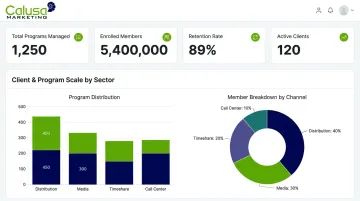
The platform itself is cloud-based SaaS, requiring no integration and no app download, directly addressing the integration burden that derails many enterprise loyalty rollouts. Enterprise clients can configure and launch a program in weeks, not quarters, without pulling their IT department into the project.
Behind the platform sits a full-service model:
- Travel booking and confirmation for programs ranging from a handful of top performers to group incentive trips of up to 10,000 people
- Fulfillment through locally sourced, drop-shipped logistics across more than 100 countries, backed by a dedicated Director of Fulfillment
- Customer support available seven days a week, staffed by real, bilingual, in-house team members, not an outsourced call queue
Calusa also flexes across program types rather than forcing every client into one format. Options include digital punch cards for simple repeat-purchase tracking, ANY-Card gift card programs for subscriber or customer rewards, and incentive travel for high-value dealer or advertiser motivation. Clients can start a conversation about program design to see which structure fits their audience.
Frequently Asked Questions
What is an enterprise loyalty program?
An enterprise loyalty program is a large-scale reward or incentive system built to engage and retain complex member bases — customers, dealers, or employees — across multiple locations or business units, rather than a single storefront.
How do enterprise loyalty programs differ from small business loyalty programs?
Enterprise programs handle far greater scale, more stakeholder groups, and heavier fulfillment demands. A small business might track one reward type at one location; an enterprise program often coordinates several reward types across hundreds of sites.
What industries benefit most from enterprise loyalty programs?
Distribution, media and publishing, timeshare and hospitality, call centers, and retail all see strong results, based on real client patterns across those verticals. Each industry adapts the same core mechanics to its own audience.
How much does it cost to launch an enterprise loyalty program?
Cost depends on member count, reward mix (merchandise, gift cards, or travel), and program complexity. Because pricing varies so widely by scope, it's best to request a custom quote based on your specific goals.
How do you measure the success of an enterprise loyalty program?
Track active participation rate, redemption rate, retention improvement, and incremental revenue attribution. Enrollment numbers alone don't tell you whether the program is actually changing behavior.
Can enterprise loyalty programs be used for employees as well as customers?
Yes. Many enterprises run parallel programs for customer/dealer loyalty and internal employee recognition. These can often be managed within the same platform to efficiently engage different audiences like subscribers, advertisers, and staff.