
Introduction
Ask a CFO whether incentive travel is a strategic investment or a perk, and you'll often get a shrug. Many leaders still file trip rewards under "nice to have," the first line item cut when budgets tighten.
That perception is outdated. A 2024 IRF Trends Report found 48% of senior leaders call incentive travel an essential strategic differentiator, while only 13% see it as an area to cut. Yet fewer than one in four program owners actually track ROI, leaving the strategic case underfunded and underproven.
This article breaks down a documented incentive travel case study, the exact formula for calculating ROI, and how to design a program built to pay for itself.
Key Takeaways
- Incentive travel boosts performance ratings and tenure when tied to specific, trackable objectives
- ROI combines hard numbers (revenue, market share) with soft signals like engagement and retention
- One channel-sales case generated nearly $750,000 in net incremental ROI after program costs
- Success hinges on clear qualification rules, year-round communication, executive hosting, and reliable logistics
What Is an Incentive Travel Program?
An incentive travel program rewards participants with an earned trip for hitting specific, pre-communicated performance goals. That distinction matters: a standard vacation or blanket perk asks nothing of the recipient. Earned travel asks for a defined result first.
The Anticipation Cycle
The mechanism behind incentive travel is the cycle leading up to the trip. Participants set goals, track progress, build anticipation, hit targets, and finally receive the trip as a public recognition moment. That loop keeps people engaged for months, not just during the vacation week.
Common reward formats include:
- Group cruises for teams or top-tier distributors
- All-inclusive resort getaways in the Caribbean, Mexico or similar destinations
- Points-based travel catalogs letting winners choose their own trip
- Exclusive experiential rewards, such as a "Top Gun" style flight-school experience
- Hybrid options pairing a travel voucher with a gift card for smaller wins
Who Actually Runs These Programs
Incentive travel isn't limited to enterprise sales floors. It shows up across a wide range of industries:
- Channel partners, distributors and resellers earn trips for hitting volume targets
- Media companies reward advertisers for incremental ad spend
- HVAC and electrical distributors use travel to drive online orders and product training completion
- Jewelry retailers reward customers making a major purchase, like an engagement ring, with a travel certificate tied to the moment
Why Travel Beats Cash for Loyalty
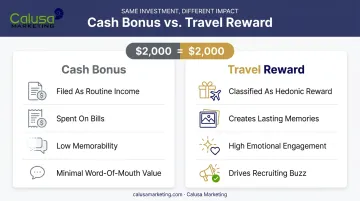
Recipients mentally file cash alongside a paycheck and spend it on bills. Travel stays memorable. Research on mental accounting theory shows recipients associate hedonic, non-cash rewards with fun and lasting memories, while classifying cash as a routine, utilitarian resource. A $2,000 trip often outperforms a $2,000 bonus in engagement and word-of-mouth recruiting value, even though the dollar cost is identical.
Real-World Case Study: How Incentive Travel Programs Deliver Measurable ROI
Published case studies show what's possible when incentive travel is built around specific numbers rather than good intentions. Here's a breakdown of a documented Fortune 500 channel-sales program studied by the Incentive Research Foundation.
The Business Challenge & Program Objectives
The manufacturer/distributor faced tougher competition, new pricing pressure, and shrinking incentive budgets. Previous programs had also let VAR inventory and accounts receivable balloon. Leadership set three explicit targets:
- Revenue growth of at least 20% over the prior year
- VAR market share of at least 30%
- Net operating income of at least 10% of revenue
Program Design & Strategy
Master Resellers could earn a "Top Gun" style flight-school experience, while qualifying VARs and their guests received an eight-day, seven-night Caribbean resort trip. Individual revenue-improvement targets were set for each Master Reseller and VAR rather than a blanket team goal, so every participant knew their personal number.
Execution & Overcoming Challenges
Group incentive travel always carries operational risk, whether it's flight delays, weather, or supplier capacity.
IRF's broader disruption research found that during the 2020 travel shutdown, roughly 70% of organizations preserved their qualification rules rather than changing them mid-stream. Three-quarters of programs forced to cancel travel substituted points, merchandise, or gift cards instead of dropping the reward entirely. That flexibility protects a program's credibility when logistics go sideways.
Measurable Results & ROI Breakdown
Over nine months, the numbers moved fast:
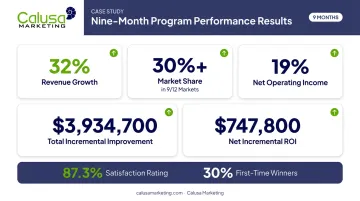
- Total revenue rose 32%, well past the 20% target
- Market share topped 30% in nine of 12 markets
- Net operating income reached 19% of revenue, nearly double the goal
- VAR inventory dropped from 44.8 to 40.2 days on hand
- Accounts receivable fell to 15% of revenue, with days outstanding improving to 54
The incremental figure that truly isolates the program's effect stands out: total incremental improvement came to $3,934,700, against $3,186,900 in incremental program costs, for $747,800 in net incremental ROI.
The soft numbers backed up the hard ones. Thirty percent of Master Reseller earners were first-time winners, meaning the program recruited new top performers rather than rewarding the same names every year. Survey ratings came back 87.3% "excellent," and key Master Reseller turnover dropped two percentage points year over year. The lesson holds across formats: specific targets, protected timelines, and full fulfillment support turn incentive travel from a cost center into a measurable revenue driver.
How to Measure ROI for Your Own Incentive Travel Program
The formula the Incentive Research Foundation (IRF) uses is straightforward:
ROI = (Total Incremental Improvement – Total Incremental Program Cost) ÷ Total Incremental Program Cost
- Total incremental improvement is the performance gain directly attributable to the program: extra revenue, margin, or retained accounts
- Total incremental program cost is everything spent on travel, logistics, and rewards above normal operating costs
Build a Control Group First
The formula only works if you can isolate the program's actual effect. IRF's "Return on Objectives" approach compares qualifying participants against a similar group of non-participants, matched for factors like account size or region. Without that baseline, you're measuring a good year, not a good program.
Track these hard metrics:
- Revenue growth and incremental sales
- Net operating income
- Accounts receivable days and inventory turnover (for channel/distributor programs)
- Employee or customer retention rates
Track these soft metrics:
- Post-event survey scores (satisfaction, perceived value)
- Engagement and motivation ratings from managers
- Recruitment inquiries or new-hire interest tied to program visibility
- Anecdotal feedback from leadership who attended
Calusa Marketing's reporting dashboard consolidates these hard and soft metrics in one place, so you're tracking the full picture instead of juggling spreadsheets.
A nine-month channel program and a multi-year tenure study both point the same direction. Measure the immediate performance shift around the event, then keep watching for six to twelve months to catch retention and loyalty effects that show up later.
Key Success Factors of High-ROI Incentive Travel Programs
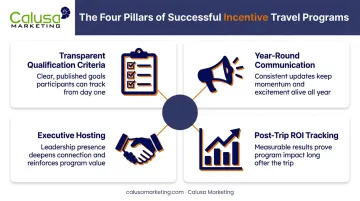
- Transparent qualification criteria. Participants should be able to calculate their own progress at any moment, not guess at where they stand.
- Year-round communication. Progress updates, leaderboard check-ins, and staged destination reveals keep motivation alive between goal-setting and the actual trip.
- Executive hosting. When leadership shows up as hosts rather than sponsors, the trip becomes a recognition event and an informal networking opportunity a conference room can't replicate.
- Post-trip ROI tracking. Comparing sales and retention data before and after the trip proves its dollar impact.
Programs missing any one of these elements tend to see participation drop after year one, even when the destination itself is compelling.
Choosing the Right Incentive Travel Partner
Booking flights, negotiating hotel blocks, and staffing a support line for hundreds of travelers is a full-time job most sales or marketing teams don't have time for. That reality is why many teams bring in a dedicated incentive marketing partner instead of managing group travel in-house.
Look for a partner that offers:
- A track record of client retention (a sign programs actually deliver results)
- Full-service fulfillment: bookings, confirmations, and live support seven days a week
- A rewards platform that works without app downloads or IT integration
- Group buying power that translates into real savings on hotel and cruise rates
Calusa Marketing, for example, manages more than 1,000 incentive programs with a 99% client retention rate, offering fully transferable travel rewards alongside group buying power on hotel and cruise bookings. That combination of scale and hands-on fulfillment lets a program run without pulling internal staff away from their day jobs.
Frequently Asked Questions
What is the main concept in incentive travel?
Incentive travel rewards participants with an earned trip for hitting specific, pre-set performance goals. The reward creates a motivational cycle of anticipation, achievement and recognition that keeps people engaged well before the trip itself.
What are good examples of incentive travel rewards?
Common examples include resort getaways, group cruises, points-based travel catalogs and exclusive experiential trips like a flight-school style adventure. Many programs pair these with gift cards for smaller achievements.
How do you calculate ROI for an incentive travel program?
Subtract total incremental program cost from total incremental improvement, then divide by the incremental cost. Comparing participant results against a non-participant control group makes the number far more reliable.
What makes an incentive travel program successful?
Clear goal alignment, consistent year-round communication, executive hosting, and dependable fulfillment logistics separate high-performing programs from one-off trips. Miss any of these and engagement tends to fade after the first year.
Is incentive travel more effective than cash bonuses?
Behavioral economics research shows travel rewards create stronger emotional engagement and longer-lasting motivation than cash, which recipients tend to spend on routine expenses and quickly forget. Cash still matters for lower-income earners facing financial hardship.
How much should a company budget for an incentive travel program?
Budgets scale with group size and destination, from cost-effective hotel or cruise certificates to premium experiences running $500 to $25,000 per couple. Plan spend against expected incremental revenue rather than picking a fixed number first.