Get it wrong and you'll feel it fast. Missed policy compliance, ballooning costs, or a traveler stranded overseas with no one to call. Get it right, and travel becomes a smooth, predictable part of doing business.
This article breaks down what separates a travel agent from a TMC, when each makes sense, and introduces a third option most companies never consider: a dedicated incentive marketing partner built for travel-as-reward programs, not standard itineraries.
Key Takeaways
- Travel agents handle personal trips well but don't scale for corporate travel programs.
- TMCs deliver corporate travel management, policy compliance, and 24/7 risk support.
- Your choice hinges on travel volume, budget, compliance needs, and risk exposure.
- Rewarding employees or customers with travel needs a specialized incentive partner, not a standard agent or TMC.
Travel Agent vs Travel Management Company: Quick Comparison
Here's how the two options compare across the factors that matter most when making this decision.
| Factor | Travel Agent | Travel Management Company |
|---|---|---|
| Client Focus | Individuals, families, occasional business travelers | Corporations with frequent or complex travel needs |
| Services Offered | Books flights, hotels, cars, and packages as needed | Manages policy, booking, expense tracking, and risk end-to-end |
| Pricing Structure | Commission or flat per-trip fees, varies by season | Management fee plus per-booking fees, often offset by negotiated rates |
| Support & Availability | Business-hours support, limited emergency help | 24/7 support with real-time emergency response worldwide |
| Technology & Reporting | Basic booking tools, minimal data tracking | Advanced platforms with detailed spend analytics |
The pattern is simple: agents serve people, TMCs serve programs. The right fit depends on which one describes your travel activity.
What is a Travel Agent?
A travel agent, also called a travel advisor, works as a retail seller for airlines, hotels, cruise lines, and tour operators, according to the American Society of Travel Advisors (ASTA). They plan trips on your behalf, using supplier relationships and insider knowledge to find rates and itineraries you'd struggle to piece together alone.
For a family planning a two-week Europe trip, or a founder booking a handful of client visits each year, that expertise means real savings in both time and money. You describe what you want; someone else handles the details.
Travel agents come in a few common flavors:
- Online agents operate primarily through digital platforms and virtual booking tools.
- Corporate/business travel specialists focus on companies with occasional but complex trip needs.
- Niche or luxury agents build expertise in specific destinations, cruises, or high-end travel.
- Host agencies provide back-office support to independent advisors operating under a larger umbrella.
Where Travel Agents Fit Best
Travel agents remain the right call for:
- One-off personal or family vacations
- Small business owners booking occasional meetings or conferences
- Budget-conscious travelers who still want expert guidance on deals
- Complex leisure trips like multi-country tours or luxury cruises
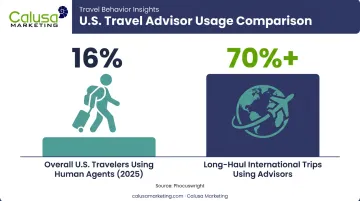
Despite the rise of self-booking apps, human advisors haven't disappeared. 16% of U.S. travelers used a human travel agent in 2025, according to Phocuswright's research on travel agents in the digital age. That reliance climbs sharply for complicated trips, where advisor use jumps well above 70% for long-haul international travel.
Agents clearly hold their ground for occasional, leisure-driven trips. Once travel turns frequent, international, or operationally complex, the math starts to shift toward a different kind of partner.
What is a Travel Management Company (TMC)?
A TMC is built for organizations that book travel constantly, not occasionally. Instead of handling individual trip requests, a TMC manages an entire corporate travel program: setting policy, negotiating rates, tracking spend, and keeping travelers safe across every trip in the pipeline.
That infrastructure delivers outcomes finance and HR teams actually care about:
- Policy compliance keeps bookings within budget and approved suppliers automatically.
- Cost control comes from negotiated corporate rates and spend visibility across the company.
- Risk management means knowing where every traveler is during a flight delay, storm, or security event.
Delivering those outcomes looks different depending on the provider. Some TMCs offer full-service, agent-assisted booking, while others run mostly self-service platforms with light human backup. Many blend both, an app for routine bookings, a live person for anything complicated.
Where TMCs Make Sense
TMCs earn their keep once a company crosses a certain threshold of travel activity. Signs you're there:
- 10 or more business trips a year across the organization
- Regular international travel requiring visa, safety, or currency coordination
- Travel to higher-risk destinations where duty-of-care matters
- Multiple departments booking travel without shared visibility into spend
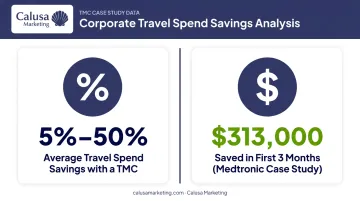
Industries like energy, marine, large enterprise, and government or NGO sectors treat a TMC as standard infrastructure. The Global Business Travel Association notes that a TMC can help a company save between 5% and 50% of travel spend, depending on how mature the program was before the switch.
Real numbers back this up. When Medtronic implemented BCD Travel's Tripsource platform for managing healthcare-professional and trip logistics, the program delivered $313,000 in savings within its first three months. That's one company's result, not a universal guarantee, but it shows what's possible once booking chaos turns into a managed system.
Travel Agent vs TMC: Which One Should You Choose?
The right answer depends on four factors: how often your team travels, your budget, your compliance requirements, and how much risk exposure you're carrying.
Ask yourself:
- How many trips does your company book per year? Under 10, a travel agent likely covers it. Above that, a TMC starts paying for itself.
- What's your risk profile? International travel or large traveling teams need duty-of-care infrastructure a solo agent can't provide.
- Do you need policy enforcement? If departments book however they want, a TMC brings order and cost control.
- How complex is your reporting need? Finance teams tracking spend across dozens of travelers need the analytics a TMC provides.
Choose a travel agent if you book infrequent, personalized trips, run a small business attending a handful of conferences each year, or lead a team taking one annual retreat.
Choose a TMC if travel has become a recurring operational function, with multiple travelers, frequent bookings, and real financial exposure if something goes wrong.
This isn't a permanent decision. A company booking five trips a year today might be booking fifty in three years. Revisit the choice as volume grows. Don't wait until a compliance gap or a stranded traveler forces the conversation.
Beyond Traditional Travel: When Travel Becomes a Business Incentive
Here's what neither a travel agent nor a TMC is built for: travel used as a reward instead of a business necessity.
When a company sends a top sales rep to Cancun for hitting quota, or gifts a loyal customer a cruise certificate, the trip serves as a motivational tool. It comes with requirements standard travel providers don't handle.
What Incentive Travel Actually Requires
Reward-based travel programs need:
- Transferability – a recipient who can't travel on the awarded dates should be able to gift the trip to a family member, employee, or customer instead.
- Group buying power at scale – programs might reward 10 people or 10,000, and pricing needs to work at either end.
- Program-wide fulfillment – someone has to manage qualification rules, certificate issuance, guest communication, and redemption logistics, not just book flights.
A TMC's infrastructure is built for policy compliance on business trips. A travel agent is built for one-off personal bookings. Neither is designed to run a 12-month incentive program with thousands of participants redeeming trips on their own schedule.
A Different Kind of Partner
This is where incentive marketing firms like Calusa Marketing operate. Based in St. Petersburg, Florida, Calusa manages travel as one piece of a broader rewards ecosystem that includes gift cards, merchandise, and digital loyalty programs. The company runs more than 1,000 client programs serving over 500,000 program members.
The differences show up in practice:
- Trips are fully transferable, so a recipient who can't travel doesn't lose the reward.
- Group programs scale from 10 to 10,000 participants, with buying power that keeps per-person costs down.
- Calusa's fulfillment team handles booking, confirmations, hotel coordination, and even hard-to-get event tickets (Masters tournament passes included), so clients never touch the logistics.
- Customer support runs seven days a week, since reward recipients redeem trips on their own timeline, not on business hours.

Jim Normandin, Regional President of APG Media of Chesapeake & Florida, credited his company's incentive partnership with generating millions of dollars in incremental revenue. That result reflects program design and execution, not something a single booking transaction could deliver.
If your company is exploring travel as a reward for employees, dealers, or customers, this is a different conversation than choosing between an agent and a TMC. Talk to a partner built specifically for reward fulfillment before you lock in a program structure.
Frequently Asked Questions
What is the difference between a travel management company and a travel agency?
A travel agency handles individual or occasional trips, one booking at a time. A TMC manages ongoing corporate travel programs, including policy compliance, cost control, and risk oversight across every trip.
What is a travel management company?
A TMC is a specialized partner that manages end-to-end business travel, booking, policy enforcement, expense reporting, and traveler safety for organizations with frequent or complex travel needs.
What are the four types of travel agents?
Common categories include online agents, corporate/business travel specialists, niche or luxury agents, and advisors working under host agencies. These describe sales channel, specialty, and business structure rather than one official classification.
What is the difference between a destination management company and a travel agency?
A destination management company (DMC) handles local, on-the-ground logistics like events, tours, and ground transport within a specific destination. A travel agency arranges the broader trip, including flights and lodging.
Is a travel agent or TMC better for a growing business with occasional trips?
A travel agent usually covers infrequent trips just fine. Once travel volume grows or spend becomes harder to track, a TMC's cost controls and reporting start to justify the switch.
Can travel rewards or incentive travel be booked through a typical agent or TMC?
They can book the trip itself, but reward fulfillment, transferability, and program-wide management call for a specialized incentive marketing partner instead of a standard agent or TMC.