Introduction
Price wars are a race to the bottom. In markets flooded with near-identical products, the businesses that win are the ones customers choose to stick with, not the ones with the lowest sticker price.
Brand loyalty often gets dismissed as a soft marketing idea, but it shows up in hard numbers: retention rates, repeat spend, and acquisition costs. A Harvard Business Review analysis found that acquiring a new customer can cost five to 25 times more than retaining an existing one.
This article breaks down the measurable benefits of brand loyalty and how businesses build it through consistent experience and structured loyalty programs.
Key Takeaways
- Loyal customers churn less and resist competitor discounts far better than price-driven buyers
- Customer lifetime value climbs as tenure increases, often significantly by year three
- Referrals from loyal customers cut acquisition costs and marketing spend
- Loyalty creates a buffer against price increases, service issues, and economic downturns
- Structured loyalty programs are one of the fastest ways to turn these gains into results
What Is Brand Loyalty (Brief Context)
Brand loyalty is a customer's consistent preference for your brand over competitors, driven by trust and experience rather than price alone.
That's different from basic customer retention, which can simply mean habit, convenience, or high switching costs keeping someone around:
- A customer stuck with a bank because switching accounts is a hassle isn't loyal
- A customer who drives past three competitors to buy from you is
Brand loyalty isn't a single campaign or a one-time discount. It's the outcome of consistent value delivery and intentional engagement, compounded over every interaction a customer has with you.
Key Benefits of Brand Loyalty
The benefits below tie directly to metrics businesses already track: retention rate, customer acquisition cost (CAC), customer lifetime value (CLV), and revenue growth. Not abstract brand sentiment.
Higher Customer Retention Rates
Loyal customers don't jump ship when a competitor runs a flash sale. They've already decided you're worth staying with, and that decision holds even under pressure.
Operationally, this shows up as:
- Fewer win-back campaigns and re-engagement emails needed
- More predictable repeat purchase cycles for forecasting
- Lower reliance on reactive discounting to stop churn
The financial case is significant. Research by Bain & Company, cited in a 2014 Harvard Business Review analysis, found that increasing customer retention by just 5% can increase profits by 25% to 95%. The exact range depends on your industry and cost structure, but the direction is consistent: small retention gains produce outsized profit gains.
KPIs impacted: retention rate, churn rate, Net Promoter Score (NPS)
Higher Customer Lifetime Value (CLV) and Spend
Loyal customers don't just come back. They spend more each time they do, and their basket size tends to grow with tenure.
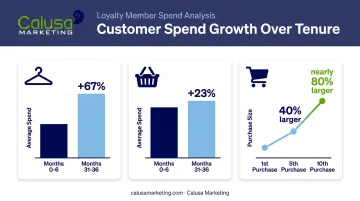
Bain and Mainspring's research on online shoppers found some striking patterns:
- Repeat apparel customers spent 67% more in months 31-36 of the relationship than in months 0-6
- Repeat grocery customers spent 23% more over that same window
- The average apparel customer's fifth purchase was 40% larger than their first, and the tenth was nearly 80% larger
This benefit matters most if you run a subscription model, recurring purchase cycle, or tiered/premium offering, where small increases in average order value compound fast across a customer base.
KPIs impacted: CLV, average order value, purchase frequency
Lower Customer Acquisition Costs and Organic Referrals
Loyal customers become unpaid advocates. They tell friends, post reviews, and bring in new business without a marketing spend attached.
That matters because acquisition is expensive and getting more so. The same HBR analysis found that acquiring a new customer can cost 5 to 25 times more than retaining an existing one, depending on the study and industry.
Word-of-mouth carries weight that paid ads simply can't match. According to Nielsen's Trust in Advertising research, 88% of global consumers trust recommendations from people they know more than any other advertising channel.
KPIs impacted: CAC, referral rate, marketing ROI
Resilience and Competitive Insulation
Loyal customers give you the benefit of the doubt. A price increase, a shipping delay, or a service hiccup won't automatically send them to a competitor.
That patience is real, but it isn't infinite. PwC's global consumer survey found stark limits to that goodwill:
- 32% of consumers worldwide would stop doing business with a brand they loved after just one bad experience
- 49% in Latin America said the same
- 17% of U.S. consumers would leave after one bad experience, rising to 59% after several
Price still matters too: 79% of U.S. respondents said they might switch for a better price, and 52% might switch for better product quality. Loyalty raises the threshold for switching. It doesn't eliminate it.
KPIs impacted: share of wallet, price elasticity, complaint resolution rate
What Happens When Brand Loyalty Is Missing or Ignored
Skip building loyalty, and the gaps show up fast:
- Higher churn, forcing constant reliance on discounting just to keep customers around
- Rising acquisition costs as you compete purely on price instead of preference
- Unpredictable revenue, making forecasting and planning genuinely difficult
- Vulnerability to competitor promotions and broader market disruptions
- Missed referral growth, leaving organic word-of-mouth on the table
BCG's research on loyalty economics offers a warning here: excessive discounting trains customers to buy based on price, not brand affinity, and price-based rewards are easy for competitors to copy. There's no loyalty margin left to protect.
How to Build and Get the Most Value from Brand Loyalty
Brand loyalty compounds when it's built through consistency and structured recognition, not one-off discount codes.
Start With Consistency
Every touchpoint matters: product quality, service response times, communication tone. Inconsistency at any one of these erodes trust faster than a single great experience builds it. This is the foundation loyalty is built on. Skip it, and no rewards program will fix the gap.
Add Structure With Loyalty and Incentive Programs
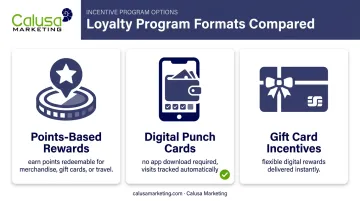
Once consistency is in place, structured programs give customers a tangible reason to stay engaged. Common formats include:
- Points-based rewards — customers earn points on purchases, redeemable across a catalog of merchandise, gift cards, or travel
- Digital punch cards — a smartphone-wallet card (no app download) that tracks visits and triggers rewards after a set number of purchases
- Gift card incentives — flexible digital rewards customers can use where they already shop
This is where platforms like Calusa Marketing's cloud-based SaaS loyalty and incentive solutions come in. Programs launch without app downloads or IT integration, which matters if your team doesn't have the bandwidth for a lengthy technical rollout.
Clients across HVAC distribution, retail, and media have used points-based and digital punch card formats to reward repeat purchases and account growth without adding to their internal operational load.
Track and Refine
A loyalty program isn't a set-it-and-forget-it investment. Set up regular reviews of retention rate, NPS, and CLV.
A program that looked strong at launch can quietly lose effectiveness if rewards don't evolve with customer behavior. McKinsey's research found that roughly two-thirds of established loyalty programs fail to deliver value over time, often because nobody revisited the reward structure.
Review the data. Adjust before it stalls.
Conclusion
The benefits of brand loyalty—higher retention, greater CLV, lower CAC, and resilience against competitors—don't show up overnight. They compound when built intentionally, through consistent experience and structured recognition rather than a single campaign.
Treat brand loyalty as an ongoing practice rather than a project with an end date. Partnering with an experienced incentive marketing provider like Calusa Marketing can help you launch and manage a loyalty program faster, without adding operational weight to your existing team.
Frequently Asked Questions
What are the benefits of brand loyalty?
Brand loyalty drives higher customer retention, increased lifetime value, and lower acquisition costs through referrals. It also builds resilience against competitor discounting and market disruption.
What are the 5 advantages of branding?
Strong branding creates differentiation, builds trust, supports premium pricing power, encourages customer advocacy, and stabilizes long-term revenue. Each of these fuels the emotional preference that becomes brand loyalty.
How is brand loyalty different from customer loyalty?
Customer loyalty is often transactional, driven by convenience, habit, or discounts. Brand loyalty is emotional and preference-based, meaning customers choose you even when a cheaper or more convenient option exists.
How do you measure brand loyalty?
Common metrics include retention rate, Net Promoter Score (NPS), customer lifetime value (CLV), and repeat purchase rate. No single metric tells the full story, so track them together.
How long does it take to build brand loyalty?
There's no universal timeline. It builds through repeated positive experiences over months or years, and the pace varies by industry, purchase frequency, and how consistent your service stays.
Do loyalty programs actually increase brand loyalty?
Well-designed programs reinforce loyalty when paired with consistent quality and service. Personalization and real value deepen relationships more than generic discounts, which only buy short-term behavior.