Only 20% of employees worldwide were engaged in 2025, according to Gallup's State of the Global Workplace report, which surveyed more than 141,000 adults across 140+ countries. The rest are either checked out or actively working against their employer's goals.
Employee engagement isn't the same as job satisfaction. A satisfied employee is content. An engaged employee feels an emotional and psychological investment in their work, one that shows up in extra effort, better ideas, and a genuine stake in outcomes.
This guide covers why engagement matters to your bottom line, the four pillars behind it, proven strategies you can start using this quarter, and how to actually measure whether any of it is working.
Key Takeaways
- Top-quartile engagement teams post 23% higher profitability than bottom-quartile teams.
- Engagement consistently comes down to four pillars: purpose, growth, recognition, and connection.
- Structured recognition programs deliver fast, measurable engagement gains at low cost.
- Sustaining engagement requires ongoing measurement and manager involvement, not a once-a-year survey.
Why Employee Engagement Matters in the Workplace
Engagement isn't a soft HR metric. It shows up directly in financial performance, retention costs, customer outcomes, and productivity.
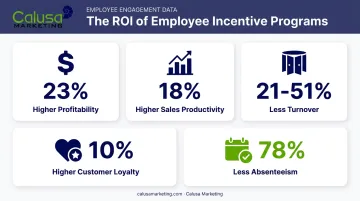
The financial case is hard to ignore. Organizations with top-quartile engagement scores see 23% higher profitability than those in the bottom quartile, plus 18% higher sales productivity and 14% higher productivity based on production and evaluation records.
Turnover tells a similar story. High-engagement teams experience 21% less turnover in high-turnover industries and 51% less turnover in low-turnover industries.
That gap matters because replacing a single employee typically costs between half and two times their annual salary. Gallup has pegged the total cost of voluntary turnover to U.S. businesses at roughly $1 trillion a year.
Engagement also reaches customers before they ever realize it:
- Top-quartile engagement teams achieve 10% higher customer loyalty scores than bottom-quartile teams
- Engaged employees create measurably better service interactions, according to Harvard Business Review research
- Absenteeism drops by 78% on high-engagement teams compared to disengaged ones
None of this is a niche problem. Globally, 80% of employees fall outside the "engaged" category — 64% not engaged, 16% actively disengaged. That's the baseline most companies are starting from, and it's exactly why engagement deserves a real strategy rather than an annual checkbox.
The 4 Pillars of Employee Engagement
Different consultancies use different language, but the underlying research tends to converge on the same four areas. Gallup's Q12 framework, one of the most widely used employee engagement models, maps closely to these pillars.
Purpose
Employees need to see a clear line between their daily tasks and the organization's mission. Gallup's Q12 captures this directly: does the company's purpose make an employee feel their job matters? Without that connection, work becomes transactional rather than meaningful.
Growth & Development
Ongoing learning and visible career pathing keep people invested for the long haul. Q12 items ask whether someone at work encourages development and whether progress has been discussed in the last six months. It also asks whether the employee has had chances to learn and grow in the past year. Skip these conversations, and top performers start job hunting.
Recognition & Reward
Consistent appreciation reinforces the behaviors a company actually wants more of. Gallup's model asks a simple but telling question: has this person received recognition or praise in the last seven days? Most companies fail that test badly, leaving employees feeling invisible despite solid performance.
Connection & Trust
People stay where they feel like they belong. That means a supervisor who cares about them as a person, a workplace where their opinions count, and ideally a genuine friendship or two. This pillar is the glue that holds the other three together.
Proven Strategies to Improve Employee Engagement in the Workplace
These are the highest-impact levers available, spanning communication, recognition, growth, leadership, and wellbeing. None require a massive budget to start.
Improve Communication and Employee Voice
Trust and communication are directly linked. Employees who are given honest opportunities to weigh in on organizational changes are 7.4 times more likely to trust leadership, according to Gallup research.
That transparency needs to extend to how employee input gets used, too. Deloitte found that only 37% of employees feel confident their organization uses workforce data responsibly, and that confidence drives 35% higher trust in leadership.
Build the loop with:
- Short, frequent pulse surveys instead of one annual behemoth
- Quarterly town halls where leadership answers real questions
- Regular one-on-ones where managers actually listen, not just report status
Recognize and Reward Employees Consistently
Recognition might be the single fastest engagement lever available. Employees who received high-quality recognition in 2022 were 45% less likely to have left their organization by 2024, per longitudinal Gallup and Workhuman research.
Most companies want to recognize employees; the real struggle is operationalizing it at scale. Manual shout-outs and occasional gift cards don't scale past a handful of employees, and inconsistency undermines the whole effort.
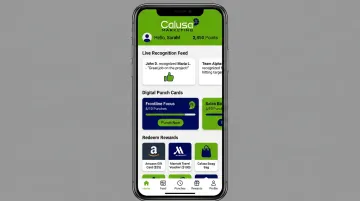
This is where a structured platform helps. Companies like Calusa Marketing provide cloud-based SaaS reward platforms, digital punch cards, gift cards, and travel incentives that let organizations launch a recognition program without app downloads or IT integration.
Clients such as Alorica and Inktel have used platforms like this to build recognition around agent recruitment, retention, and KPI achievement, giving frontline teams a consistent, visible way to be rewarded.
Recognition works best when it's specific:
- Tie it to a defined company value ("this reflects our commitment to reliability")
- Attach it to an actual achievement, not a generic "great job"
- Make it timely, ideally within days of the accomplishment, not months later
Invest in Growth, Development, and Career Pathing
Career stagnation is one of the top reasons people quit. In McKinsey research, 41% of employees cited lack of career development and advancement as the top reason they left their previous job.
Think of career paths as a lattice, not a ladder. Lateral moves, cross-functional projects, and stretch assignments often engage people more than a straight climb upward.
Build that lattice with:
- Cross-functional projects that expose employees to new teams and skills
- Mentoring programs pairing junior staff with experienced leaders
- Targeted upskilling tied to roles employees actually want next
Address these together, and you've closed one of the biggest flight risks in your workforce.
Strengthen Manager Effectiveness and Trust
Direct managers carry more engagement influence than any other single factor. Gallup estimates that managers account for at least 70% of the variance in employee engagement scores across business units. That means engagement strategy is really manager strategy.
Invest in:
- Coaching skills, not just performance review mechanics
- Feedback delivery that's specific and frequent
- Training that builds psychological safety on teams, not just compliance awareness
Support Employee Wellbeing, Flexibility, and Work-Life Balance
Burnout and disengagement feed each other. The World Health Organization estimates that depression and anxiety cause 12 billion lost working days annually, costing the global economy roughly $1 trillion per year in lost productivity.
Practical wellbeing initiatives don't need to be elaborate:
- Flexible scheduling or hybrid options where the role allows it
- Employee assistance programs (EAPs) that are actually promoted, not buried in a handbook
- Wellness benefits tied to real usage incentives, not just a line item in open enrollment
How to Measure Employee Engagement
You can't improve what you don't track, and engagement measurement works best as a blend of numbers and narrative.
Quantitative metrics worth tracking:
| Metric | What It Tells You |
|---|---|
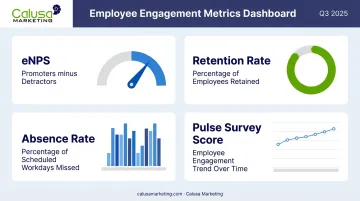
| eNPS (0-10 scale) | Percentage of promoters minus detractors; a quick temperature check |
| Retention rate | Employees who stayed the full period ÷ employees at period start |
| Absence rate | Full-time employees missing scheduled work due to illness or other reasons |
| Annual/pulse survey scores | Deeper engagement drivers across pillars like purpose and trust |
eNPS is useful but limited. Qualtrics and CIPD research both caution that it's too simple on its own and shouldn't replace a fuller engagement measure like Gallup's Q12.
Numbers only tell half the story. Pair them with:
- Collect open-ended survey comments
- Hold listening sessions or focus groups
- Monitor message-board or intranet sentiment
Then close the loop. Share what you heard and what you're doing about it. Skipping this step is the single fastest way to kill trust in your next survey cycle.
Common Mistakes That Undermine Employee Engagement Efforts
Even well-intentioned engagement programs fail for predictable reasons.
Treating engagement as a one-time initiative. An annual survey followed by silence isn't a strategy. Engagement needs to be a standing leadership priority, reviewed regularly like revenue or safety metrics.
That disconnect often carries into the next mistake: the action gap. According to Qualtrics research on survey fatigue, 92% of employees say it's important that their company listens to feedback. Only 7% believe their company acts on it well. Employees who believe feedback gets acted on report more than double the engagement of those who don't.
The pattern repeats with recognition: generic, infrequent recognition. A companywide email once a quarter doesn't feel personal, and employees know the difference. Structured, consistent reward programs solve this by making recognition frequent and specific rather than occasional and vague.
Frequently Asked Questions
What is the best way to improve employee engagement?
Consistent recognition, clear two-way communication, growth opportunities, and strong manager relationships combined produce the fastest, most durable improvements. No single tactic works in isolation.
What are the 4 pillars of employee engagement?
Most frameworks converge on Purpose, Growth & Development, Recognition & Reward, and Connection & Trust. Together, they cover why employees stay, grow, feel valued, and feel like they belong.
How do you measure employee engagement effectively?
Combine pulse surveys, eNPS, retention and absenteeism tracking, and qualitative listening sessions like focus groups. Numbers show the "what," while open feedback explains the "why."
How quickly can employee engagement improve after implementing new initiatives?
Visible wins like public recognition or acting on recent feedback can shift sentiment within weeks. Deeper cultural change around trust and manager relationships typically takes several months.
Does employee recognition actually reduce turnover?
Yes. Employees who feel consistently recognized are far more likely to stay with their employer long-term. Structured incentive programs, such as Calusa Marketing's reward platforms, help companies deliver that recognition consistently instead of leaving it to chance.
What's the difference between employee engagement and employee satisfaction?
Satisfaction reflects passive contentment with a job. Engagement reflects active emotional commitment and the discretionary effort employees choose to put in beyond their basic requirements.