Here's the harder truth: throwing more money at the problem rarely fixes it. Pay bumps and perks buy short-term goodwill, not loyalty. Real loyalty is built differently, and in 2026 it's built under different conditions than it was even three years ago.
AI is reshaping job descriptions mid-career. Hybrid work has changed how (and whether) people bond with coworkers. Four generations now share the same Slack channels with wildly different expectations of what "a good job" looks like. Building loyalty this year takes more intention, not less.
This article covers three simple, low-cost ways to build lasting employee loyalty in 2026, plus a bonus tip on structuring incentive programs so they actually work.
Key Takeaways
- Employee loyalty is emotional commitment built on trust and growth, not tenure or a paycheck
- Development, recognition, and honest communication are 2026's top loyalty levers
- Structured, tech-enabled recognition beats ad hoc gestures like occasional shoutouts
- Tracking eNPS and attrition rate shows whether your efforts are working
What Is Employee Loyalty in 2026?
Employee loyalty is the emotional commitment an employee feels toward an organization's mission and future. It's the belief that staying is worth it because the company has earned their trust, not simply because leaving feels inconvenient.
That's different from engagement, which measures how connected someone feels to their daily tasks. An employee can be highly engaged with their current project and still be updating their résumé. Loyalty is longer-term and harder to fake.
Why 2026 Changes the Equation
Three shifts are rewriting what loyalty requires:
- AI-driven role changes: employees whose tasks are being automated or restructured need reassurance about where they fit next
- Hybrid and remote norms: fewer hallway conversations mean fewer organic moments of connection and recognition
- Multigenerational teams: Gen Z, Millennials, Gen X, and Boomers often define "feeling valued" in different ways
With 13% of the workforce walking out the door annually, and replacement costs running high for every role level, the stakes for getting this right are only growing.
3 Simple Ways to Build Employee Loyalty in 2026
None of these require a massive budget or a six-month rollout. They require consistency, and a willingness to make loyalty a system rather than an occasional gesture.
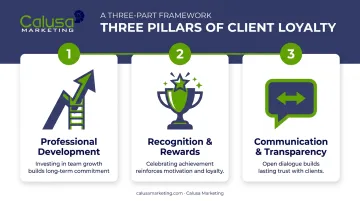
Way 1: Invest in Professional Development and Growth Paths
Lack of growth is still the top reason people quit. McKinsey research found that 41% of workers cited insufficient career development and advancement as the main reason they left their previous job.
That's a stagnation problem more than a compensation one.
Low-cost ways to fix it:
- Pair senior and junior staff in structured mentorship programs
- Offer free or low-cost online courses for reskilling in AI-adjacent or industry-specific skills
- Run quarterly "career conversations" separate from performance reviews, focused purely on where someone wants to go
- Tie tuition reimbursement or certification support directly to internal promotion criteria
A distribution company offering tuition reimbursement tied to a clear promotion path sends a very different message than one offering it as a generic benefit nobody uses. Visible internal promotion matters too. When employees see coworkers get promoted from within, growth stops being theoretical.
Way 2: Recognize and Reward Contributions Consistently
Generic gift cards and occasional shoutouts don't move the needle the way most managers assume. Gallup followed nearly 3,500 employees from 2022 to 2024 and found that well-recognized employees were 45% less likely to have changed employers two years later.
The same research found employees who received recognition meeting at least four quality pillars were nine times more likely to be engaged than those who received none.
Ad hoc recognition often falls flat because it's inconsistent and impersonal. A structured system fixes this by making recognition predictable and letting people choose rewards that actually mean something to them.
Many companies outsource this to specialized platforms. Calusa Marketing, for example, builds SaaS-based reward platforms that let companies operationalize recognition without adding to HR's plate:
- Digital punch cards let managers reward small wins frequently and instantly
- The ANY-Card gift card system gives employees choice instead of a one-size-fits-all card nobody wants
- No app download is required, which matters for frontline and deskless teams
A structured platform also builds milestone recognition into the process itself, rather than relying on a manager to remember a five-year anniversary. That consistency is what tells employees their tenure and effort are actually noticed, not just assumed.
Way 3: Improve Workplace Communication and Transparency
Poor manager communication is one of the most common, and most preventable, reasons people leave. Unclear expectations and leadership that feels distant or uninterested erode trust faster than almost anything else.
Practical fixes that don't require new headcount:
- Share direction and decisions through company newsletters or monthly town halls
- Run quarterly pulse surveys to catch problems before exit interviews do
- Build camaraderie with cross-department meetups or team messaging channels
- Close the loop by telling employees what changed because of their input, and being honest about what didn't and why
That last point matters more than most leaders realize. A survey nobody hears back about teaches employees that their voice doesn't count, which is worse than not asking at all.
Transparent communication also builds psychological safety, which hybrid and remote teams need more of, not less. When people can't read a room in person, clear and consistent communication becomes the substitute for the trust that used to build itself organically over coffee.
Bonus Tip: Build a Structured Incentive and Recognition Program
A manager's occasional thank-you email and an HR spreadsheet tracking anniversaries rarely add up to a program. They're scattered efforts that depend on someone remembering to act. A centralized, structured program removes that dependency entirely.
This is the space Calusa Marketing operates in, building full-service recognition and reward programs for companies that don't want to manage the logistics themselves. The company has managed 1,000+ incentive programs for over 500,000 members, maintaining a 99% client retention rate.
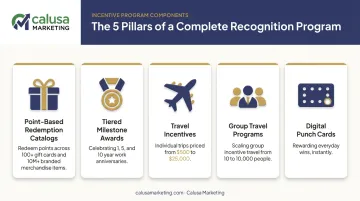
A well-built program typically includes:
- Point-based redemption catalogs so employees choose rewards that matter to them
- Tiered service and milestone awards for 1-year, 5-year, and 10-year anniversaries
- Travel incentives for top performers, from hotel and cruise certificates to high-end individual trips priced between $500 and $25,000
- Group travel programs scaled for anywhere from 10 to 10,000 people
- Digital punch cards for frequent, low-friction recognition of everyday wins
The bigger operational win is what companies stop doing. Outsourcing fulfillment and customer support means HR isn't managing gift card inventory, chasing travel bookings, or fielding reward questions. That frees the team to focus on strategy instead of logistics.
Common Frameworks for Measuring and Building Employee Loyalty
There's no single agreed-upon model for employee loyalty, and any source claiming otherwise is oversimplifying. Two frameworks show up often enough to be worth knowing, as long as you understand they vary by source.
Perceptyx's 5 C's framework breaks loyalty into:
- Compensation: competitive pay that supports retention
- Career Development: visible investment in growth
- Culture: an inclusive, sustaining environment
- Communication: open, transparent information sharing
- Connection: genuine team relationships and belonging
Phenom's 3 R's framework simplifies things further:
- Respect: treating employees as valued contributors
- Recognition: acknowledging achievements as they happen
- Rewards: providing meaningful returns for contributions
Frameworks are only useful if you measure against them. Two metrics do that well:
| Metric | Formula | What It Tells You |
|---|---|---|
| eNPS | % Promoters − % Detractors | How likely employees are to recommend your company as a place to work |
| Turnover Rate | (Separations ÷ Average Headcount) × 100 | How many employees are actually leaving over a given period |
Pick a framework, track both metrics quarterly, and adjust. Loyalty efforts that aren't measured tend to fade into good intentions.
Frequently Asked Questions
What are common frameworks for building employee loyalty, like the 5 C's and 3 R's?
These frameworks organize loyalty-building into memorable categories, such as compensation, culture, career, communication, and connection, or respect, recognition, and rewards. Definitions vary by source, so check the section above for specifics.
What is the 3-month rule in a job?
It typically refers to the initial 90-day period many employers use as a probationary or evaluation window. Both employer and new hire assess fit during this time before deeper commitment on either side.
What are 5 qualities of a good employee?
Reliability, teamwork, leadership, strong communication, and integrity consistently top the list. These are also the traits most loyalty-building efforts are designed to retain.
How is employee loyalty different from employee engagement?
Engagement measures connection to daily work and tasks. Loyalty measures long-term emotional commitment to the organization itself, even when a specific project isn't exciting.
How much does losing an employee actually cost a business?
Gallup estimates replacement costs at roughly 40% of annual salary for frontline roles, 80% for technical professionals, and up to 200% for managers and leaders. The more skilled the role, the steeper the cost.
What's the fastest way to improve employee loyalty on a limited budget?
Start with personalized verbal recognition, transparent communication about company decisions, and a small-scale reward pilot. Scale into a formal program once you see what resonates.