Sales leaders feel this pressure daily: close faster, without cutting corners on relationship quality. Many assume the fix is simple: buy more software. It isn't. Real sales acceleration blends technology, process discipline, and human motivation.
This article covers what a sales acceleration program actually is, the three pillars behind one that works, best practices for building it, tools worth evaluating, and how to measure whether it's paying off.
Key Takeaways
- Sales acceleration blends technology, process, and people strategies for faster, more predictable deals
- Automation and data only work when paired with coaching and incentive-based motivation
- Tracking sales velocity, win rate, and deal size lets leaders refine strategy continuously
- Partnering with incentive design specialists amplifies results without adding operational strain
What Is a Sales Acceleration Program?
A sales acceleration program is the combined use of tools, tactics, and strategies that help sales teams move prospects through the pipeline faster while improving conversion rates and revenue predictability. It functions as a coordinated system, not a single tactic.
How It Differs From Sales Enablement
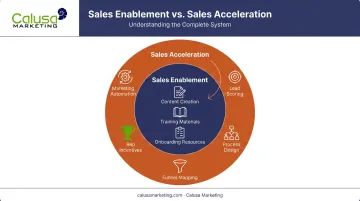
Sales enablement (content, training, onboarding materials) is one piece of the puzzle. Acceleration is bigger. It also includes:
- Marketing automation and lead scoring
- Process design and funnel mapping
- Rep motivation and incentive structures
Think of enablement as equipping reps with the right tools. Acceleration is making sure the entire system, from lead capture to closed deal, runs without friction.
Why It Matters Right Now
Buying committees keep growing. Forrester's 2026 State of Business Buying research found that a typical B2B purchase now involves 13 internal stakeholders and 9 external influencers, and that number climbs further for complex or strategic purchases. More people in the room means more opinions, more approval steps, and more chances for a deal to stall.
That's exactly why acceleration can't rely on tools alone. Aligning technology, process, and people is the only way to keep a 13-person buying committee moving instead of stuck in review.
Industry context matters here. Traditional sectors like distribution, media, home improvement, and retail often lean harder on rep motivation and incentive structures than on pure automation.
A SaaS company might live and die by its lead-scoring model. A regional HVAC distributor or media sales team, however, is more likely to see results from a well-designed contest or President's Club trip than from another software integration.
The 3 Pillars of a High-Performing Sales Acceleration Strategy
No single lever moves a stalled pipeline. Three pillars work together, and weakness in any one undermines the others.
Technology: Automating Tasks and Surfacing Insights
Automation and AI-driven lead scoring cut down on manual busywork, letting reps spend time on opportunities most likely to close. CRM systems centralize activity so nothing falls through the cracks between touchpoints.
Beyond core CRM functions, two categories matter most:
- Conversation intelligence: surfaces buyer signals and objections from call recordings
- Sales engagement platforms: sequence outreach and flag when a prospect goes cold
- Pipeline analytics tools: flag stalled deals before they slip through the cracks
We'll cover specific tool categories in more depth later in this article.
Process: Creating Consistency and Removing Bottlenecks
Clear lead qualification criteria and defined routing rules eliminate the guessing game between marketing and sales. Without them, good leads sit untouched while reps chase the wrong ones.
Mapping the sales funnel end-to-end shows exactly where deals stall: a slow first response, a missing follow-up cadence, or an approval bottleneck on the buyer's side. Fix what the data shows, not what you assume.
People: Motivation, Coaching, and Incentives
Even the best CRM fails if reps aren't skilled or motivated to use it well. Coaching, structured onboarding, and continuous feedback loops directly affect ramp time and ongoing performance.
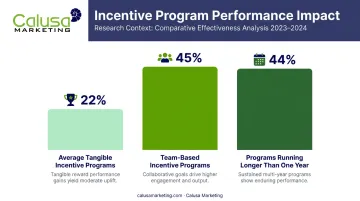
Incentives matter more than many sales leaders assume. A meta-analysis of 45 scientific studies, sponsored by the Incentive Research Foundation, found that properly designed tangible incentive programs increased work performance by an average of 22%. Team-based incentives delivered as much as 45%, and programs running longer than a year sustained 44% gains. That's a meaningful, lasting effect, not a short-lived bump.
This is where structured recognition matters:
- Run sales contests with tiered prizes
- Attach spiffs to short-term goals
- Send top performers on travel rewards
- Distribute gift cards for quick-turnaround incentives
Calusa Marketing works specifically in this space, designing incentive and reward programs from gift card spiffs to President's Club travel. These programs support the people pillar without adding operational weight to a sales team already stretched thin.
Best Practices for Building & Running a Sales Acceleration Program
Building a program that actually works takes sequencing. Buying tools before you have a plan tends to waste budget.
- Define measurable goals first — shorter cycle time, higher win rate, better forecast accuracy — before evaluating a single vendor
- Map your current process end-to-end to find bottlenecks and misalignment between marketing and sales before layering on new tech
- Align sales, marketing, and customer success around shared data and consistent messaging, so buyers never get conflicting information
- Invest in continuous coaching, not one-time onboarding — use real call and deal data to reinforce what actually works
- Build a layered incentive program beyond straight commission
That last point deserves more detail. A single commission structure rarely sustains motivation on its own. Layering in tiered rewards gives reps something to work toward at every level:
- Digital gift cards for quick, short-term wins
- Fully transferable travel certificates tied to quarterly performance
- Group President's Club trips for top annual producers
Programs like these, offered through providers such as Calusa Marketing, can typically be deployed without app downloads or heavy internal IT lift, which matters when sales ops teams are already stretched.
Finally, set a regular review cadence. Quarterly is a reasonable starting point. Look at what's actually driving results, in both your tech stack and your incentive structure, and adjust rather than assuming last year's setup still fits.
Essential Sales Acceleration Tools by Category
Tools matter, but they're not the whole story. Here's how to think about the core categories:
| Category | Purpose | Example |
|---|---|---|
| CRM & automation | Centralizes pipeline data, automates routine tasks | Salesforce |
| Conversation/revenue intelligence | Surfaces buyer signals from calls and emails | Gong |
| Sales engagement/prospecting | Sequences outreach, manages follow-up cadence | Outreach |
When evaluating any tool, weigh these factors:
- Data security and compliance: non-negotiable for regulated industries handling sensitive customer records
- Data quality — garbage in, garbage out applies to lead scoring too
- Customization — does it fit your process, or force you into someone else's?
- Scalability: will it hold up at twice your current volume, or buckle under the load?
None of this replaces the people-and-incentive layer covered earlier. Tools support reps. They don't replace the motivation that keeps a rep pushing through a long quarter.
How to Measure the Success of Your Sales Acceleration Program
Track these four metrics consistently:
- Sales velocity: how fast deals move through the pipeline overall
- Win/conversion rate: the percentage of opportunities that close
- Average deal size: whether deal value is growing or shrinking
- Sales cycle length: how long it takes from first touch to close
One framework has shaped how sales teams track these metrics for years. Mark Roberge's influential 2015 book, The Sales Acceleration Formula, built its framework around hiring, training, management, and demand generation using data and technology. The mathematical formula many teams use today to track velocity comes from Salesforce's velocity formula:
Sales velocity = (number of opportunities × average deal value × win rate) ÷ sales cycle length
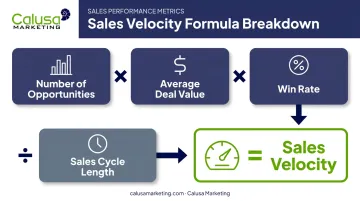
Run this calculation quarterly, and you'll see whether your acceleration efforts are actually moving the needle or just creating activity. Pair the number with qualitative rep feedback: ask what's frustrating reps and what's actually working. Use both inputs to refine your tech stack and incentive structure, focusing on what's real, not just what's on a dashboard.
Frequently Asked Questions
What is a sales accelerator program?
It's the combined use of tools, processes, and people-focused tactics that help sales teams move prospects through the pipeline faster and close more deals. It touches technology, workflow design, and rep motivation together.
What is the 30-60-90 rule in sales?
It's a structured ramp plan for new hires, broken into three 30-day phases: learning the company and product, then contributing and applying that knowledge, then operating independently with full ownership.
What is the 3-3-3 rule in sales?
There's no single agreed-upon definition. One common version means researching a prospect for 3 minutes, finding 3 relevant insights, and building a 3-sentence outreach message. Another refers to contacting a prospect 3 times across 3 channels with 3 different messages.
How is sales acceleration different from sales enablement?
Enablement (content, training, materials) is one component within the broader acceleration strategy. Acceleration also includes automation, process design, and incentive-driven motivation working together.
How long does it take to see results from a sales acceleration program?
Most teams see measurable improvement within one to two quarters, depending on process complexity and how quickly reps adopt new tools and incentive structures.
Can incentive and rewards programs really accelerate sales performance?
Yes. Incentive programs deliver measurable performance gains, particularly with team-based structures and programs sustained over a full year rather than short one-off contests. Well-designed incentives increase engagement in ways commission alone often doesn't.