Introduction
Loyalty programs used to be simple: swipe a card, earn a point, repeat. That model is fading fast.
Today's customers expect their favorite brands to entertain them, not just track their purchases. Many programs still fall flat — engagement stalls, redemption rates stay low, and members sign up once and never come back.
This article breaks down what actually works. We'll cover the measurable impact of gamification, the mechanics that drive real results, and examples from both consumer and B2B brands, plus a practical roadmap for implementation.
Along the way, we'll draw on Calusa Marketing's 75+ years of combined incentive program experience to connect the theory to real client programs.
Key Takeaways
- Gamification lifts app engagement by up to 60% and boosts purchase frequency 6x in documented cases
- Six core mechanics (points, tiers, challenges, badges, leaderboards, and chance-based rewards) each tap a distinct psychological motivator
- Programs succeed when built around clear business goals, not novelty for its own sake
- Distributors, media companies, and retailers alike use gamified tactics to cut churn and grow lifetime value
- A well-chosen technology partner removes the technical burden of launching a gamified program
What Is Gamification in Customer Loyalty Strategies?
Gamification means applying game-design elements (points, competition, achievement, chance) to a business context that isn't naturally a game, with the goal of shaping customer behavior.
A traditional loyalty program is transactional: buy something, earn a point, redeem it later. A gamified program adds layers of progress, recognition, and social interaction on top of that basic exchange.
| Program Type | How It Works |
|---|---|
| Static programs | Track purchases and offer a discount at a threshold |
| Gamified programs | Add visible milestones, badges, rankings, and surprise rewards that make the process feel like play |
The format has evolved through three distinct stages:
- Paper and digital punch cards: buy nine, get the tenth free
- App-based point systems: points, tiers, and basic rewards catalogs
- Personalized, AI-driven experiences: missions and rewards tailored to individual purchase history and behavior
Each stage added more engagement value without abandoning the core mechanic of "do something, get something."
The Impact of Gamification on Customer Loyalty: Why It Works
The Psychology Behind the Play
Gamification works because it satisfies basic psychological needs. Self-determination theory, developed by researchers Ryan and Deci, identifies autonomy, competence, and relatedness as core drivers of intrinsic motivation.
A well-designed badge or tier system gives members a sense of competence (visible progress), autonomy (choice in how they earn rewards), and relatedness (social recognition among peers). That combination creates habit-forming engagement loops that a plain points ledger simply can't replicate.
One caution: research on loyalty rewards shows that overly rigid, controlling mechanics (strict deadlines, forced requirements) can reduce intrinsic motivation. The mechanic needs to feel like a game, not an obligation.
Where Gamification Moves the Needle
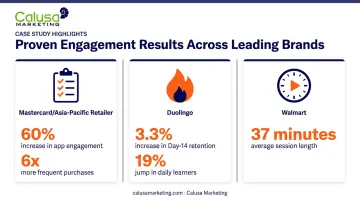
The numbers back up the theory. Mastercard's analysis of an Asia-Pacific retailer found that adding a gamified mission board with personalized challenges drove a 60% increase in app engagement during the first 12 months, with game participants purchasing 6x more frequently than nonparticipants.
Retention gains show up in subscription contexts too. Duolingo's internal A/B test changed its streak mechanic, letting one completed lesson extend a streak instead of requiring a strict daily XP goal. The result: a 3.3% increase in Day-14 retention and a 19% jump in new daily learners who maintained a streak.
That same Mastercard case included Walmart's branded interactive miniseries, which held shoppers for an average of 37 minutes per session. That figure shows gamified experiences can hold attention even in categories where every brand competes for the same few seconds of a customer's day.
Badges and leaderboards add one more benefit: they're shareable. When a member unlocks a milestone and posts it, that's free word-of-mouth marketing your competitors don't get from a standard punch card.
Core Gamification Mechanics Driving Loyalty Program Success
Not every mechanic fits every audience. Here's how the most common ones function and where they add value.
Points, Tiers & Milestone Challenges
Points systems work because progress is visible. Members can see exactly how close they are to the next tier, which keeps them coming back to close the gap. Time-bound challenges, like leaving a review, referring a friend, or buying from a new category, nudge customers toward specific business goals while feeling like a game rather than a chore.
- Creates a long-term reason to stay engaged, not just a one-time transaction incentive
- Tiers add status: "Gold" or "Platinum" members feel recognized, not just rewarded
- Referral missions grow the customer base organically
- Cross-category challenges increase basket size without discounting
Social Recognition & Chance-Based Rewards
Visible achievements and competitive rankings tap into status-seeking behavior. Members don't just want the reward; they want to be seen earning it. Spin-to-win wheels and scratch cards tap a different instinct: instant gratification. Industry vendor data has suggested conversion improvements well above typical popup benchmarks, though the methodology behind those figures isn't always disclosed, so treat vendor-reported lift numbers as directional rather than universal.
- Leaderboards work particularly well in competitive customer bases (sales contests, fitness apps, gaming communities)
- Badges give members something to display and share, extending brand reach organically
- Chance-based rewards suit one-time engagement spikes: sign-ups, seasonal promotions, app downloads
- Should complement, not replace, an ongoing points or tier structure
Digital Punch Cards & Milestone Rewards
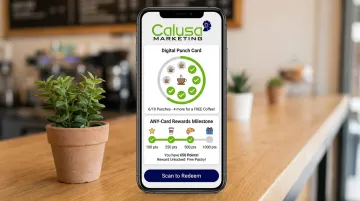
For businesses that want gamification without the complexity, the digital punch card remains one of the lowest-lift, highest-familiarity mechanics available. Customers already understand "buy nine, get the tenth free"; digitizing it just removes the paper and adds tracking.
Calusa Marketing's digital punch card and ANY-Card reward solutions give small and mid-sized businesses, distributors, and retailers a gamified milestone structure without building custom software. It's an accessible entry point for brands that want the psychology of progress without a multi-month build.
Real-World Examples: Brands Winning with Gamified Loyalty
KFC's Rewards Arcade replaced a slow, stamp-based loyalty club with instant-win arcade games tied to purchases. According to loyalty technology provider Antavo, the relaunch drove 26% more weekly active app customers and a meaningful jump in tokenized transactions. The results prove that swapping a static punch-card model for instant gratification can reignite a stalled program.
Media and subscription brands lean on a different set of mechanics. The New York Times treats its Games division (Wordle, Connections, and similar puzzles) as part of an "essential subscription" strategy designed to build daily habits that feed paid relationships. Duolingo's streak mechanic serves the same function: give users a reason to open the app every single day.
This is directly relevant to publishers and broadcasters. Companies in Calusa Marketing's client base (including media and broadcasting organizations) face the same daily-attention challenge as any streaming app or news outlet: give the audience a reason to return today, not just this month.
B2B and distribution-focused companies gamify differently, but the psychology is identical. Points-based sales contests and leaderboards motivate channel partners the same way badges motivate consumers, through visible progress and competitive status.
Distributors across electrical, HVAC, and tire categories (verticals Calusa Marketing regularly serves) use these mechanics to keep dealer networks engaged between sales cycles, not just at the point of a single transaction.
The common thread across every example comes down to three rules:
- Match the mechanic to the motivation: arcade games satisfy consumers chasing instant rewards, streaks build daily habits, and leaderboards drive competitive dealers.
- Tie the reward to real outcomes: a leaderboard means nothing if the prize isn't worth chasing.
- Design for repeat engagement: daily puzzles and streak mechanics work because they give users a reason to return, not just a one-time incentive.
How to Implement Gamification Into Your Loyalty Strategy
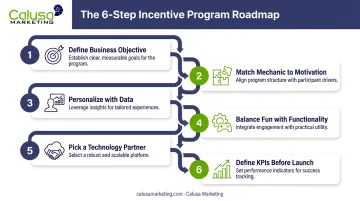
Getting gamification right requires sequencing six decisions in the right order, from defining the objective to tracking the right KPIs after launch.
- Start with a business objective. Increase purchase frequency, boost referrals, or reduce churn, then pick one and design backward from it.
- Match the mechanic to the motivation type. Competitive customers respond to leaderboards; achievement-driven ones respond to badges and tiers; collectors respond to points and punch cards.
- Personalize with existing data. Challenges built around a customer's actual purchase history complete at higher rates than generic ones.
- Balance fun with functionality. Keep the mechanic intuitive, and make sure the reward carries real, tangible value that customers can actually redeem.
- Pick a technology partner that removes friction. Calusa Marketing's cloud-based SaaS reward platform requires no integration and no app download, with white-glove fulfillment and 7-day customer support built in — a practical way to launch without a lengthy IT project.
- Define KPIs before launch. Track engagement rate, redemption rate, repeat purchase rate, and customer lifetime value, then iterate based on what the data shows.
The businesses that get the most out of gamification treat it as an ongoing measurement discipline. Set the metric first, then build the mechanic around it, and adjust based on the data it produces.
Frequently Asked Questions
What are some examples of gamified loyalty programs?
Common examples include tiered milestone programs, spin-to-win promotions for instant rewards, and digital punch cards for repeat visits. Retailers, restaurants, and distributors across many industries use these mechanics to keep members returning.
Does Gen Z like gamification?
Yes. Deloitte's Digital Media Trends research found gaming is the favorite entertainment activity for 27% of Gen Z teens, with teen males averaging 12 hours of gaming per week. That level of engagement makes points, badges, and challenges a natural fit for Gen Z loyalty campaigns.
What are the four C's of customer loyalty?
Researcher Jennifer Rowley's framework identifies four loyalty types: captive (stuck due to few alternatives), convenience-seeker (driven by ease), contented (satisfied but not deeply attached), and committed (strong attachment and repeat behavior).
How do you measure the ROI of a gamified loyalty program?
Track engagement rate, redemption rate, repeat purchase frequency, and customer lifetime value. Compare these metrics before and after launch, and against a non-gamified control group when possible.
Is gamification suitable for B2B loyalty programs?
Absolutely. Distributors and channel partners respond well to points-based sales contests and leaderboards, which motivate performance the same way consumer badges drive repeat purchases.
What's the difference between gamification and a loyalty program?
A loyalty program is the reward framework itself — the points, tiers, and redemption catalog. Gamification is the set of techniques, like challenges and leaderboards, layered on top to boost engagement within that framework.