Introduction
Incentive marketing used to mean a sales contest and a case of steak knives. Not anymore.
Today it spans employee recognition, channel sales, referral programs, and customer loyalty across nearly every industry, from HVAC distribution to blood donation centers.
The problem? With so many program types, reward formats, and platforms competing for budget, business leaders struggle to separate what actually works from what just sounds good in a pitch.
The global loyalty-management market is valued at $13.6 billion in 2025 and is projected to nearly double by 2033, according to a 2025 industry report from Grand View Research. That growth reflects real demand, but it also means more noise to filter through.
This article breaks down where the industry stands, the trends reshaping it, the program types actually driving results, and how to choose the right approach for your business.
Key Takeaways
- Incentive programs drive retention, sales performance, and channel loyalty across B2B and B2C.
- Digital-first, cashless rewards are replacing physical checks and cards as the standard.
- Choose program type (loyalty, sales, channel, referral, travel) based on your goal, not trends.
- Outsourcing program management cuts administrative burden while improving ROI.
The Current State of the Incentive Marketing Industry
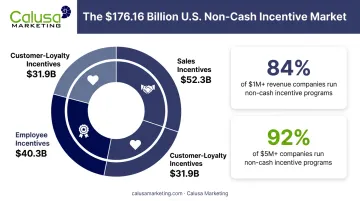
Non-cash incentives are a massive, established piece of the U.S. economy already. The Incentive Federation's 2022 study estimated the market at $176.16 billion, broken into sales incentives ($52.3B), employee incentives ($40.3B), and customer-loyalty incentives ($31.9B).
Adoption is nearly universal among larger companies: 84% of U.S. companies with $1M+ in revenue ran at least one non-cash incentive program, climbing to 92% among companies over $5M.
Incentive Programs Have Moved Well Beyond Retail
The days of incentive programs living only in retail loyalty apps are over. Structured reward programs now show up in:
- B2B distribution — HVAC, electrical, plumbing, and tire dealers running points-based loyalty and channel rebate programs
- Media and broadcasting — subscriber acquisition/retention and advertiser incentive programs
- Healthcare-adjacent sectors — blood and plasma donation centers using gift cards to drive donor recruitment
- Vacation ownership — timeshare companies incentivizing presentation attendance
This cross-industry spread isn't accidental. Distribution alone shows heavy adoption: an estimated 48% of qualifying U.S. companies rewarded channel or distribution partners with non-cash incentives, per the Incentive Federation's research.
Economic Pressure Is Pushing More Companies to Formalize Programs
Two forces are driving this. First, competitive labor markets. Gallup reported that 51% of U.S. employees were watching for or actively seeking a new job as of May 2024, with replacement costs running as high as 200% of salary for managers and leaders. Structured recognition programs are one of the few levers companies have left to fight that churn.
Second, rising acquisition costs are pushing companies toward retention-focused spend, even if the shift hasn't fully caught up in ad budgets yet. Running retention programs at that scale exposes a different problem: manual, spreadsheet-based tracking simply can't keep pace with thousands of participants, so SaaS-based reward platforms have become the operational standard rather than the exception.
This same shift toward durable, platform-based programs shows up clearly in retention data. Calusa Marketing, which manages more than 1,000 programs for 500,000+ members, maintains a 99% client retention rate, reflecting the industry's broader move toward long-term, relationship-based incentive strategies over one-off promotions.
Top Trends Shaping Incentive Programs
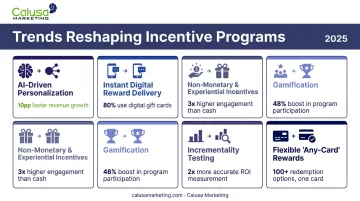
Six shifts are reshaping how programs get designed and delivered right now.
AI-driven personalization. Companies increasingly use purchase and behavior data to tailor rewards to individuals rather than blasting the same offer to everyone. BCG's Personalization Index found that leaders using AI-enabled personalization grew revenue 10 percentage points faster annually than laggards, based on a study of 5,000 consumers across 10 countries.
McKinsey separately found AI-supported targeted promotions produce 1% to 2% incremental sales lift.
Instant, digital reward delivery. Physical checks and mailed cards are fading fast. Gift cards, including digital and e-cards, were used by 80% of companies running sales programs and 80% running employee programs in 2022.
The pandemic accelerated this shift further, with a 26% increase in gift cards used as rewards between 2020 and 2022 as remote work reduced physical fulfillment options.
Non-monetary and experiential incentives. Access, recognition, and exclusive experiences increasingly outperform straight discounts for long-term loyalty. Research from the University of Waterloo, cited by the Incentive Research Foundation, found that generating the same behavior lift with cash could require up to three times more spend than non-cash rewards.
Gamification. Leaderboards and tiered challenges are being layered onto point programs, though the effects are mixed. A two-year study of nearly 4,900 loyalty-program users found rewarded newsletter subscriptions shortened the time between purchases by about 20 days.
Rewarded wish-list activity, by contrast, correlated with €13.16 (about $14) less spending per purchase in the same study. Gamification works, but only when matched to the right behavior.
Incrementality testing. Program owners are moving past redemption-volume tracking toward proving true lift. One IRF case study using a pseudo-control group attributed $37.2 million in incremental purchases and calculated 112.5% ROI for a single client.
Flexible "any-card" rewards. Choice is winning. In a survey of 500 U.S. consumers, 41% selected the ability to choose their own reward as a preferred option, and 80% said they'd likely use a pay-with-points feature if offered.
Types of Incentive Programs by Business Goal
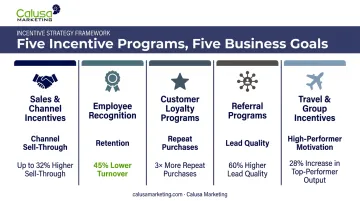
Program type should map directly to the behavior you're trying to change. A referral program won't fix channel-partner apathy, and a SPIF won't reduce call-center turnover. Match the tool to the goal first.
Sales & Channel Incentive Programs
SPIFs (Sales Performance Incentive Funds) and dealer/distributor rebate programs are the backbone of channel-driven industries like HVAC, electrical, and plumbing distribution. These typically reward short-term wins, such as selling a set quantity of a specific product within a defined window, to drive sell-through and keep partners loyal to one brand over a competitor's.
Employee Recognition & Engagement Programs
Points-based recognition and years-of-service milestones are common tools for reducing turnover in call center, distribution, and customer service environments. The data supports the investment:
- A longitudinal study of 3,500 employees found well-recognized workers were 45% less likely to have changed employers after two years
- Only 22% of employees said they receive the right amount of recognition, leaving significant room for programs to close that gap
Customer Loyalty & Retention Programs
Point-based and tiered structures reward repeat purchases, subscriptions, or engagement. Media and publishing brands lean on this heavily for subscriber acquisition and retention, often through simple gift card incentives rather than complex tier systems. It works because it's easy to understand: do the thing, get the reward, repeat.
Referral Programs
Referral incentives generate lower-cost, higher-quality leads because referred customers behave differently from the start. A Wharton-published study tracking nearly 10,000 bank accounts over 33 months found referred customers delivered:
- 25% higher contribution margins than non-referred customers
- 18% lower churn and 16% higher lifetime value
- 31% to 57% more referrals of their own
Travel & Group Incentive Programs
Cruises, group trips, and transferable vacation certificates carry a high perceived value that consistently outperforms cash bonuses for motivation. In fact, 80% of respondents rated group incentive travel as "extremely" or "very" motivating. Timeshare and vacation-ownership companies rely on this heavily, as do high-performing B2B sales teams running President's Club-style trips.
Common Challenges & Best Practices for Program Success
Running a program is one thing; keeping it effective for years is another.
Incentive fatigue sets in when recipients grow desensitized to rewards. Symptoms include falling participation and rewards that once felt exciting starting to feel routine. The Incentive Research Foundation recommends countering this with:
- Varied and personalized rewards instead of a single static offer
- Occasional surprise elements that break predictability
- Clear rules and attainable goals so participants don't disengage from confusion
Fixing fatigue is only half the battle. Administrative burden is the other silent killer. Tracking redemptions, handling fulfillment, and fielding customer service questions in-house eats time that could go toward strategy. This is why many companies outsource program operations entirely to specialized firms, such as Calusa Marketing, rather than building internal infrastructure from scratch.
Even smooth-running operations can't save a program that lacks direction. Undefined objectives doom more programs than bad reward selection ever does. Before launch, define the goal and establish a baseline to measure against:
- Retention — reducing turnover or churn
- Sales lift — increasing revenue per participant
- Lead generation — growing qualified prospects
Programs launched without this step tend to drain budget while nobody can prove what, if anything, improved.
How Calusa Marketing Helps Businesses Navigate These Trends
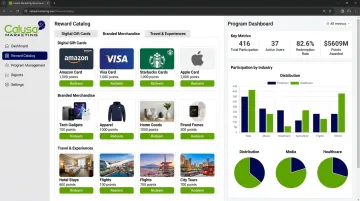
Calusa Marketing built its platform around the exact friction points covered above. Its cloud-based SaaS reward platform requires no integration and no app download, so companies can launch a modern, flexible incentive program in days rather than months.
That flexibility shows up in the reward catalog itself, which includes:
- Over 100 digital gift card options, including a VISA cash-alternative
- More than 10 million authentic branded merchandise items, shipped to 100+ countries
- Custom incentive travel, ranging from individual luxury trips to group programs for up to 10,000 people
Calusa's white-glove fulfillment model, paired with customer support available seven days a week, directly addresses the administrative burden and fatigue challenges outlined earlier. Clients don't manage redemption questions, lost cards, or booking logistics. Calusa's team, including a dedicated Director of Fulfillment, handles it.
The firm's client roster reflects the cross-industry adoption discussed throughout this article:
- Distribution: Hajoca (800+ locations), Johnstone Supply, Baker Distributing, and Midstate Tire use points-based programs to drive online orders and account growth
- Media: iHeart Media, Audacy, and Postmedia use travel incentives to grow advertiser spend, while Houston Chronicle and McClatchy use gift cards for subscriber retention
- Healthcare-adjacent: Memorial Blood Centers uses gift cards to drive donor recruitment and repeat donations
- Timeshare: Capital Vacations, InnSeason Resorts, and Travel Resorts of America use gift cards to boost presentation attendance
- Call centers: Alorica and Inktel use rewards programs tied to agent recruitment, retention, and KPI performance
Across more than 1,000 programs and 500,000 members, Calusa maintains a 99% client retention rate by treating every account as a long-term partnership rather than a one-time sale.
Frequently Asked Questions
How does the incentive program work?
Participants earn points, credits, or rewards for completing specific actions, such as purchases, referrals, or hitting performance targets. These are then redeemed through a platform for gift cards, travel, merchandise, or other rewards.
What is the most widely used sales incentive program?
SPIFs (Sales Performance Incentive Funds) and point-based sales incentive programs are among the most common formats. They typically offer short-term bonuses tied to hitting specific, time-bound sales goals.
What is a simple definition of incentive?
An incentive is a reward or benefit offered to motivate a specific behavior. Unlike a discount, which simply lowers price, an incentive is designed to change what someone does.
What industries benefit most from incentive marketing programs?
Distribution (HVAC, electrical, plumbing), media/broadcasting, timeshare/vacation ownership, and call centers see the strongest ROI. These industries often have long sales cycles or channel-based selling that rewards ongoing motivation.
How much should a company budget for an incentive program?
Budgets vary widely by goal and industry, and should be based on projected ROI and behavior change rather than a fixed percentage of revenue. Running a pilot phase before full rollout is the most reliable way to validate spend.
What is the difference between a loyalty program and an incentive program?
Incentive is the broader strategic umbrella, covering any reward used to influence behavior across customers, employees, or channel partners. Loyalty programs are a specific subset focused on repeat customer engagement over time.