Many retailers know CX matters. Fewer have connected the dots between their technology stack, their frontline employees, and their loyalty efforts into one cohesive strategy. The result is a patchwork of good intentions that doesn't always translate into a consistent customer journey.
This guide breaks down what retail CX actually means, why it's become the primary battleground for customer loyalty, the core pillars that make it work, and practical steps to improve it. We'll also cover where CRM fits in and how to measure whether your efforts are paying off.
Key Takeaways
- Retail CX is the sum of every customer interaction, not just customer service moments
- 29% of consumers have already switched brands after a poor experience, making CX a revenue issue
- Omnichannel consistency, personalization, and employee experience have the biggest measurable impact on customer experience
- Loyalty programs and unified customer data turn one-time buyers into repeat customers
- NPS, CSAT, and CES give you a measurable way to track progress
What Is Retail Customer Experience (and Retail CX Management)?
Retail customer experience is the cumulative emotional and functional impression a customer forms from every interaction with your brand, across digital and physical channels alike. It spans the browsing session, the checkout flow, the packaging, the return policy, and everything in between.
Retail customer experience management (CXM) is the strategic discipline built around that idea. It's the ongoing process of collecting, analyzing, and acting on data from those touchpoints to continuously improve the journey. McKinsey frames CX broadly as everything an organization does to put customers first and manage their journeys from end to end.
CX vs. Customer Service: What's the Difference?
Customer service is one component of the journey, such as resolving a shipping complaint or answering a product question. Customer experience is the entire arc surrounding that moment.
Consider a typical path:
- A customer browses products on your website
- They complete a purchase through your app
- Their delivery arrives damaged or late
- They contact support to resolve the issue
- They leave a public review based on how that resolution felt
Every one of those five steps shapes the final impression, but only step four is technically "customer service." Retail CX increasingly spans both e-commerce and brick-and-mortar environments, which means retailers need a unified view of the customer rather than siloed data sitting in separate systems.
Why Retail Customer Experience Matters More Than Ever
The financial stakes are no longer theoretical. A PwC 2025 survey of over 5,500 U.S. consumers found:
- 29% have stopped buying from a company entirely after one poor experience, whether online or in person
- 70% of executives admit customer expectations are evolving faster than their companies can keep up
That expectation gap matters because products and prices across retail categories often look nearly identical. When a customer can buy the same jeans, the same skincare product, or the same appliance from five different retailers at similar prices, experience becomes the tiebreaker.
Strong CX doesn't just prevent churn. It drives measurable upside:
- Higher customer lifetime value as satisfied shoppers keep coming back
- Increased word-of-mouth referrals, which cost nothing and carry more trust than paid ads
- Stronger retention rates, reducing the constant pressure to acquire new customers to replace lost ones
Retailers who treat CX as a cost center are missing the point. It's one of the few levers left that actually moves revenue.
Key Components (Pillars) of Retail Customer Experience Management
Good retail CX rests on a handful of interconnected pillars. Miss one, and the whole structure feels shaky to the customer, even if they can't articulate why.
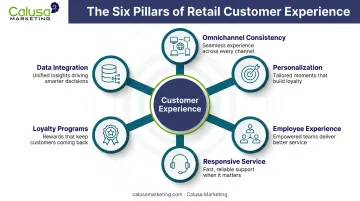
Together, these six pillars determine whether a shopper feels valued or forgotten:
- Omnichannel consistency: Pricing, promotions, and service quality should feel seamless across online, app, and in-store channels. McKinsey found that omnichannel shoppers buy 1.7 times more often than single-channel shoppers and spend more per visit.
- Personalization: Tailoring recommendations, offers, and communications based on purchase history isn't optional anymore. Shoppers expect it and notice when it's missing.
- Employee experience and empowerment: This pillar often gets overlooked, but engaged, well-trained frontline staff shape how customers feel about a brand. A disengaged cashier or untrained associate undoes marketing dollars fast.
- Responsive customer service: Fast, multi-channel support across chat, phone, and social media resolves issues before they escalate into public complaints or lost customers.
- Loyalty and incentive programs: Structured rewards build emotional connection and repeat behavior. Calusa Marketing's cloud-based SaaS platforms let retailers launch loyalty, digital punch card, and gift card programs without an app download or IT integration.
- Data and technology integration: Feedback, transaction, and behavioral data need to live in one place, not scattered across disconnected systems, to guide real decisions.
How to Improve the Retail Customer Experience
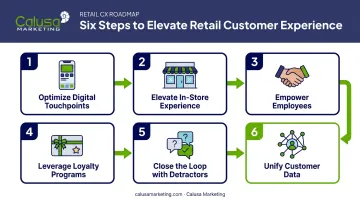
Improving retail CX means tightening digital friction points, investing in people, and using loyalty mechanics to keep customers coming back.
Optimize digital touchpoints. Slow-loading pages, confusing navigation, and clunky checkout flows drive cart abandonment. Simplifying your checkout to the fewest necessary steps and making mobile navigation intuitive reduces the friction that pushes shoppers to leave without buying.
Elevate the in-store experience. Thoughtful store layout, well-trained staff, and convenient options like self-checkout or buy-online-pickup-in-store give customers control over how they want to shop.
Empower and engage employees. Business units with highly engaged employees see 10% higher customer loyalty and lower turnover, according to Gallup. Investing in frontline tools and training keeps your best people in front of customers instead of walking out the door.
Leverage loyalty and incentive programs. Digital punch cards, flexible gift card options, and incentive travel rewards give retailers a low-friction way to turn one-time buyers into repeat customers. Calusa Marketing, for example, offers ANY-Card gift card flexibility across 100+ digital brands plus fully managed incentive travel rewards.
Close the loop with detractors. Don't let negative feedback sit unanswered. Following up, owning the mistake, and resolving the issue directly rebuilds trust faster than any apology email template.
Unify customer data across channels. Marketing, in-store staff, and support teams all need the same real-time view of the customer. Without it, you get contradictory promotions and repeated questions that frustrate shoppers.
The Role of CRM in Retail Customer Experience Management
CRM systems are the backbone that makes personalization possible at scale. They centralize purchase history, preferences, and past interactions in one place, so a customer doesn't have to repeat their story every time they contact support or browse a new category.
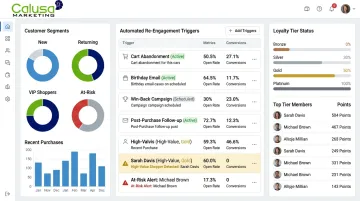
Beyond storage, CRM platforms increasingly integrate directly with loyalty and incentive programs. That integration triggers targeted offers, rewards, or re-engagement campaigns based on actual customer behavior, not guesswork.
Here's what that looks like in practice:
- Triggers automatic re-engagement offers for customers who haven't purchased in 90 days
- Grants early access to loyalty reward tiers for high-value shoppers
- Flags at-risk customers likely to churn before they actually do
AI-powered analytics built on top of that CRM data take it further, helping retailers predict customer needs and proactively address issues before they escalate into complaints or lost sales. This technology strengthens the relationship, making it easier to manage at scale as customer volume grows.
How to Measure Retail Customer Experience
You can't improve what you don't measure, and three core metrics anchor most retail CX programs:
| Metric | What It Measures | How It's Calculated |
|---|---|---|
| Net Promoter Score (NPS) | Overall loyalty and likelihood to recommend | Percentage of promoters minus percentage of detractors |
| Customer Satisfaction Score (CSAT) | Satisfaction with a specific interaction or purchase | Percentage of respondents rating 4 or 5 out of 5 |
| Customer Effort Score (CES) | How easy it was to resolve an issue or complete a task | Average agreement rating on a 1-to-5 effort scale |
As a benchmark, retail NPS above 50, CSAT above 80%, and CES below 2 all signal strong performance.
Beyond survey-based metrics, operational indicators tell you just as much:
- Cart abandonment rate signals friction in your checkout flow
- Return rate can point to mismatched expectations between marketing and product
- Conversion rate reflects how well your site or store turns interest into purchases
Don't ignore the informal signals either. Online reviews and social sentiment give you a real-time pulse on how customers actually feel, often before that feeling shows up in a formal survey response.
Frequently Asked Questions
What is customer experience management in retail?
Retail CX management is the ongoing process of collecting, analyzing, and acting on customer data across every touchpoint, from browsing to post-purchase support. This continuous cycle improves satisfaction and loyalty over time.
What are the key components (pillars) of customer experience management in retail?
The core pillars are omnichannel consistency, personalization, employee experience, responsive customer service, loyalty programs, and integrated data. Each pillar reinforces the others.
What is the role of CRM in retail customer experience management?
CRM centralizes customer data, including purchase history and past interactions, to enable personalization, targeted offers, and predictive insights across the entire customer journey.
How do you measure customer experience in retail?
Use NPS, CSAT, and CES as core survey metrics, combined with operational indicators like cart abandonment rate, return rate, and conversion rate to track experience quality.
What is the difference between customer experience and customer service in retail?
Customer service is one interaction-based component, such as resolving a complaint. Customer experience covers the entire end-to-end journey, from discovery through post-purchase.
How can loyalty programs improve retail customer experience?
Loyalty and incentive programs deepen emotional connection, encourage repeat purchases, and generate valuable data that fuels personalization across future interactions.