Companies routinely pour budget into bonuses, commissions, and perks, only to see flat engagement or a motivation spike that fades within weeks. The problem usually isn't the dollar amount. It's the design.
Behavioral economics offers a different lens. Instead of assuming employees and customers weigh every reward like a spreadsheet, it accounts for the biases, timing effects, and emotional triggers that actually drive behavior. This article translates the core principles into practical, testable lessons for building incentive plans that change behavior, not just budgets.
Key Takeaways
- Reward timing beats reward size for driving day-to-day behavior change.
- Loss-framed messaging can outperform gain-framed appeals, though results vary by context.
- Non-cash rewards often outperform cash by feeling more thoughtful and holding value longer.
- Complex incentive rules cause employees to misallocate effort, not just work less hard.
- Blending individual and team structures balances motivation with fairness.
What Is an Incentive Plan? The Behavioral Foundation
An incentive plan is a structured program that ties rewards, monetary or non-monetary, to specific future behaviors or performance outcomes. That's an important distinction from a bonus, which typically rewards past performance after the fact. An incentive looks forward; a bonus looks backward.
Traditional incentive design leans on a simple assumption: people are rational actors who respond predictably to reward size. Offer more money, get more effort. Behavioral economics complicates that picture.
Decades of research, starting with Kahneman and Tversky's prospect theory, show that decisions are shaped by cognitive biases, framing, and context just as much as by the actual value on offer. People don't evaluate rewards in a vacuum. Instead, they:
- Compare rewards to reference points, not absolute value
- Discount future payouts irrationally, favoring immediate gratification over larger delayed rewards
- Respond differently depending on how a reward is presented
This behavioral gap explains a pattern many incentive designers have seen firsthand: a company with a generous budget rolls out a new bonus structure, and performance barely moves. The money was there. The psychology wasn't. The rest of this article breaks down exactly where that psychology comes from and how to design around it.
Core Behavioral Economics Principles Every Incentive Designer Should Know
Five behavioral principles explain most of why incentive plans succeed or stall. Understanding the psychological "why" behind each one makes it far easier to diagnose a struggling program.
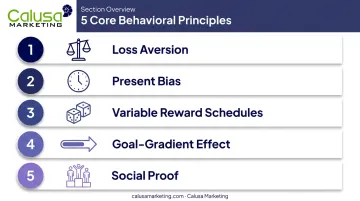
Loss Aversion: Framing Rewards as Losses to Avoid
People feel the pain of losing something roughly twice as strongly as the pleasure of gaining an equivalent amount. That's the core insight from prospect theory, and it has direct incentive-design applications.
Rather than framing a reward as something to earn, frame it as something already earned that could be lost. A points-based or tiered rewards program can show a participant sitting at "Gold" status with a visible risk of dropping to "Silver" if performance slips next quarter.
That framing taps into loss aversion far more effectively than a simple "hit this target and get a bonus" message.
The effect is real, but it isn't universal. A field experiment with Chicago Heights teachers found that loss-framed bonuses, paid upfront and then taken back for underperformance, increased math achievement by 0.2 to 0.4 standard deviations, while a conventional gain-framed bonus of equal size produced no significant effect.
Later meta-analyses found the effect shrinks considerably outside the lab, so loss framing works best as one tool among several, not a guaranteed fix.
Present Bias and the Power of Immediate Recognition
Hyperbolic discounting describes the tendency to overvalue immediate rewards relative to larger, delayed ones. It's why a $50 reward next week can feel more motivating than a $200 bonus in six months, even though the math clearly favors waiting.
This is precisely why annual bonuses often underperform compared to smaller, more frequent recognition moments. Research from Cornell found that earlier rewards increase intrinsic motivation compared with delayed rewards, largely because people perceive a stronger connection between the activity and its payoff when the gap is short.
A quarterly bonus feels disconnected from the specific behavior that earned it. A same-week spot award doesn't.
The practical takeaway: shrink the interval between behavior and reward wherever possible.
Variable Reward Schedules and the "Surprise" Effect
Slot machines and gamified apps rely on variable ratio reinforcement, rewarding behavior after an unpredictable number of repetitions rather than a fixed schedule. The unpredictability itself sustains engagement.
Applied to incentive plans, unannounced spot bonuses or surprise recognition moments can keep participants engaged longer than a rigid, fully predictable payout calendar. Employees stop anticipating exactly when the next reward lands, which keeps effort more consistent between formal review periods.
One caveat: organizational research has found that while variable schedules can raise output, employee attitudes toward the program are sometimes better under a more predictable fixed-ratio structure. Unpredictability boosts activity, not necessarily satisfaction, so pairing surprise rewards with a baseline of predictable recognition tends to work better than relying on surprise alone.
The Goal-Gradient Effect: Motivation Accelerates Near the Finish Line
People push harder as they perceive themselves closing in on a goal. This is the goal-gradient effect, and it's the same reason a coffee loyalty card with a visible "2 stamps to go" note drives more repeat visits than one showing "just getting started."
Incentive plans can exploit this through:
- Progress bars showing exact distance to the next reward tier
- Milestone rewards at the 25%, 50%, and 75% marks of a larger goal
- Tiered thresholds that make the next level feel within reach, not distant
The catch: visible progress doesn't automatically help. Research on online progress indicators found that displays can either reduce or increase drop-off, depending on whether the shown progress feels like it's accelerating or stalling. A milestone tracker only works if participants believe the finish line is genuinely reachable.
Social Proof and the Overjustification Effect
Leaderboards work because people compare themselves to peers, and visible ranking can be a powerful motivator on its own. But there's a genuine trade-off.
The overjustification effect describes what happens when a large extrinsic reward gets attached to a task people already found interesting or meaningful. A landmark meta-analysis of 128 experiments by Deci, Koestner, and Ryan found that expected tangible rewards tied to engagement or performance can undermine free-choice persistence and reported interest in the underlying task.
In practice, this means leaderboards and public recognition tend to work best when they highlight effort and improvement rather than turning every task into a prize-contingent transaction. Use social visibility to celebrate performance. Don't let it replace the reasons people cared about the work in the first place.
Types of Incentive Plans Through a Behavioral Lens
Once you understand the psychology, the next step is matching plan structure to how your workforce or customer base actually behaves.
Individual vs. Team-Based Incentives
Individual incentives lean hard on loss aversion and personal goal-gradient effects. They're highly motivating for the individual, but they can create unhealthy internal competition if not managed carefully.
Team incentives lean on social proof and shared accountability instead. A workplace field experiment found group incentives increased performance by 19% with negligible free-riding, though other tournament research found that wider prize spreads can increase sabotage between competitors.
A hybrid model often threads this needle best: individual recognition layered on top of a collective team goal. Participants get personal credit for their contribution while still benefiting from group momentum.
Monetary vs. Non-Monetary Rewards
Cash gets spent and forgotten fast. That's hedonic adaptation at work: people quickly adjust to a cash reward as the new normal, while an experience or a memorable item tends to stick emotionally far longer.
A workplace gift-exchange experiment found that an in-kind gift increased worker output by roughly 25%, while an equivalent cash gift produced no significant productivity increase. The researchers attributed the gap to perceived thoughtfulness, not the dollar value itself.
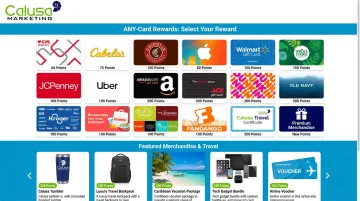
This is where reward variety matters. Platforms that combine multiple reward categories let recipients choose what actually feels meaningful to them, rather than forcing a one-size-fits-all cash payout.
Calusa Marketing's ANY-Card program, for example, offers 100+ digital gift card options, a merchandise catalog with over 10 million branded items, and travel certificates ranging from hotel stays to five-star trips.
Instant vs. Deferred Incentive Structures
Present bias applies directly here. Spot awards and real-time digital rewards typically outperform quarterly or annual payouts for shaping day-to-day behavior. The reward lands close enough to the triggering action for the brain to connect the two.
A deferred bonus, paid three months after the behavior it was meant to reward, has already lost most of its psychological punch by the time it arrives.
Common Behavioral Design Mistakes to Avoid
Even well-funded incentive programs stumble into the same handful of behavioral traps.
Over-complicating the math. Complex, multi-variable calculations blur the line between effort and reward. A study of roughly 1,200 participants found convoluted schemes cause employees to misallocate effort, not simply try less hard. Simpler, visible progress tracking protects the goal-gradient effect discussed earlier.
Relying only on large cash payouts. Bigger checks don't guarantee bigger motivation. Ariely and colleagues found that in high-stakes conditions, top performers earned just 19.5% of the possible payout versus 36.7% under medium stakes. Heavy cash reliance also accelerates hedonic adaptation, breeding incentive fatigue.
Infrequent communication and delayed payouts. Every week a reward sits unpaid, the perceived link between behavior and outcome weakens. This directly undercuts the present-bias advantage that makes incentives work in the first place.
Building a Behaviorally-Smart Incentive Plan: A Practical Framework
Turning these principles into an actual program comes down to a few concrete steps.
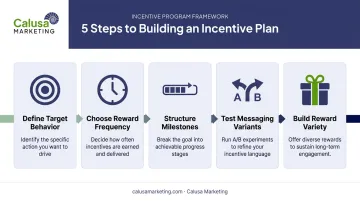
Define the target behavior precisely. Vague goals like "improve performance" don't give the brain a clear reference point. Specific, measurable actions do.
Choose reward frequency based on present-bias principles. Favor more frequent, smaller rewards over rare, large ones whenever the goal is behavior change rather than pure retention bonuses.
Structure milestones using the goal-gradient effect. Build visible progress markers so participants can see the distance closing, not just the finish line far in the distance.
Test both loss-framed and gain-framed messaging with a small segment before a full rollout. What resonates with a sales team might not land the same way with a customer loyalty audience.
Build in reward variety and choice. Cash, travel, merchandise, and recognition each appeal to different people. Offering a mix helps offset hedonic adaptation and keeps the program feeling fresh.
Technology plays a real role in making this practical rather than theoretical. Closing the gap between behavior and reward keeps present-bias-driven motivation working in your favor. Three features make the biggest difference:
- Real-time point tracking
- Instant reward redemption
- Flexible, configurable reward catalogs
Calusa Marketing's cloud-based reward platform, for instance, requires no app download and no technical integration. Clients configure tiered, instant, or flexible incentive structures and typically launch a live program in under a week. That kind of low-lift setup makes behaviorally-informed design achievable for a small dealership network just as easily as a national retail chain.
Frequently Asked Questions
What does an incentive plan mean?
An incentive plan is a structured program that ties rewards, monetary or non-monetary, to specific future performance goals. Unlike a bonus, which rewards past results, an incentive is forward-looking and designed to shape behavior before it happens.
What are the types of incentive plans?
Common types include individual, team-based, hybrid, monetary, and non-monetary incentive plans. Each leans on different behavioral triggers, from personal goal-gradient effects to social proof and shared accountability.
What is the behavioral economics theory of incentives?
Behavioral economics studies how cognitive biases, such as loss aversion and present bias, shape the way people respond to rewards. It challenges the assumption that reward size alone predicts motivation.
Why do some incentive programs fail even with large rewards?
Poor timing, overly complex rules, and a lack of reward variety can undermine even a generous budget. Research shows high-stakes rewards can sometimes reduce performance rather than boost it.
How does loss aversion affect incentive plan design?
Framing a reward as something already earned that could be lost tends to be more motivating than framing it as a future gain. Field studies show this can meaningfully boost performance, though the effect varies by context.
Are non-monetary rewards more effective than cash incentives?
Non-monetary rewards like travel or curated merchandise often create longer-lasting motivation because people adapt to cash quickly but remember experiences. Field research has found in-kind gifts can outperform equivalent cash rewards in driving output.