Choosing the wrong tool has real costs. A stipend won't push a sales rep to close more deals. An incentive won't reliably cover a remote employee's home-office setup month after month. Get the mechanism wrong, and the money spent stops producing the outcome you actually wanted.
This guide breaks down what separates incentives from stipends — definitions, tax treatment, common use cases, and a straightforward framework for deciding which one fits your specific business goal.
Key Takeaways
- Incentives reward a specific action, like cash, travel, or gift cards, and are earned, not guaranteed
- Stipends are fixed, recurring payments tied to an expense category, paid regardless of performance
- Both are taxable, but IRS rules differ; calling something a "stipend" doesn't make it tax-free
- Sales, loyalty, and referrals thrive on incentives, while stipends support wellness, remote work, and professional development
- Many companies pair both: stipends for baseline support, incentives layered on top for performance
Incentive vs Stipend: Quick Comparison
| Factor | Incentive | Stipend |
|---|---|---|
| Purpose | Drives a specific action (sale, referral, safety milestone) | Supports a recurring need (wellness, home office, education) |
| Payment Trigger | Earned only when a goal is achieved | Paid on a fixed schedule, regardless of output |
| Tax Treatment | Supplemental wages or 1099 income | Taxable fringe benefit unless an exclusion applies |
| Form | Cash, gift cards, merchandise, travel, points | Almost always a fixed cash allowance |
| Typical Recipient | Sales reps, channel partners, loyal customers | Interns, remote employees, wellness program participants |
The tax line deserves extra attention. Under IRS Publication 15, bonuses, prizes, and awards count as supplemental wages. Employers can generally apply an optional 22% withholding rate — jumping to 37% on amounts over $1 million in a calendar year.
Stipends don't get an automatic pass either. IRS Publication 15-B states plainly that a fringe benefit is taxable unless the tax code specifically excludes it. There's no blanket exemption just because a payment is labeled a "stipend."
What is an Incentive?
An incentive is a reward tied to a specific, measurable action. Hit the target, get the reward. Miss it, and there's nothing. That direct link between behavior and payoff is what makes incentives such an effective motivation tool — for employees chasing a sales quota and for customers deciding whether to make a repeat purchase.
Done well, incentives move real business metrics:
- Incremental sales from reps or channel partners chasing a specific bonus
- Improved retention among customers enrolled in loyalty programs
- Higher average spend when rewards unlock at spending thresholds
- Qualified leads generated through referral or sign-up incentives
Common formats include cash bonuses, gift cards, branded merchandise, travel rewards, digital punch cards, and points-based loyalty systems.
Modern programs increasingly run through cloud-based platforms, skipping app downloads and system integrations entirely. A digital loyalty card, for instance, can land directly in a customer's phone wallet within seconds of a QR code scan, with programs going live in under a week rather than the months a legacy points system might require.
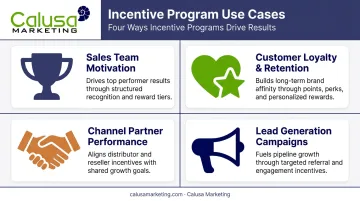
Use Cases of Incentives
Incentives show up wherever a business needs to change behavior fast:
- Sales team motivation: bonuses or trips tied to hitting quota
- Customer loyalty and retention: points, punch cards, or gift-with-purchase offers
- Channel partner performance: rewards for distributors and dealers who hit volume targets
- Lead generation campaigns: referral bonuses or sign-up incentives
Some industries lean on incentives more heavily than others:
- HVAC and electrical distributors use points-based rewards to drive online ordering volume
- Media companies use travel incentives to push advertisers toward incremental ad spend
- Jewelry retailers tie luxury travel rewards to big-ticket purchases like engagement rings
- Timeshare and vacation ownership companies use similar mechanics to reward referrals and renewals
Calusa Marketing works across each of these verticals, building incentive programs (travel rewards, gift card fulfillment, and digital punch cards) designed to turn incentive spend into a measurable outcome rather than a line-item expense.
One caution worth flagging: incentive design isn't foolproof. Research cited by Harvard Business Review found that sales-rep "sandbagging," or delaying deals to optimize commission timing, can reduce total revenue by 4% to 6%. Poor incentive design carries real financial risk, not just missed opportunity. Getting the mechanism right matters as much as choosing the reward itself.
What is a Stipend?
A stipend is a fixed payment an employer makes at regular intervals to help offset a specific type of expense. It doesn't move based on performance. An employee gets the same amount whether they had a breakout quarter or a quiet one.
That predictability is the point. Stipends offer:
- Simplified budgeting — the same line item, every pay period
- Easier administration — no performance tracking or approval workflow needed
- Support for wellbeing — without touching base pay or triggering renegotiation
That same predictability shows up across common stipend categories: wellness stipends, remote work or technology stipends, professional development stipends, and transportation stipends. The defining structural difference from an incentive stays constant: a stipend isn't earned through output or results. It's paid because the employee exists in a category, such as remote worker, intern, or full-time staff member, not because they hit a number.
Use Cases of Stipends
Stipends fit naturally into a benefits strategy built around ongoing support rather than short-term performance:
- Distributed and remote workforces — covering home-office equipment or internet costs
- Interns and apprentices — offsetting living or commuting expenses during a training period
- Wellbeing initiatives — gym memberships, mental health apps, or general wellness allowances
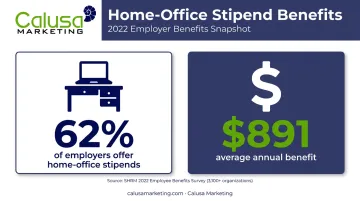
Remote work stipends in particular have become standard practice. SHRM's 2022 Employee Benefits Survey, covering more than 3,100 organizations, found that 62% of employers offered some form of subsidy or reimbursement for home-office equipment, with the average benefit landing around $891. That's a substantial share of the market treating home-office support as a baseline expectation, not a perk.
Incentive vs Stipend: Which Is Better for Your Goals?
There isn't a universally "better" choice between an incentive and a stipend: the right option depends entirely on what you're trying to accomplish.
Ask this first: are you trying to change a specific behavior, or support an ongoing need?
- Choose an incentive for sales growth, customer loyalty, referral volume, or hitting a defined KPI, since the reward only shows up after the result does.
- Choose a stipend for supporting wellness, remote work, or professional development — needs that exist independent of any single week's performance.
- Combine both when you want a baseline layer for everyone, with incentives stacked on top to push specific performance goals.
Plenty of organizations take this hybrid approach. A distributor might offer every employee a wellness stipend while running a points-based incentive program for its sales team.
Match the tool to the outcome you're actually trying to produce, not to whichever mechanism seems universally stronger on paper.
Real-World Example: Incentives Driving Measurable Results
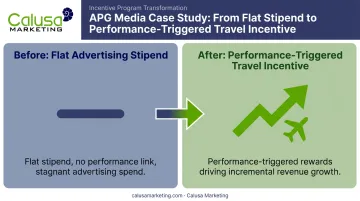
APG Media of Chesapeake & Florida needed a way to keep advertisers increasing their spend, a persistent challenge in media, where a flat allowance does nothing to encourage growth. A fixed stipend wouldn't have moved the needle; advertisers had no reason to spend more than the previous cycle.
Instead, APG Media worked with Calusa Marketing to build a structured incentive program using travel rewards, tied directly to incremental advertising spend from both the internal sales team and external advertiser clients. The reward only unlocked when spend actually increased.
Jim Normandin, Regional President of APG Media, described the results directly:
"Alex Brown and the Calusa team have worked with our sales teams to generate millions of dollars of incremental revenue... innovative solutions supported by a quality product that incentivized our sales team as well as our clients to grow our incremental revenue base."
The shift from a flat approach to a performance-triggered travel incentive gave both the sales team and the advertisers a reason to push past their existing spend levels.
If your business wants similar results, Calusa Marketing designs incentive programs, from travel rewards to gift card and digital punch card systems, built around the specific outcome you're trying to drive.
Frequently Asked Questions
What is an incentive stipend?
This hybrid term usually refers to a fixed allowance meant to loosely encourage a behavior, like a wellness or training stipend. True incentives are performance-triggered, while stipends are not, so this term blends two different mechanisms.
Who usually gets a stipend instead of a salary?
Stipends typically go to interns, students, apprentices, and volunteers as support for expenses rather than a performance-based wage. Note that apprentices are generally paid employees under wage law, not a pure stipend arrangement.
Are incentives taxed the same way as stipends?
Both are generally taxable, but reporting differs. Incentives are usually supplemental wages or 1099 income, while stipends fall under fringe benefit rules unless an exclusion applies. Talk to a tax advisor before assuming either is tax-free.
What's the difference between a stipend and a bonus?
A bonus is a form of incentive, usually tied to performance or a milestone. A stipend is fixed and recurring, paid regardless of results.
Can a company offer both incentives and stipends?
Yes. Many organizations combine stipends for baseline support (like wellness or remote work) with incentives layered on top to drive specific performance goals.
How do I decide between an incentive program and a stipend for my team?
Base the decision on your goal. If you're rewarding a specific measurable outcome, choose an incentive. If you're supporting an ongoing need regardless of performance, choose a stipend.