This slow fade is more common than most teams admit. PMI's survey of over 1,000 executive sponsors and practitioners found that one in three unsuccessful projects failed to meet their goals because of poorly engaged sponsors, and projects hit their goals just 41% of the time when sponsors performed none of the five critical support actions, compared to 75% when they performed all five (PMI, 2014).
A stakeholder engagement strategy matrix fixes the guesswork. It turns "I think they're on board" into a trackable, measurable process. This guide covers the definition, the five engagement levels, a six-step build process, core principles, and how incentive programs help close the gap between where a stakeholder is and where they need to be.
Key Takeaways
- A matrix plots current versus required engagement to reveal the risk gap
- Five standard levels (Unaware, Resistant, Neutral, Supportive, Leading) give teams a shared language
- Targets should match role, not chase universal enthusiasm
- Monthly reviews and milestone check-ins keep the matrix accurate as sentiment shifts
- Incentive and recognition programs help push internal stakeholders from Neutral toward Leading
What Is a Stakeholder Engagement Strategy Matrix?
A stakeholder engagement strategy matrix is a framework that plots each stakeholder's current engagement level against the level required for the project or organization to succeed. The distance between those two points is the engagement gap — the specific work your team still needs to do.
This is a different tool than a stakeholder list. A list catalogs names, titles, and departments. A matrix plans a journey. It assumes that awareness alone doesn't get anyone across the finish line, and it forces you to define what "success" looks like for each individual person or group.
Core Components of the Matrix
Every functional matrix rests on two building blocks:
- Stakeholder identification and categorization: sorting people as internal or external, then classifying them as decision-makers, influencers, or implementers based on their actual role in delivering outcomes
- The engagement-level dimension: recording current state, desired state, and the gap between them, which becomes the basis for every strategy you build
Skip either piece and the matrix collapses into a glorified contact sheet.
Why the Current vs. Desired Gap Matters
Current state has to come from observed behavior (meeting attendance, tone of feedback, willingness to commit resources), not from what someone said in a hallway conversation. Teams that assume support instead of verifying it tend to discover the truth at the worst possible moment: right before a go-live date or budget review.
Desired state isn't one-size-fits-all either. A regulator might only need to reach Neutral to stop causing friction. A department head who controls your budget usually needs to be Supportive or Leading, because their disengagement can stall the whole initiative.
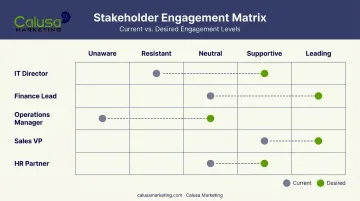
The 5 Levels (Stages) of Stakeholder Engagement
Most practitioners rely on a standardized five-level scale, first codified in the Project Management Institute's PMBOK Guide, to track where each stakeholder stands. The goal is matching each person to the engagement level their role actually requires, whether that means basic awareness or active leadership.
Unaware
The stakeholder has no knowledge the initiative exists. That's fine early on, but risky if it lingers. Someone who discovers a project affecting them late in the game tends to react defensively rather than neutrally, as with a department head blindsided by a system rollout the week before go-live.
Resistant
This stakeholder actively opposes the work: withholding data, blocking resource access, or badmouthing the project to peers. Resistance is uncomfortable, but it's also informative. It often signals a legitimate flaw in the plan, such as a missed dependency or unrealistic timeline, rather than a simple communication failure. Investigate before you push harder.
Neutral
Aware but uncommitted, this is usually your largest group and the most dangerous one to ignore. Neutral stakeholders don't stay neutral forever — without proactive engagement, they tend to drift toward resistance rather than support.
Supportive
These stakeholders help when asked and generally speak positively about the initiative, though they won't drive it forward on their own. Give them a specific task and a deadline, and they'll follow through reliably.
Leading
Leading stakeholders champion the work without being asked. They remove obstacles proactively and use their own influence to bring others along. Every initiative needs a handful of these people in the right seats.
How to Build a Stakeholder Engagement Strategy Matrix in 6 Steps
Building the matrix once isn't the point. The process below turns it into a living document your team actually uses.
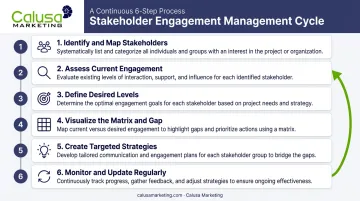
- Identify and map stakeholders. Scan process maps, org charts, and governance bodies to capture everyone who's impacted by, or capable of influencing, the initiative.
- Assess current engagement honestly. Use behavioral data, sentiment cues, and direct conversations to build an evidence-based baseline for each person, not a guess.
- Define desired engagement levels. Set proportional targets: critical path owners need at least Supportive, executive sponsors need Leading, and end users typically need Supportive by rollout.
- Visualize the matrix and the gap. Build a grid marking current (C) and desired (D) status per stakeholder. Color-code by priority so the biggest gaps stand out immediately.
- Create targeted strategies for each gap. Match tactics to the specific movement needed:
- Unaware → Aware: briefings and direct communication
- Resistant → Neutral: listening sessions that address root concerns
- Neutral → Supportive: involvement in real decisions, not just updates
- Supportive → Leading: mentorship roles or seats on a steering committee
- Monitor, review, and update regularly. Schedule monthly reviews, milestone checkpoints, and trigger-based updates after any major organizational change. A reorg or leadership shift can flip a stakeholder's status overnight.
Key Principles of Stakeholder Engagement
Three principles hold the whole system together:
- Honesty over assumption. Engagement status has to come from observed evidence, such as attendance, participation quality, and resource commitments, not optimism. PMI's guidance is explicit that stakeholder maps should be revisited frequently rather than treated as settled facts.
- Tailored communication. A single message sent to every stakeholder will underperform. Prosci's benchmarking work found that senior leaders are the preferred messengers for business-case updates, while immediate supervisors are preferred for personal-impact conversations. Match the messenger and the message to the audience.
- Continuity. Engagement isn't a kickoff-day checkbox. It shifts constantly as priorities, staffing, and circumstances change, which is exactly why the matrix needs scheduled revisits rather than a single pass.
Stakeholder Engagement Matrix vs. Stakeholder Analysis Matrix
These two tools get confused constantly, but they answer different questions.
| Dimension | Stakeholder Analysis Matrix | Stakeholder Engagement Matrix |
|---|---|---|
| Core question | Who matters, and how much attention do they deserve? | Where does each stakeholder stand, and where do they need to be? |
| Timing | Typically a one-time categorization exercise (power/interest grid) | Continuous tracking, reassessed on a schedule |
| Output | Prioritization for the stakeholder register | A behavioral gap that drives specific action plans |
A power/interest grid works well for deciding who deserves a seat at the table, but it doesn't reveal how someone's attitude is trending over time. Many organizations run both together: analysis for prioritization, engagement matrix for tracking movement over time.
From Neutral to Leading: Using Incentive Strategies to Close the Engagement Gap
Spotting a gap on the matrix is the easy part. Closing it, especially with internal stakeholders like sales teams, dealers, or employees, usually takes more than a well-written email. It takes tangible motivation.
Structured incentive and recognition programs are a proven lever here. A meta-analysis of 45 studies by the Incentive Research Foundation found that properly designed incentive programs improved performance by 22% on average, with team-based incentives reaching 45% (IRF, 2002).
That's the mechanism behind moving a Neutral or Supportive stakeholder into a Leading one: give them a concrete reason to champion the work, not just a request to.
This is where Calusa Marketing fits into the picture. The St. Petersburg, FL-based incentive marketing firm has spent over a decade managing programs that operationalize exactly this shift, currently overseeing 1,000+ programs and 500,000+ members.
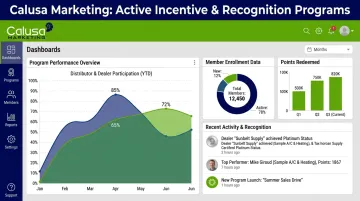
Two client programs show what that looks like in practice:
- Hajoca: A sales incentive program tied directly to KPIs across a distributor network spanning 800+ locations and 20+ business entities
- Johnstone Supply: A points-based loyalty program built around two behaviors, driving online orders and completing product education, designed to move participants from passive to active engagement
What makes this practical rather than theoretical is the delivery model. Calusa's cloud-based SaaS platform runs without added IT work:
- No integrations or app downloads required, with most programs live in under a week
- Built-in reporting that shows who's participating and who isn't
- Zero added backlog for internal IT teams, since nothing needs custom development
For an organization shifting a sales force or dealer network from Neutral to Leading, that combination of speed and low operational overhead often matters as much as the incentive design itself.
Frequently Asked Questions
What is a stakeholder engagement strategy matrix?
It's a framework that maps each stakeholder's current engagement level against the level required for project success. The gap between the two guides which strategies you build for each person.
What are the stages or levels of stakeholder engagement?
The five standard levels are Unaware, Resistant, Neutral, Supportive, and Leading. Each stakeholder should reach the level their role requires, not necessarily the top of the scale.
What are the key principles of stakeholder engagement?
Base engagement status on observed evidence, not assumption. Communication should be tailored to each stakeholder's power and interest, and the entire process needs to run continuously, not as a one-time exercise.
What is the difference between a stakeholder analysis matrix and a stakeholder engagement matrix?
An analysis matrix (like a power/interest grid) is typically a one-time categorization exercise. An engagement matrix continuously tracks behavioral movement between current and desired states.
How often should a stakeholder engagement matrix be updated?
Review it monthly at minimum, plus at major milestones or after significant organizational changes like leadership turnover or reorgs that can shift stakeholder sentiment quickly.
What tools or strategies help track stakeholder engagement over time?
Project management platforms and sentiment tracking through feedback or meeting participation help monitor movement over time. Structured incentive and recognition programs work particularly well for moving internal stakeholders, like sales teams, toward active advocacy.