Introduction
If you've ever bought car insurance, you've probably heard of Progressive's "Loyalty Rewards" program. Small accident forgiveness kicks in on day one, and bigger perks arrive the longer you stay. It's a simple idea that sticks.
That same logic, rewards that grow as the relationship deepens, works far beyond insurance. Distributors, media companies, and service businesses use the identical structure to keep customers and employees engaged for years instead of months.
Here's the problem: most businesses still run flat loyalty programs where every member gets the same perk regardless of tenure. That leaves real retention value on the table.
This article breaks down what progressive loyalty rewards actually are, how the tier mechanics function, and how any business, not just an insurance carrier, can build one.
Key Takeaways
- Tiered programs increase reward value as spend, tenure, or engagement grows, unlike flat, same-for-all models
- The goal-gradient effect drives people to work harder as they approach a reward milestone
- Acquiring a new customer costs 5 to 25 times more than retaining an existing one
- Poorly communicated tiers or stagnant top-level rewards can quickly drain engagement
- SaaS-based platforms can launch multi-tier programs faster than custom-built systems
What Is a Progressive Loyalty Rewards Program?
A progressive (or tiered) loyalty program increases reward value as a member's spend, tenure, or engagement grows. Contrast that with a flat program, where a first-time buyer and a ten-year customer get identical perks. Flat programs treat loyalty as invisible. Progressive ones make it pay off.
Progressive Insurance is the clearest consumer example. Its official Loyalty Rewards program automatically enrolls every auto policyholder and grants Small Accident Forgiveness starting on day one. From there, benefits unlock at set tenure milestones, rewarding customers simply for staying, according to Progressive's official Loyalty Rewards page.
This milestone logic isn't unique to insurance. It shows up everywhere:
- Distributors rewarding dealers for hitting annual purchase thresholds
- Media companies unlocking subscriber perks after a year of continuous service
- Service businesses offering priority scheduling to long-tenured clients
Why Progression Beats Flat Rewards
The psychology behind this is well documented. The goal-gradient effect describes how people accelerate their effort as they get closer to a reward.
A landmark study analyzed nearly 949 completed café reward cards. It found that customers' interpurchase times shrank by roughly 20%, or 0.7 days as they approached their free coffee, according to a goal-gradient study published in the Journal of Marketing Research. That acceleration predicted higher odds of the customer re-engaging in the next reward cycle.
That's the mechanism progressive programs exploit. Flat rewards give a customer no reason to push toward anything. Tiered rewards give them a finish line worth sprinting for.
How Progressive Loyalty Rewards Work: The Tier and Milestone System
Most tiered programs follow a familiar shape: an easy entry tier, a middle tier for repeat engagement, and a top tier reserved for the most committed members. Progressive Insurance's own structure is a textbook version of this.
| Tier | Milestone | Benefit Added |
|---|---|---|
| Immediate | Day 1 | Small Accident Forgiveness |
| Silver | 6 months | Continuous Insurance Discount |
| Gold | 1 year | Teen Driver Discount |
| Platinum | 3 years | Continuous Insurance Discount |
| Diamond | 5 years | Large Accident Forgiveness |
| Emerald | 10 years | Priority Call Routing |
| Crown | 20 years | Lifetime Renewal Guarantee |
Source: Progressive's official Loyalty Rewards page
So what does "Gold" actually mean? For Progressive, it's the status reached at the one-year mark, unlocking a Teen Driver Discount that newer policyholders don't get. That's the pattern behind naming conventions like Gold, Silver, or Platinum across industries: a label signaling that a member crossed a specific tenure or spend threshold.
Three Common Progression Models
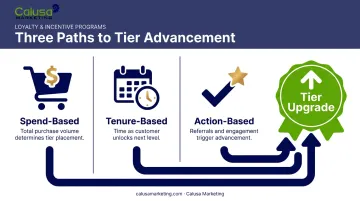
Businesses generally move members between tiers using one of three approaches:
- Spend-based — total purchase volume determines tier placement
- Tenure-based — time as a customer or employee unlocks the next level
- Action-based — referrals, reviews, or specific engagement behaviors trigger advancement
Once a business settles on a model, the next challenge is deciding how each tier's benefits actually reach the member.
Automatic vs. Earned Benefits
Not every tier benefit works the same way. Some, like Progressive's accident forgiveness, apply automatically the moment a milestone is hit. Others require the member to take action, like redeeming a specific offer or completing a referral. Spelling out which benefits are automatic versus opt-in upfront heads off support tickets from members expecting a perk that never arrives.
The payoff for building these tiers correctly shows up in the data. A longitudinal study of a German B2B distributor's multi-tier program, tracked from 2009 to 2017, found that a customer's absolute tier status affected their share of wallet. Any change in relative status between tiers had a measurable effect too. Separately, a Japanese supermarket chain's analysis of 263,163 customer visits found a three-tier structure outperformed a simpler two-tier design in modeled operating income.
Key Benefits of a Progressive Loyalty Rewards Program
Tiered structures aren't just a nice-to-have. They change how members behave.
- Higher retention: members have a growing incentive to stay rather than restart their progress with a competitor
- Increased average spend: the pull toward the next milestone pushes members to buy or engage more often
- Stronger referrals: top-tier members feel recognized and become natural brand advocates
- Better behavioral data: tier movement reveals which members are most engaged, and which are starting to disengage
- Lower acquisition costs over time: upgrading existing members costs far less than chasing new ones
That last point matters more than most businesses realize. Acquiring a new customer can cost 5 to 25 times more than retaining an existing one, depending on the industry according to Harvard Business Review. A tiered program directly targets that gap by making it easier and more rewarding to keep the customers you already have.
McKinsey's research on top-performing loyalty programs backs this up further. Programs that execute well can drive 15% to 25% annual revenue growth among members who actively redeem rewards. That growth comes from a mix of higher purchase frequency and larger basket size, driven directly by members chasing the next tier.
Types of Rewards to Offer at Each Loyalty Tier
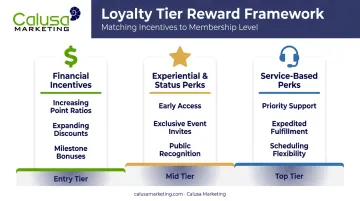
The right reward mix depends heavily on which tier you're designing for. Lower tiers need low-friction wins. Top tiers need something money alone can't easily replicate.
Financial incentives that scale with tier:
- Increasing point-earning ratios at higher levels
- Expanding percentage discounts as spend or tenure grows
- Unlocking bonus rewards at specific milestones
Experiential and status perks for top tiers:
- Early access to new products or promotions
- Invitations to exclusive events
- Public recognition that signals status, not just savings
Service-based perks that cost little but land big:
- Priority customer support lines
- Expedited order fulfillment
- Added scheduling flexibility for long-tenured clients
This is where reward variety earns its keep. A mid-tier member might respond well to a digital gift card. A top-tier client might want something different: a transferable travel certificate they can share with a spouse or gift to a customer of their own. That kind of reward feels personal, not transactional.
Common Pitfalls to Avoid When Building a Progressive Program
Even well-intentioned tiered programs fail when the mechanics get in the way of the psychology that makes them work.
Overcomplicating the structure. If members can't easily calculate where they stand or what they need to hit the next tier, they disengage. Deloitte's 2025 survey of 5,564 US loyalty members found that the average person belongs to eight programs but actively uses only five. Worse, 40% admitted to sometimes forgetting to redeem rewards entirely.
Letting top-tier rewards stagnate. Your most valuable members are the ones you can least afford to bore. A study of multi-tier B2B loyalty programs found a negative tenure effect on share of wallet among top-tier customers: elite members don't stay engaged on autopilot. They need refreshed value over time.
Failing to communicate progress clearly. The entire motivational engine behind progressive rewards depends on members seeing how close they are to the next milestone. Hide that information, and the incentive to keep going disappears with it.
A quick self-check before launch:
- Can a member explain their current tier and next milestone in one sentence?
- Does the top tier get new value at least annually?
- Is progress visible without requiring a support call?
How Calusa Marketing Helps You Build a Progressive Loyalty Program
Designing the tier logic is one thing. Running it, without turning your team into a full-time loyalty department, is another. That's where Calusa Marketing comes in.
Calusa designs and manages configurable, tiered loyalty and incentive programs through a cloud-based SaaS platform. There's no integration project and no app for clients or members to download, which matters when you're trying to launch a multi-tier program without months of IT overhead.
The reward flexibility maps naturally onto tier design:
- Digital punch cards for entry-level engagement and repeat-visit tracking
- ANY-Card gift cards with over 100 options, plus a VISA cash alternative, for mid-tier flexibility
- Fully transferable travel incentives for top-tier recognition, handled through white-glove fulfillment that covers bookings, confirmations, and guest support
This tier flexibility operates at scale: Calusa manages more than 1,000 programs serving 500,000-plus members, with a 99% client retention rate. Clients like Hajoca, spanning 800-plus locations, and Postmedia, which runs layered employee, subscriber, and advertiser incentive programs simultaneously, rely on this infrastructure to keep multi-tier programs running smoothly.
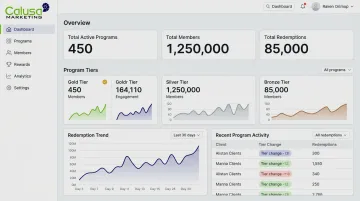
Once a program launches, Calusa's team handles ongoing management and provides customer support seven days a week. That support takes the operational weight of running a tiered program off your internal staff.
Frequently Asked Questions
What are loyalty rewards with Progressive? What are progressive loyalty rewards?
Progressive loyalty rewards are benefits that scale with a member's tenure or engagement instead of staying flat. Most programs grant baseline perks right away, then unlock additional rewards as members hit new milestones.
What does gold loyalty mean for Progressive? What does a "Gold" tier mean in a progressive loyalty program?
"Gold" typically marks a milestone a member reaches after hitting a tenure or spend threshold, unlocking perks unavailable to newer members. It's a visible signal of continued loyalty that encourages members to stay engaged.
How is a progressive loyalty program different from a standard loyalty program?
Standard programs give every member the same flat reward regardless of tenure or spend. Progressive programs increase reward value as members hit new spend, tenure, or engagement milestones.
What industries benefit most from progressive loyalty programs?
Distributors, retailers, media companies, and service businesses with repeat customers or long employee tenure see the biggest gains. Any business with an ongoing relationship, not a one-time transaction, is a strong fit.
How long does it take to launch a progressive loyalty program?
Timelines vary based on tier complexity and reward types. A configurable SaaS platform, rather than a custom-built system, can significantly shorten setup time from months to weeks.
Can progressive loyalty programs work for employees as well as customers?
Yes. The same milestone-based logic used for customer loyalty applies internally, rewarding tenure, performance, or referrals to boost employee and sales team retention.