That's contingent reward leadership in a nutshell: if you do this, you get that.
Many organizations struggle to strike the right balance between motivating performance and building genuine engagement. Lean too hard on rewards and you risk short-term thinking. Ignore them and you leave a proven motivational lever on the table. This post breaks down what contingent reward leadership actually is, its core traits, where it shines and where it falls short, and how real companies apply it.
Key Takeaways
- Contingent reward leadership ties specific rewards directly to pre-defined performance outcomes.
- It's a transactional style that complements, not replaces, vision-driven transformational leadership.
- Recognition paired with rewards can make employees four times more likely to stay engaged.
- Rewards work best when they boost engagement, not as a standalone performance fix.
- Distributors and channel networks often scale this style through structured, points-based programs.
What Is Contingent Reward Leadership?
"Contingent" simply means dependent on a condition being met. Applied to leadership, it means rewards only show up once specific, pre-established goals or behaviors have actually happened , not before, not as a gesture of good faith.
This concept comes directly from transactional leadership theory. James MacGregor Burns first drew the line between transactional and transformational leadership in 1978, and Bernard Bass expanded it for organizational settings in 1985. Contingent reward became one of the core transactional behaviors measured in leadership research ever since.
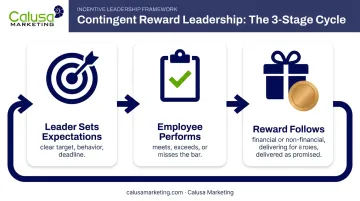
The mechanism is straightforward:
- Leader sets clear expectations: a target, a behavior, a deadline.
- Employee performs: meeting, exceeding, or missing that bar.
- Reward follows: financial or non-financial, delivered as promised.
This works because of a psychological principle called Social Exchange Theory: reciprocity. When a leader delivers on a promise, followers trust the exchange and reciprocate with effort. Break that trust once, and the whole system loses its motivational pull.
Contingent Reward vs. Transformational Leadership
Contingent reward leadership is transactional: it's an exchange. Transformational leadership is different: it inspires through shared vision, values, and purpose rather than a direct payoff.
Neither approach works best alone. Research on leadership styles has found that transformational leadership can add meaningfully to outcomes like satisfaction with supervision, even after contingent reward is already accounted for. In other words, clear exchanges get people moving, but purpose keeps them moving long after the bonus check clears. A simple example makes the contrast clear: a rep who hits quota earns a contingent bonus, while a leader who paints a vision for the team's future builds commitment that outlasts any single payout.
Contingent Rewards vs. Noncontingent Rewards
Noncontingent rewards show up regardless of performance: think base salary or standard health benefits. They're not earned through a specific achievement; they're part of the baseline deal.
Contingent rewards are different. They're earned, not guaranteed. That distinction matters practically:
Noncontingent rewards provide stability and security, while contingent rewards act as the lever for driving specific behaviors or results.
A company that only offers noncontingent pay has no built-in way to reward the rep who closed 30% more deals than everyone else on the team.
Key Characteristics of Contingent Reward Leadership
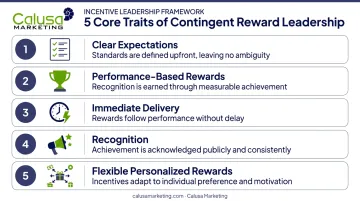
Not every "bonus program" qualifies as contingent reward leadership. A handful of traits separate the ones that actually work.
- Clear expectations. Leaders define measurable goals upfront (output-based, time-based, quality-based, or attitude-based) so employees know exactly what earns a reward.
- Performance-based rewards. Bonuses, cash awards, perks, or promotions attach to individual outcomes instead of getting spread evenly across the team.
- Immediate delivery. Rewards delivered right away reinforce the effort-to-outcome connection better than a bonus that arrives three months later.
- Recognition. Public or private acknowledgment builds trust and boosts performance; a 2022 Gallup-Workhuman recognition study found recognized employees are four times as likely to be engaged at work.
- Flexible, personalized rewards. Tailoring the reward (cash, merchandise, travel, gift cards) to individual preferences matters more than the dollar amount alone.
That last point trips up a lot of programs. Flexibility isn't a nice-to-have; it's what makes the reward land.
A $200 gift card means something very different to a 25-year-old sales rep than it does to a 50-year-old distribution manager.
Advantages and Disadvantages of Contingent Reward Leadership
Like any leadership tool, this one cuts both ways depending on how it's applied.
Advantages
- Reduced ambiguity. Clear if-then criteria help employees focus effort exactly where it matters, instead of guessing what leadership actually values.
- Cost efficiency. Tying spend directly to results makes contingent rewards a more targeted use of budget than blanket raises applied regardless of output.
- Short-term productivity gains. This approach can deliver measurable ROI fast, particularly in sales-driven environments where output is easy to track and reward.
Disadvantages
- Discourages risk-taking. An overemphasis on hitting specific results can push employees toward "safe," proven behaviors instead of creative problem-solving or experimentation.
- Creates internal friction. Poorly calibrated rewards, or those perceived as unfair, can spark competition or resentment among team members who feel the criteria weren't applied evenly.
- Doesn't guarantee results. A 2024 study of 273 healthcare employees found contingent rewards showed no significant direct link to performance; employee engagement, not the reward itself, drove the actual outcome.
Contingent Reward Leadership in Action
The clearest evidence for this style doesn't come from a boardroom. It comes from a battlefield simulation, where researchers assessed 72 U.S. Army infantry platoons and over 1,500 soldiers ahead of a two-week combat exercise.
Platoon leaders who scored high on contingent reward statements like "rewards us when we do what we're supposed to do" saw stronger unit performance. So did leaders who scored high on transformational behaviors like emphasizing shared mission. The study found both styles predicted performance, and neither replaced the other.
That pattern holds in business too. Sales teams, distributor networks, and customer-facing teams tend to perform best when contingent rewards (commissions, spot bonuses, tiered incentives) sit alongside a broader sense of purpose and recognition.
Distribution networks put this into practice at scale:
- Johnstone Supply runs a points-based loyalty program rewarding two trackable behaviors: ordering online and completing product education
- Baker Distributing rewards digital order adoption with points redeemable for gift cards
- Hajoca, operating across 800-plus locations, uses a custom KPI-linked program tied to enterprise-wide sales growth targets
Companies across industries, from HVAC and electrical distributors to media organizations, commonly partner with incentive marketing firms like Calusa Marketing to structure and administer these systems. This ensures rewards get delivered consistently and fairly across hundreds or thousands of participants.
Best Practices for Applying Contingent Reward Leadership
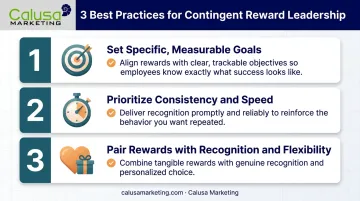
If you're building or refining a contingent reward system, a few practices separate the ones that stick from the ones that fizzle out:
- Start with specific, measurable, communicated goals. Employees should never have to guess what triggers a reward: spell it out before the program launches.
- Prioritize consistency and speed. Delayed or inconsistent delivery erodes the trust that makes this whole model work. Deliver on time, every time.
- Pair rewards with genuine recognition and flexible options. Cash works for some people; travel or merchandise works better for others.
Running this in-house, especially across a large distributor network or multi-location business, gets complicated fast — tracking points, fulfilling rewards, reporting results. That's the administrative burden a cloud-based incentive platform, like the ones Calusa Marketing builds for its clients, is designed to remove.
Programs like Johnstone Supply's and Hajoca's run on this kind of infrastructure specifically so the reward-tracking and fulfillment side doesn't fall on internal teams already stretched thin.
Frequently Asked Questions
What is contingent reward?
A contingent reward is compensation or recognition given specifically when an employee meets a pre-defined performance goal or behavior standard. It's earned, not automatic.
What is a contingent reward leadership style?
It's a transactional leadership approach where leaders set clear goals upfront and provide rewards only when those goals are actually achieved. No goal met, no reward delivered.
What is the difference between contingent and noncontingent rewards?
Contingent rewards require meeting specific criteria, like hitting a sales target. Noncontingent rewards, like base pay, are given regardless of performance outcomes.
What are the 4 types of reward and punishment?
Leadership research identifies four categories: contingent reward, contingent punishment, noncontingent reward, and noncontingent punishment. Only contingent reward and punishment tie directly to actual performance.
Is contingent reward leadership the same as transactional leadership?
Contingent reward leadership is a core component of transactional leadership, but transactional leadership also includes contingent punishment: corrective actions tied to performance shortfalls.
Does contingent reward leadership actually improve employee performance?
Research links contingent rewards to performance mainly through increased employee engagement, not direct cause and effect. They work best when employees feel invested, not just paid.