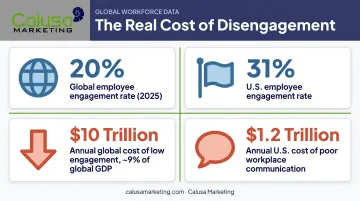
Only 20% of employees worldwide were engaged in 2025, and Gallup estimates that low engagement costs the global economy roughly $10 trillion in lost productivity every year — about 9% of global GDP. In the U.S., the number is better but still far from good: 31% engaged.
Here's the part most leadership teams miss: disengagement is rarely a pay problem or a perks problem. It's a communication problem. This article walks through the internal communication strategies — transparent leadership messaging, real feedback loops, and structured recognition — that actually move the needle on engagement.
Key Takeaways
- Trust, not perks, drives real engagement through consistent communication.
- Transparency during change builds the strongest employee confidence in leadership.
- Closing the feedback loop unlocks the fastest, most overlooked engagement wins.
- Recognition programs give employees a reason to engage with communication.
- Tracking eNPS, participation, and open rates turns engagement into a managed metric.
Why Internal Communication Is the Foundation of Employee Engagement
Poor internal communication carries a real, measurable cost. Vendor research from Grammarly and The Harris Poll estimated it costs U.S. businesses $1.2 trillion annually, or about $12,506 per employee, through wasted time, duplicated work, and missed deadlines. That's not a rounding error for most HR budgets.
Disengagement is almost always downstream of a communication breakdown. When employees don't understand why a decision was made, or don't trust that leadership is telling them the full story, they pull back. The signs are rarely dramatic. Instead, employees:
- Stop volunteering ideas in meetings
- Skim updates instead of reading them closely
- Settle into doing the minimum required
This is why so many engagement initiatives fall flat. A pizza party or a one-off wellness challenge can't fix a trust deficit. Companies that treat engagement as an events calendar instead of a communication discipline tend to see short-lived bumps, followed by the same disengagement creeping back in a few months later.
The rest of this article covers what actually works: consistent, honest communication paired with real feedback and recognition systems.
Strategy 1: Build Trust With Transparent, Consistent Leadership Communication
Transparency is the foundation everything else sits on. Employees don't expect leadership to have every answer: they expect honesty about what's known, what isn't, and when they'll hear more.
Communicate Proactively During Times of Change
Change is where trust is won or lost. A few guidelines:
- During a merger or acquisition: Lead with confirmed facts, name what's still undecided, and give a realistic timeline for the next update. Silence gets filled with rumor.
- During a reorg or layoffs: Explain the business rationale plainly, acknowledge the disruption honestly rather than minimizing it, and detail the support available for both departing and remaining staff.
McKinsey's research on M&A transitions found that employees trust their direct supervisor more than any other information source during a deal. Equipping managers to deliver this messaging matters as much as the message itself.
Establish Multiple Channels With a Consistent Cadence
One well-run town hall does more for trust than a dozen scattered emails. Structured Q&A sessions, run consistently, signal that leadership is willing to be questioned in public, not just praised.
A few practical additions:
- Newsletters and a company intranet create a single source of truth, reducing the "did you hear..." rumor mill.
- Ask employees which channels they actually use through a short pulse survey rather than assuming. Axios HQ found that 67% of employees prefer email or newsletters for critical updates.
Strategy 2: Build a Genuine Two-Way Feedback Loop
Collecting feedback that never leads anywhere is worse than not asking at all. It tells employees their input is theater.
Collect Feedback Consistently Through Multiple Touchpoints
Skip the once-a-year, 80-question engagement survey as your only listening tool. Instead:
- Run short pulse surveys monthly or quarterly
- Use one-question polls embedded in existing communications
- Keep an open, anonymous comment channel running year-round for sensitive topics like workload, burnout, or psychological safety
Anonymity matters here, because employees are far more candid about a toxic manager or an unrealistic deadline when they know their name isn't attached to the response.
Close the Loop So Employees See Their Input Matters
This is the biggest gap in internal communication today. Qualtrics found that 84% of HR leaders believe their organization uses feedback effectively. Only 43% of employees report seeing any positive change after taking a survey, a 41-point perception gap between what leadership believes and what employees experience.
Closing that gap doesn't require a new system. It requires a habit:
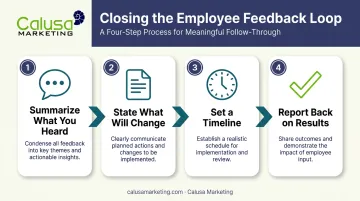
- Summarize what you heard in plain language, not corporate jargon
- State what will change, what won't, and why
- Set a timeline for follow-through
- Report back on whether it actually happened
The easiest way to make this stick? Embed a short "you said, we did" recap into the newsletter you're already sending. Don't treat it as a separate initiative: that's how it gets forgotten.
Strategy 3: Recognize and Reward Employees to Reinforce Engagement
Recognition is one of the highest-ROI levers in engagement, and one of the most poorly executed. Most programs are infrequent, generic ("great job, team!"), or entirely top-down, which drains their impact fast.
Build a Structured, Values-Based Recognition Program
A recognition program needs actual structure to work:
- Define the goal: is this about retention, values reinforcement, or performance?
- Vary the methods: peer shoutouts, service milestones, spot bonuses
- Set clear nomination criteria so recognition doesn't feel arbitrary
- Promote it consistently so it stays visible, not a forgotten Slack channel
Specific, tied-to-an-action recognition ("You stayed late to fix the client escalation on Tuesday: that mattered") consistently outperforms generic praise.
According to a Gallup and Workhuman study of over 3,400 U.S. employees, those who received high-quality recognition were 45% less likely to leave their organization within two years. That's one of the strongest retention signals in engagement research.
Scale Recognition With Incentive & Reward Programs
Manual recognition (a card, a shoutout in a meeting) is meaningful but hard to scale. Structured incentive programs solve that, giving HR and comms teams a consistent, low-effort way to keep recognition running without adding to their workload.
This is where a company like Calusa Marketing fits in. As a technology-based incentive marketing firm, Calusa builds and fulfills employee recognition programs through:
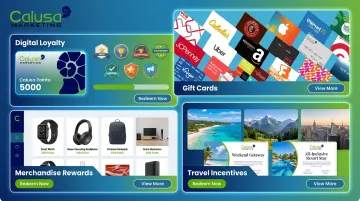
- Digital loyalty cards that replace paper punch cards, delivered straight to an employee's phone wallet with no app download
- Gift card programs (its ANY-Card platform) spanning 100+ retail and dining options
- A merchandise rewards catalog with over 10 million items from brands like Nike, Apple, and Yeti, shipped to 100+ countries
- Travel incentives, ranging from hotel and cruise certificates to fully managed group trips for President's Club-style events
The real value of a platform like this comes from removing the administrative burden, not the reward catalog itself. Cloud-based, no integrations, no app to manage. That's what keeps a recognition program running consistently instead of fizzling out after the first quarter.
One more piece worth building in: involve managers directly in the nomination and recognition process. Recognition that only flows from the C-suite reaches a fraction of the workforce. Recognition that managers can trigger in the moment reaches everyone.
Measuring the Impact of Your Internal Communication Strategy
None of this matters to leadership without numbers behind it. Three KPIs worth tracking on an ongoing basis:
| KPI | What It Tells You |
|---|---|
| eNPS (Employee Net Promoter Score) | % promoters minus % detractors on a 0-10 "would you recommend working here" scale |
| Survey participation rate | Whether employees believe their input is worth the time to give |
| Communication open rates | Whether your channels are actually reaching people |
A few practical notes on benchmarks: there's no universal "good" eNPS score, so treat it as a trend line specific to your organization rather than a target to chase.
Email open rates vary widely too, ranging roughly 50% to over 70% depending on platform and definition. Compare your own numbers over time rather than against outside averages.
Beyond the top-line numbers, segment this data by department, location, and tenure. A company-wide average can hide a struggling team or location that's quietly bleeding people. Catching that in the data is far cheaper than catching it in exit interviews.
Finally, measure continuously rather than relying on a single annual survey. Monthly or quarterly tracking gives comms and HR teams the evidence trail needed to justify continued investment when budget conversations come around.
Frequently Asked Questions
What are the 5 strategies to improve communication in the workplace?
The core strategies are: transparent leadership communication, consistent multi-channel messaging, two-way feedback loops that close with action, structured recognition programs, and ongoing measurement of engagement metrics like eNPS and open rates.
What is an internal communication strategy?
It's a structured, repeatable plan for how an organization shares information, gathers employee feedback, and builds trust across channels like town halls, newsletters, and intranets, rather than communicating reactively or on an ad-hoc basis.
How does internal communication affect employee engagement?
Clear, consistent communication builds the trust and clarity employees need to stay invested in their work. Without it, engagement initiatives like recognition or perks tend to fall flat because they aren't backed by genuine confidence in leadership.
What are common barriers to internal communication in the workplace?
The most common barriers are inconsistent messaging across channels, relying on only one communication method, and collecting employee feedback that never visibly leads to action. This gap erodes trust over time.
How can incentive and recognition programs improve internal communication?
Recognition gives communication a positive, tangible purpose. When employees see input and effort acknowledged through specific praise or rewards, they're more likely to stay engaged with company messaging going forward.
How do you measure the success of an internal communication strategy?
Track KPIs like communication open rates, survey participation, and eNPS consistently over time rather than relying on an annual check-in. Segmenting this data by team or location helps catch disengagement before it shows up in turnover.