Motivating retail employees is genuinely harder than motivating a typical office team. Your workforce is deskless, mostly hourly, and often juggling multiple jobs. Margins are thin, schedules shift weekly, and customers don't pause for a bad day. Generic corporate engagement tactics — annual surveys, quarterly all-hands meetings, a plaque in the break room — simply don't reach someone stocking shelves at 6 a.m.
This guide walks through the exact steps for building a motivation strategy that works for hourly, high-turnover retail teams: what to do first, what you need in place before you launch, and the mistakes that quietly sink otherwise well-funded programs.
Key Takeaways
- Retail motivation needs both intrinsic drivers (autonomy, growth) and extrinsic rewards (pay, recognition)
- Real-time, mobile-first recognition beats once-a-year perks for deskless frontline staff
- Structured, KPI-linked incentives outperform one-off gestures like pizza parties
- Most failures stem from excluding part-time staff or inconsistent manager follow-through, not budget
- Baseline data and leadership buy-in matter more than program size
How to Improve Employee Motivation in Retail: Step-by-Step
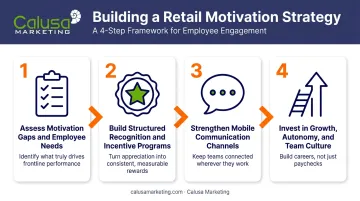
Step 1: Assess Current Motivation Gaps and Employee Needs
Before designing anything, find out what's actually broken. Pulse surveys and exit interviews reveal specific pain points, such as pay, scheduling, recognition, and communication, instead of forcing a one-size-fits-all fix onto every store.
, since gaps rarely look the same across a chain. One store might struggle with scheduling; another with manager relationships
- Segment by motivation type — some employees respond to achievement and competence (clear goals, skill-building), others to purely extrinsic drivers (pay, rewards)
- Prioritize interventions based on where turnover risk and dissatisfaction are highest, not where it's easiest to act
Skipping this step is the single fastest way to waste a program budget on the wrong fix.
Step 2: Build Structured Recognition and Incentive Programs
in-the-moment shoutouts, whether from a peer or a shift manager, do more retention work than a once-a-quarter award ceremony.
Beyond recognition, structured incentives give employees something concrete to work toward:
- Bonuses or spot cash tied to sales targets or attendance
- Gift cards for hitting customer satisfaction benchmarks
- Digital punch cards for consistent, everyday performance
- Travel rewards for top-tier annual achievement
, with no corporate login required 2. Build two-way feedback channels so associates can flag issues, not just receive announcements 3. Replace email newsletters with real-time shift alerts so nobody gets blindsided by a schedule change
If your only communication channel is an email inbox nobody checks, even a well-designed recognition program won't reach the people it's meant for.
Step 4: Invest in Growth, Autonomy, and Team Culture
Career development isn't a nice-to-have. McKinsey's research found it was the top-ranked reason frontline retail workers considered leaving, and employees who felt their employer invested in their development were four times more likely to say they intended to stay.
Practical ways to build this in:
- Embed microlearning into daily workflows rather than a standalone training portal nobody opens
- Give employees real autonomy over task order or minor decisions, and involve them in goal-setting
- Protect break spaces and schedule team activities, especially during peak seasonal crunches when burnout spikes
None of this replaces pay or recognition. It works alongside them.
When and What You Need Before Launching a Retail Motivation Strategy
Timing and preparation determine whether a motivation program sticks or quietly dies after a few weeks.
When to Prioritize a Formal Initiative
- Turnover, absenteeism, or customer satisfaction scores are trending downward
- You're entering a seasonal hiring surge or opening new stores, when new hires form habits early and are easiest to shape
- Employee surveys or exit interviews keep surfacing the same complaints about recognition or pay
Waiting until these signals pile up only makes the fix more expensive to reverse. Treat any one of them as your launch trigger, not as background noise to monitor for another quarter.
What You Need Before You Start
Once you've decided to launch, three prerequisites determine whether the program takes hold:
| Prerequisite | Why it matters |
|---|---|
| Leadership and store-manager buy-in | Recognition behaviors need to be modeled, not just mandated by HR |
| Baseline data | Current engagement, turnover, and absenteeism figures let you measure real movement |
| A low-friction tool | Choose the platform before launch, not mid-rollout |
A cloud-based platform like Calusa Marketing's needs no app download or IT integration, letting managers launch in days rather than months.
Skipping the baseline data step is common and costly: without it, you can't prove the program worked, even if it did.
Key Factors That Affect Motivation Program Results in Retail
Program outcomes depend less on size than on how well a handful of variables are managed:
- Reward timing and frequency: Delayed recognition disconnects the reward from the effort. A bonus that arrives eight weeks later won't reinforce the behavior you want repeated.
- Accessibility for deskless staff: Requiring a corporate email or desktop login locks out most of the frontline workforce before the program even starts.
- Manager involvement and consistency: Employees look to their direct supervisor for day-to-day recognition, so inconsistent follow-through undermines even a well-designed program.
- Fairness across roles: Rewarding only top sellers alienates stockers, cashiers, and support staff—the people keeping the store running. Broad-based incentives lift morale more evenly than a single leaderboard.
Common Mistakes to Avoid When Motivating Retail Employees
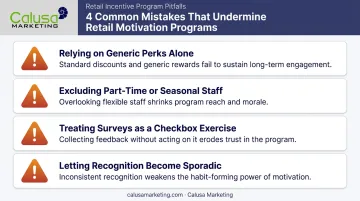
- Relying on generic perks alone — pizza days and gift cards don't fix broken scheduling or communication gaps underneath
- Excluding part-time or seasonal staff from eligibility, which alienates the majority of your frontline headcount
- Treating surveys as a checkbox instead of acting on the feedback and closing the loop with employees
- Letting recognition become sporadic, which fails to reinforce the behaviors the program was built to encourage
Conclusion
Retail motivation comes down to three things: access, timely recognition, and consistent follow-through. Not a single perk, not one big program launch.
Most failed initiatives trace back to poor accessibility for hourly staff or inconsistent execution rather than lack of budget. Get the fundamentals right first, and the size of the program matters far less.
Executing this consistently takes bandwidth that many retail teams don't have in-house. Retailers in that position don't need to build the program alone. Calusa Marketing works with retail and consumer-facing businesses to handle incentive program setup, gift card and merchandise fulfillment, and reward logistics. That way, managers can stay focused on the floor instead of chasing down prize orders.
Frequently Asked Questions
How do you motivate employees in retail?
Combine fair, timely pay with real-time recognition, accessible mobile communication, and visible growth opportunities. Programs that skip any one of these tend to underperform, regardless of budget.
What motivates people to work in retail?
Industry surveys consistently point to team culture, recognition, flexible scheduling, and career growth potential. Career development ranks especially high among reasons employees stay or leave.
What are the most effective incentives for retail employees?
Bonuses, gift cards, discounts, and travel rewards tied to measurable KPIs like sales, attendance, or customer satisfaction tend to outperform one-off, unstructured perks.
How much does high turnover cost retail businesses?
Broad industry benchmarks put replacement costs anywhere from roughly a third of an employee's salary to well over 100%, depending on role and seniority. Exact retail-specific figures vary widely by position.
How often should retail managers recognize employee performance?
Gallup's benchmark recommends recognition at least every seven days, delivered soon enough that employees can connect it directly to their effort. Delayed or annual-only recognition loses most of its motivational value.
Can small retail businesses afford incentive and recognition programs?
Yes. Digital punch cards, gift cards, and scaled merchandise rewards are all low-cost entry points. Partnering with an incentive marketing firm like Calusa Marketing can also reduce setup and management costs compared to building a program from scratch.