Introduction
Vendor onboarding is the structured process of collecting, verifying, and integrating a new vendor into your company's systems before any work begins or a single invoice gets paid. Skip a step, and you're looking at compliance gaps, payment delays, or a vendor relationship that sours before it starts.
This guide is built for procurement, finance, and operations teams, including distributors and dealer network managers, who need a process that actually holds up under scrutiny.
A weak onboarding process doesn't just slow things down. It exposes your organization to fraud, compliance violations, and vendor performance issues that surface months later.
"Vendor onboarding" gets thrown around a lot, but few teams break it down step-by-step. Here's what actually happens, in order, and when to adjust the process based on risk.
Key Takeaways
- Vendor onboarding gathers documents, verifies compliance, and configures systems before work begins
- A structured process cuts risk, speeds payments, and builds stronger vendor relationships
- The process spans risk assessment, data collection, contracting, system setup, and performance monitoring
- Onboarding depth should scale with vendor risk and spend, since not every vendor needs equal scrutiny
What Is Vendor Onboarding?
Vendor onboarding is the process of collecting, verifying, and integrating a new vendor's business, tax, banking, and compliance information into your company's systems. It's the administrative and financial groundwork that happens before a vendor ships product, delivers a service, or gets paid.
Done right, the outcome is simple: a vendor that's compliant, correctly configured for payment, and ready to deliver without delays on either side.
Vendor Onboarding vs. Supplier Onboarding vs. Vendor Management
These terms get used interchangeably, but they cover different territory:
- Vendor onboarding focuses on administrative and financial setup : contracts, tax forms, banking details, system access
- Supplier onboarding covers broader operational readiness, including delivery capability, quality standards, and supply chain compliance
- Vendor management is the ongoing relationship that follows onboarding : performance tracking, renewals, and issue resolution
Think of onboarding as the front door and vendor management as everything that happens once the vendor is inside the building. Both feed into each other, but they're not the same function.
Why a Strong Vendor Onboarding Process Matters
Vendor onboarding rarely lives in one department. Procurement, finance, legal, compliance, and IT all touch it at some point, and clean handoffs between those teams determine whether a vendor gets set up smoothly or gets stuck in email limbo for three weeks.
The risk of getting this wrong isn't theoretical. According to Gartner's 2023 survey on third-party risk, 45% of organizations experienced at least one third-party-related business interruption in the prior two years. The survey included 376 senior executives who manage third-party risk.
That figure reflects overall third-party exposure, not proof that every incident traces back to weak onboarding. Still, it makes a strong case for tightening the process wherever you can.
Skip proper onboarding steps, and here's what typically follows:
- Fraud exposure from unverified banking or entity details
- Compliance violations tied to missed tax or sanctions checks
- Payment failures caused by incomplete or inaccurate vendor data
- Strained relationships when vendors face delays through no fault of their own
None of these are edge cases. They're the predictable result of rushing a process that's supposed to catch problems before they start.
The Vendor Onboarding Process: Step-by-Step
At a high level, vendor onboarding flows through six phases: request and risk-tier the vendor, verify their data, finalize terms, integrate them into your systems, train them, and then monitor performance. Here's how each step actually works.
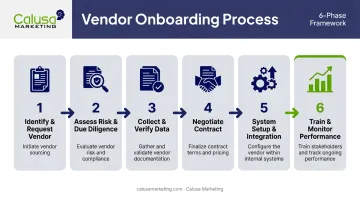
Step 1: Identify and Request the Vendor
The requesting department flags the need for a new vendor and confirms there's budget behind it. Someone, usually a procurement analyst, is assigned as the internal owner responsible for shepherding the vendor through every remaining step.
Without a named owner, onboarding stalls. Documents sit in inboxes. Nobody follows up. Assigning ownership on day one is the single easiest fix for slow onboarding.
Step 2: Assess Risk and Conduct Due Diligence
This is where the vendor's business licenses, tax registrations, and insurance certificates get collected, alongside sanctions screening and conflict-of-interest checks.
It's also where a lot of organizations fall short. Refinitiv surveyed 1,794 risk and compliance professionals across 16 countries and found that only 41% fully screened third parties against risk during onboarding. The same survey found 43% of third-party relationships received no due diligence at all.
The U.S. Treasury's OFAC guidance recommends a risk-based screening framework covering counterparties, transactions, and geographies. It doesn't mandate a single universal checklist, but it does expect organizations to have some documented approach.
Step 3: Collect and Verify Vendor Data
Here's what typically gets gathered:
- Legal entity name and structure
- Tax ID, along with a W-9 (domestic) or W-8 (foreign entity)
- Banking information for payment setup
- Ownership and beneficial-owner details
Verification tools that cross-check this data against government or financial databases catch errors before they hit your ERP system. A mistyped account number here is far cheaper to fix than a failed payment three weeks later.
Step 4: Negotiate and Finalize the Contract
Pricing, payment terms, delivery schedules, and service-level agreements get locked in during this step. Fair negotiation matters more than squeezing the best possible terms. A vendor who feels steamrolled in contracting rarely performs at their best down the line.
Step 5: Set Up and Integrate Systems
The vendor gets added to procurement, ERP, and accounts payable systems. IT provisions any necessary portal access, while AP configures payment terms, approval workflows, and remittance details.
This step is where manual, spreadsheet-driven processes tend to break down. One missed field in the AP system can delay a vendor's first payment by weeks.
Step 6: Train the Vendor and Monitor Ongoing Performance
Vendors receive portal access, invoicing instructions, and a clear picture of what's expected of them. Once they go live, ongoing KPI tracking (accuracy, lead time, responsiveness) keeps the relationship on track.
Institute for Supply Management research notes there's no industry consensus on how long onboarding should take: it can stretch to six months at large companies, though one CAPS Research member company managed the full process in 8 to 10 weeks. Timelines depend heavily on vendor risk and documentation complexity.
Vendor Onboarding Best Practices and Common Pitfalls
Most onboarding delays trace back to a handful of recurring problems:
- Manual, spreadsheet-based tracking that slows down validation and loses documents in email threads
- Incomplete vendor data that forces rework weeks after the vendor thought they were done
- Compliance checks skipped under deadline pressure, especially when a business unit wants a vendor live "yesterday"
- Unclear ownership across procurement, finance, and legal, so nobody actually drives the process to completion
Counter these with a few practical fixes:
- Standardize with checklists: every vendor tier gets a defined document list, no exceptions
- Centralize vendor data in one system instead of scattered spreadsheets and email attachments
- Automate approval routing so requests move without someone manually chasing sign-off
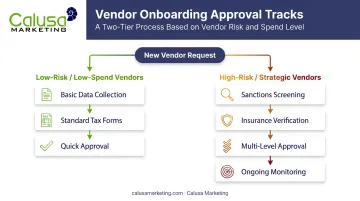
These fixes address the process bottlenecks, but one misconception deserves attention too: not every vendor needs the same level of scrutiny.
A tiered approach works better: low-spend, low-risk vendors move through a light-touch process, while high-risk or strategic vendors get the full due diligence treatment. This balances speed against control. Applying maximum scrutiny to every single vendor just slows everything down without adding proportional value.
Vendor Onboarding Checklist and Measuring Success
A phase-based checklist keeps the process consistent across departments:
| Phase | Key Actions |
|---|---|
| Pre-onboarding | Vendor request submitted, internal owner assigned |
| Due diligence | Risk assessment, sanctions and compliance checks |
| Data collection | Tax forms, banking details, insurance certificates gathered |
| System setup | AP and ERP configuration, access provisioning |
| Vendor orientation | Portal access granted, training completed |
Once the process is running, track these KPIs to see whether it's actually working:
- Onboarding cycle time — how many days from request to go-live
- First-pass data accuracy rate — how often vendor submissions are accepted without correction
- Compliance pass rate — the share of vendors clearing checks on the first attempt
- Vendor satisfaction score — feedback from the vendors who just went through the process
Cycle time is the most well-documented metric here, with APQC (American Productivity & Quality Center) defining it as the calendar days needed to set up a supplier in the procurement system. The other three are worth tracking internally, even without a published industry benchmark to compare against.
Beyond Onboarding: Keeping Vendors and Dealers Engaged Long-Term
Getting a vendor through onboarding is just the first step. For distributors and dealer networks — HVAC, electrical, plumbing, and beyond — the real challenge is keeping vendors motivated, compliant, and performing well after go-live.
That's why many organizations pair a solid onboarding process with structured incentive and loyalty programs. These reinforce the behaviors that matter after a vendor is already in the system: timely reporting, consistent sales performance, and adherence to program requirements.
Calusa Marketing works with distributors on exactly this kind of post-onboarding engagement. The St. Petersburg, FL-based incentive marketing firm builds programs using digital punch cards, gift card fulfillment, and travel rewards to keep dealer networks active long after the paperwork is done. Some examples from their client base:
- Johnstone Supply runs a points-based rewards program that encourages online ordering and product education among its dealer network
- Baker Distributing (Watsco) uses a similar points structure to drive digital channel adoption among dealers
- Midstate Tire rewards dealers based on purchase volume and account growth over time
Calusa Marketing has managed more than 1,000 programs across industries with a 99% client retention rate, a figure that reflects performance across its full client base rather than one specific vertical.
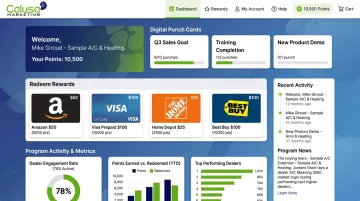
For distributors thinking beyond the onboarding checklist, that kind of ongoing engagement layer often separates a vendor who sticks around from one who drifts to a competitor.
Frequently Asked Questions
How much does vendor onboarding cost?
Costs vary widely based on vendor risk level and whether the process is manual or automated. Expect to account for internal labor hours, verification tools, and any onboarding software your team relies on.
What are the 4 stages of onboarding?
Most processes break down into due diligence and risk assessment, data collection and verification, system setup and contracting, and vendor orientation and training. Exact stage names vary by organization.
What is another name for vendor onboarding?
It's commonly called "supplier onboarding," though the two terms can differ slightly in scope. Vendor onboarding leans toward financial and administrative setup, while supplier onboarding often includes operational readiness.
How long does vendor onboarding typically take?
Timelines depend on vendor risk and documentation complexity. Low-risk vendors can move through in a few weeks, while strategic or high-risk suppliers may take considerably longer due to added due diligence.
What documents are typically required during vendor onboarding?
Common documents include a W-9 or W-8 tax form, business licenses, insurance certificates, banking details for payment setup, and a signed contract. Exact requirements depend on the vendor's tax status, industry, and jurisdiction.
Who is responsible for vendor onboarding within a company?
Procurement typically owns the overall process, but finance, legal, compliance, and IT each contribute at specific stages. Clear ownership at each handoff point is what keeps the process moving without delays.