
That's pushed millions of people toward vacation rewards programs. But with airline miles, hotel points, travel credit cards, membership clubs, and employer-sponsored travel perks all competing for attention, figuring out which one actually saves you money gets confusing fast.
This guide breaks down what vacation rewards programs are, the main types available, and how the top options stack up for different kinds of travelers. We'll also cover how businesses are using custom travel rewards to keep employees and customers loyal.
Key Takeaways
- Earn points, credits, or discounted rates for flights, hotels, cruises, and resorts
- Choose from airline, hotel, credit card, membership, or incentive travel programs
- Match programs to your travel frequency, brand loyalty, and redemption needs
- Vacation ownership, media, and distribution firms build custom loyalty programs
What Is a Vacation Rewards Program?
A vacation rewards program is any system that lets members earn points, credits, or access to discounted rates that can be redeemed for travel: flights, hotel stays, cruises, or resort vacations.
The mechanics are simple on paper: members earn through spending, brand loyalty, membership fees, or job performance, then redeem those earnings for bookings, wholesale rates, or travel certificates.
Where This Started (and How Big It's Gotten)
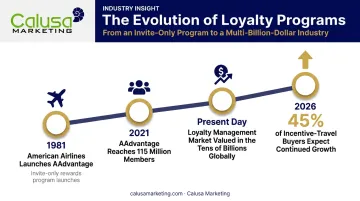
American Airlines launched AAdvantage on May 1, 1981, as an invite-only program. Early members could redeem points for a first-class ticket to any American destination. By its 40th anniversary in 2021, AAdvantage had grown to 115 million members.
That single program spawned an entire industry. Loyalty management as a broader market is now valued in the tens of billions globally, and incentive travel specifically continues to expand: a 2024 survey of more than 2,800 incentive-travel professionals found 45% of buyers expected activity to grow beyond 2024 levels by 2026.
Who Offers These Programs
- Airlines and hotel chains (the original model)
- Credit card issuers
- Travel agencies and consortiums
- Dedicated vacation clubs
- Businesses in unrelated industries using travel as a motivational tool
Some programs are free to join. Others, particularly membership travel clubs and vacation-ownership-affiliated rewards, involve a membership fee. Either way, the program should deliver measurable savings that outweigh what you paid to join.
Types of Vacation Rewards Programs
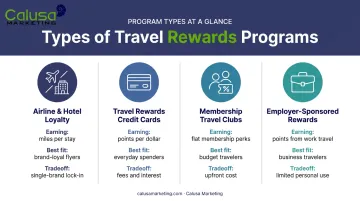
Four major categories dominate the space. Which one fits you best depends on your travel habits, or, if you're a business, your incentive goals.
Airline & Hotel Loyalty Programs
These are the original model. You earn points or miles for every flight or hotel stay, then redeem them for free travel, seat upgrades, or resort nights.
Tiered elite status adds another layer:
- Lounge access
- Complimentary upgrades
- Priority boarding and check-in
- Bonus earning rates on future bookings
The catch: value depends heavily on your specific airline or hotel brand's redemption chart, which can change without much warning.
Travel Rewards Credit Cards
Cardholders earn points or cash back on everyday purchases. These points can often transfer to airline and hotel partners or apply as statement credits toward travel purchases.
Sign-up bonuses matter here more than almost any other factor. A single bonus can be worth more than a year of regular spending, which is why comparison sites treat bonus value as a core part of ranking these cards.
Membership Travel Clubs & Wholesale Discount Programs
These clubs work differently than point-based systems. Instead of earning and redeeming, members pay a fee (or hold a qualifying membership) for ongoing access to:
- Wholesale-rate travel packages
- Price matching against other booking sites
- Bundled extras like resort credits or transportation
Costco Travel is a widely cited example. Consumer Reports found one luxury Hawaii package priced $7,684 less through Costco Travel than booking the same components separately, plus a $961 gift card bundled in.
That said, these savings aren't universal. Blackout dates can still apply, and package bookings sometimes don't earn hotel loyalty points.
Employer & Business-Sponsored Vacation Rewards
Companies increasingly reach for travel instead of cash bonuses or generic gift cards to motivate employees and reward loyal customers.
There's data behind this shift. A 2023 survey of 939 North American workers removed cash and gift cards as reward options entirely. The result: travel ranked as the single most-preferred reward, beating out paid time off, flexible scheduling, and career development opportunities.
Calusa Marketing has seen this firsthand across several industries. Media companies like iHeart Media and Audacy use travel incentives to drive incremental advertising spend, while distributors like Hajoca and Johnstone Supply use them to reward dealer performance and sales growth.
Best Vacation Rewards Programs, Reviewed
"Best" isn't a single answer here. It shifts based on who's traveling and how. Below are five categories worth reviewing separately.
Best for Frequent Flyers
The Points Guy's 2025 US airline assessment weighted loyalty at 25% of its overall score, alongside reliability, experience, cost, and reach. Two programs stood out: United MileagePlus ranked first in the loyalty component, thanks to Premier elite benefits and Star Alliance's extensive network, while American AAdvantage earned praise for strong partner airline coverage and competitive award rates.
Both reward frequent flying well, but MileagePlus edges ahead for long-haul upgrade value specifically.
Best for Hotel Loyalists
| Program | Standout Perk | Redemption Detail |
|---|---|---|
| World of Hyatt | Globalist tier includes free breakfast, waived resort fees, suite upgrades | Certificates split into Category 1-4 and Category 1-7 tiers |
| Marriott Bonvoy | Room upgrades, lounge access | Fifth award night free on 5+ consecutive night stays |
| Hilton Honors | Elite tiers starting at Silver | Fifth consecutive award night free |
| IHG One Rewards | Milestone lounge memberships, suite upgrades | Fourth award night free with eligible cobranded card |
Hyatt tends to score well for redemption value on high-end properties, while Marriott and Hilton offer broader hotel availability across price points.
Best for Flexible Points Transfer
If you don't want to commit to one airline or hotel brand, transferable credit card points solve that problem.
- Chase Ultimate Rewards: 10 airline and 4 hotel transfer partners, mostly at 1:1 ratios
- American Express Membership Rewards: 17 airline and 3 hotel partners, though transfer ratios vary (Amex-to-JetBlue runs 5:4, versus Chase's 1:1)
- Citi ThankYou Points: 15 airline and 5 hotel partners, with ratios that shift by card type
One important caveat: transfers are generally irreversible. Don't move points to a partner program until you've confirmed award availability.
Best for Value-Conscious & Group Travelers
Membership travel clubs and wholesale programs suit travelers who want predictable savings without chasing point valuations. These programs typically use group buying power to negotiate rates that individual travelers can't access alone.
They're a strong fit if you:
- Travel with family or larger groups regularly
- Prefer bundled packages over building your own itinerary
- Want price transparency over speculative point value
Best for Business & Employee Incentive Travel
For companies building incentive travel programs, "best" means something different entirely. It's less about cents-per-point valuations and more about:
- How easily the platform integrates with existing operations
- Whether the provider handles booking, confirmations, and guest support
- Group buying power for larger cohorts
This is where a managed provider matters more than any single loyalty program. Calusa Marketing, for example, manages 1,000+ programs and 500,000+ program members, handling group travel for anywhere from 10 to 10,000 people with full booking and confirmation support included.

Benefits and Potential Drawbacks of Vacation Rewards Programs
The Upside
- Real savings on flights, hotels, and cruises through everyday spending or performance
- "Free" trips funded by points instead of cash
- Exclusive perks like lounge access, upgrades, and priority service
The Downside
Point values aren't fixed. They can shrink without warning.
The Points Guy analyzed nearly 15,000 Marriott award-price data points in 2025 and lowered its Marriott Bonvoy valuation to 0.7 cents per point, a 17.6% decrease from the prior estimate. One property, the JW Marriott Masai Mara Lodge, jumped to as high as 236,000 points for a single night after Marriott adjusted award pricing.
Other common drawbacks:
- Membership fees that require enough travel to justify
- Blackout dates on premium redemption periods
- Dynamic pricing that raises point requirements even when your balance hasn't changed
For businesses, a poorly structured program creates its own headaches, from booking confusion and redemption disputes to member support requests that pull staff away from core work. A full-service partner like Calusa Marketing removes that burden by directly managing bookings, confirmations, member inquiries, and dispute resolution.
How to Choose the Right Program — Or Build Your Own for Your Business
For Individual Travelers
- Match the program to your travel frequency. Frequent flyers benefit most from airline loyalty; occasional travelers often do better with flexible credit card pointspoints.
- Check redemption flexibility. Look for blackout date policies and how far in advance you need to book.
- Confirm fees are worth it. Membership clubs only pay off if the savings exceed what you paid to join.
For Businesses Building Incentive Travel Programs
Look for a partner that offers:
- A cloud-based platform with no app download or software integration required.
- Full-service fulfillment, including bookings, confirmations, and guest support.
- Genuine group buying power for larger travel groups.
Calusa Marketing fits this model directly. The company manages more than 1,000 programs and 500,000+ program members, maintaining a 99% client retention rate across clients in media, distribution, vacation ownership, and retail. Programs range from hotel and cruise certificates to full group travel for up to 10,000 people, with Calusa's team handling every booking detail so clients don't have to.
If you're weighing whether to build a custom vacation rewards program for your employees or customers, reach out to Calusa Marketing for a consultation to talk through what fits your budget and goals.
Frequently Asked Questions
What are the best travel rewards programs?
It depends on your travel type. Frequent flyers do best with airline loyalty programs, hotel loyalists with brand-specific tiers, and occasional travelers with flexible credit card points. See the reviews above for specific picks.
How do vacation rewards programs work?
Most programs follow an earn-and-redeem model: you accumulate points, miles, or credits through spending, loyalty, or performance, then redeem them for flights, hotels, cruises, or resort stays. Redemption values vary widely by program.
Are vacation rewards programs worth it?
For frequent travelers, yes, most see net savings over time even after accounting for fees. Occasional travelers should run the math carefully, since membership costs or minimum spending thresholds can eat into the value.
Can businesses create their own vacation rewards program for employees or customers?
Yes. Companies like Calusa Marketing build custom-branded travel reward platforms tailored to a client's specific goals, whether that's employee retention, sales performance, or customer loyalty.
What's the difference between a travel rewards credit card and a membership travel club?
Credit cards use a spend-to-earn model where points accumulate on purchases and transfer to travel partners. Membership clubs typically charge a flat fee for ongoing access to wholesale or discounted rates, no spending required.
Do vacation reward points expire?
Expiration policies vary considerably by program. Some points never expire as long as the account stays active, while others expire after a set period of inactivity. Always check the specific program's terms before assuming your balance is safe.