That assumption creates real exposure. The IRS treats gift cards as cash equivalents, not gifts, which means they're taxable wages the moment they hit an employee's hands. Skip the withholding, and you're looking at back taxes, penalties, and a messier payroll audit than any $25 card was worth.
This guide breaks down the actual IRS rule, why the "de minimis" exception doesn't save you here, how to withhold and report correctly, the narrow exceptions that do exist, and how to build a recognition program that won't trigger a compliance headache.
Key Takeaways
- Gift cards count as taxable wages at any dollar amount — no de minimis exception applies
- Employers must withhold federal income tax, Social Security, and Medicare on every gift card distributed
- W-2 reporting requires including gift card value in Boxes 1, 3, and 5
- Only tangible achievement awards and rare specific-item certificates escape this rule
- Trackable distribution records protect both the business and the employee during an audit
Are Employee Gift Cards Taxable? The IRS Rule Explained
Under IRC Section 61, gross income includes all compensation "from whatever source derived," and that explicitly covers fringe benefits. Unless a specific code section carves out an exception, anything of value an employer transfers to an employee counts as taxable income.
Here's where the confusion usually starts. Personal gifts between individuals are excluded from taxable income under Section 102(a). But Section 102(c) specifically blocks employers from using that exclusion for transfers to employees. In other words, your company can't call a payment a "gift" and expect the IRS to agree.
Why Intent Doesn't Matter
The Supreme Court settled this decades ago in Commissioner v. Duberstein, which defined a true gift as coming from "detached and disinterested generosity." A $25 card handed out because someone works for you doesn't meet that bar, no matter how genuinely you appreciate them.
That means gift cards are taxable regardless of:
- Format: physical, digital, or reloadable
- Occasion: birthdays, holidays, performance, or service anniversaries
- Value: $5 or $500
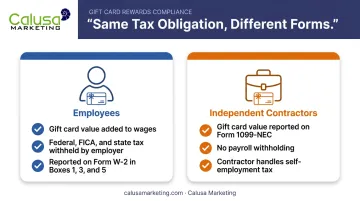
Employees vs. contractors: Both owe tax on gift cards. Employees see the value reported on Form W-2; independent contractors see it on Form 1099. The reporting mechanism changes, but the tax obligation doesn't disappear for either group.
Why the "De Minimis" Exception Doesn't Cover Gift Cards
HR teams often point to the de minimis fringe benefit rule as their escape hatch. That argument collapses under IRS scrutiny.
Understanding De Minimis Fringe Benefits
Under Section 132(e), a de minimis benefit is property or a service so small in value and given so infrequently that tracking it would be administratively impractical. Classic examples include:
- Occasional coffee or snacks in the break room
- Holiday gifts of low-value tangible property (a ham, a small gift basket)
- A few tickets to a game or show
Why Cash and Cash Equivalents Never Qualify
Treasury Regulation 1.132-6(c) draws a hard line: cash and cash-equivalent benefits are never excludable as de minimis, even when the underlying item would have qualified on its own.
The IRS made this concrete in TAM 200437030, where an employer swapped its traditional holiday ham for a $35 grocery gift certificate. Because employees could redeem it for almost anything at the store, the IRS ruled it fully taxable, even though a physical ham of equal value would have passed as de minimis.
That's the crucial distinction:
| Certificate Type | Tax Treatment |
|---|---|
| Redeemable for one specific tangible item | May qualify as de minimis in rare cases |
| Redeemable for general merchandise (Visa, Amazon, most retail cards) | Always taxable, no exception |
There's also no bright-line dollar threshold that makes a card "small enough." Rulings have found even $100 and $109 amounts too high to qualify as de minimis in related noncash award contexts. But the real issue was never the dollar figure. The cash-equivalent nature of the benefit disqualifies it, not the dollar amount.
How to Report and Withhold Taxes on Employee Gift Cards
Once you accept that a gift card is taxable, the process is straightforward, even if it takes an extra step in payroll.
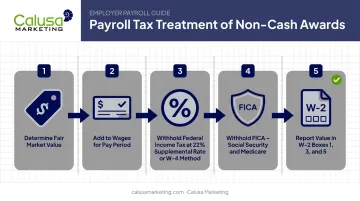
Add the fair market value of the card to the employee's wages for the pay period in which you hand it out. From there, standard payroll withholding applies:
- Federal income tax withholding based on the employee's W-4 or the supplemental wage method
- Social Security and Medicare (FICA) taxes on the full value
- State or local income tax, if applicable in your jurisdiction
The Supplemental Wage Rate
Gift cards count as supplemental wages. Per IRS guidance in Publication 15-B, employers may apply an optional 22% flat withholding rate. This applies as long as the payment is identified separately from regular wages and the employee had federal tax withheld in the current or prior year.
Once an employee's supplemental wages for the year exceed $1 million, the excess must be withheld at 37%, regardless of what's on their W-4.
W-2 Reporting
The taxable value belongs in:
- Box 1 (wages, tips, other compensation)
- Box 3 (Social Security wages, subject to the annual wage base)
- Box 5 (Medicare wages, no ceiling)
A note in Box 14 is optional and doesn't substitute for actually including the value in Boxes 1, 3, and 5. Treating a gift card as a footnote instead of real wages is exactly the kind of shortcut auditors flag.
Practical tip: Set an internal deadline requiring managers to report gift card distributions to payroll within a specific window, such as five business days. Larger employers and universities commonly use this approach to keep records audit-ready rather than reconstructing them months later.
Are There Any Exceptions? Achievement Awards & Specific-Item Certificates
A few narrow exceptions exist, and each one is more restrictive than most HR teams expect.
Employee achievement awards under Sections 74(c) and 274(j) can be tax-free, but only under strict conditions:
- Must be tangible personal property — cash, gift cards, vacations, and meals are explicitly excluded
- Given for length of service or safety achievement, not general performance
- Presented as part of a meaningful ceremony
- Capped at $400 per employee annually (or $1,600 under a qualified written plan)
- Excludes length-of-service awards during an employee's first five years, or repeat awards within four years
That tangible property requirement is the dealbreaker for most recognition programs. A gift card, even one branded as an "award," doesn't count.
The specific-item certificate exception applies only when a card is redeemable for one preselected item of minimal value, given infrequently. Standard Visa, Amazon, or retail gift cards almost never meet this bar since employees can spend them on anything.
One more exception worth knowing: Section 139 disaster relief payments can be tax-free, but only for expenses tied to a qualifying disaster, such as a federally declared disaster or a Treasury-determined catastrophic event. It has nothing to do with routine recognition or holiday gifts.
Best Practices for a Tax-Compliant Employee Recognition Program
Getting this right isn't complicated. It just requires structure instead of ad hoc decisions made by individual managers.
Start with a written policy that spells out:
- Dollar thresholds for different recognition occasions
- Who approves gift card distributions before they go out
- A consistent process for routing every distribution through payroll
Then track every single distribution. Record these details for each award:
- Recipient name
- Dollar amount
- Date of distribution
- Business purpose
This is the documentation that turns a payroll audit from a scramble into a non-event.
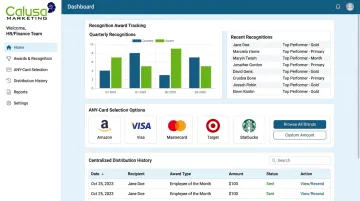
This is where a structured incentive platform earns its keep. Calusa Marketing's cloud-based gift card and rewards platform gives HR and finance teams a centralized system for distributing recognition awards through ANY-Card flexibility, so programs aren't scattered across individual manager purchases at retail counters.
The platform's centralized distribution tracking and white-glove support keep a clear record of who received what and when — exactly the documentation payroll needs to stay compliant. If you're building or auditing a recognition program, reach out to the Calusa Marketing team to walk through what your specific program requires.
Frequently Asked Questions
Are gift cards given to employees taxable income?
Yes. The IRS treats gift cards as cash equivalents, which are always taxable wages regardless of dollar amount. There's no de minimis exception that applies here.
How do you account for gift cards given to employees?
Add the card's fair market value to the employee's wages for that pay period, withhold applicable federal, state, and FICA taxes, and report the amount on their W-2.
Is there a dollar amount under which gift cards aren't taxable?
No. There's no minimum threshold. Even a $5 card is taxable because it's a cash equivalent, not because of its value.
Are gift cards given to independent contractors taxed the same way as employees?
Contractors owe tax on gift cards too, but the value is reported on Form 1099-NEC instead of a W-2, and there's no payroll tax withholding involved.
What's the difference between a gift card and a de minimis fringe benefit?
De minimis benefits are tangible, infrequent, low-value items like occasional snacks or a small holiday gift. Gift cards are cash equivalents, so they never qualify no matter how small.
Can holiday gift cards be treated as non-taxable gifts to employees?
No. Holiday timing doesn't change the tax treatment. A gift card given during the holidays is still taxable wages, just like one given for a performance bonus.