Many businesses treat vouchers as a quick fix: sales are soft, so a discount goes out. A sales team is behind target, so a bonus gets promised. The problem? Random discounting trains people to wait for the next deal instead of acting now, and it opens the door to abuse. This applies whether you're running a customer loyalty program or an internal sales incentive campaign.
This guide covers 10 practical tips for building, distributing, and optimizing a voucher marketing strategy, one that protects your margin while still driving the behavior you actually want.
Key Takeaways
- Tie every campaign to one measurable behavior, not a vague sales goal
- Segment your audience first, then match the incentive type to the goal
- Redemption rules and channel choice protect margin more than discount size does
- Ongoing testing turns voucher campaigns into a repeatable growth lever
What Is Voucher Marketing (and Why It Matters Beyond Retail)
Voucher marketing uses discounts, gift cards, punch cards, or reward credits to encourage a specific action: a purchase, a referral, a renewal, or a performance milestone. It's not just a retail coupon tactic.
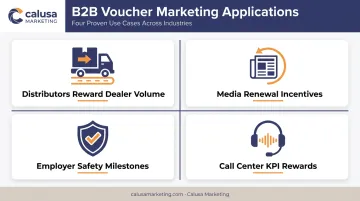
B2B companies use voucher marketing constantly, often without calling it that:
- Distributors reward dealers for hitting purchase volume targets
- Media companies offer renewal incentives to subscribers
- Employers use gift cards for safety milestones or tenure anniversaries
- Call centers reward agents for KPI achievement
The stakes are real. 64% of consumers say a digital coupon or promotion often closes the deal when they're on the fence about a purchase, according to a Forrester Consulting study commissioned by RetailMeNot. That level of influence is why a deliberate voucher strategy, not reactive discounting, is what turns a one-time coupon into repeat purchases and measurable revenue lift.
5 Foundational Tips to Build a Winning Voucher Marketing Strategy
Before a single voucher goes out the door, get these five fundamentals right. This is the planning phase, and it's where most campaigns either set themselves up to succeed or quietly guarantee a margin problem later.
Tip 1: Set a Clear, Measurable Goal for Every Campaign
"Increase sales" isn't a goal. It's a wish. Every campaign needs a single, specific behavior attached to it:
- First purchase from a new account
- Referral completion
- Sales quota attainment
- Subscription renewal
Consider the difference between a distributor rewarding a rep for hitting a quarterly target versus a media company offering a subscriber a renewal voucher. Both are voucher campaigns. Both need entirely different mechanics, timing, and redemption logic.
Calusa Marketing has seen this play out with distribution clients like Johnstone Supply and Baker Distributing. Their points-based programs were built around one trackable behavior: shifting purchases to online channels, not rewarding spending in general. Midstate Tire took it further, tying rewards to account growth above a baseline, functioning almost like a built-in quota structure.
On the media side, publishers such as McClatchy and Postmedia use gift card incentives across both acquisition and retention, giving subscribers a reason to stick around at renewal time.
Tip 2: Segment Your Audience Before You Segment Your Offers
A blanket offer sent to your entire customer or employee list wastes budget on people who would have converted anyway, and misses the ones who actually need a nudge.
Profile your audience by:
- Tenure or lifecycle stage (new vs. long-standing)
- Purchase or performance history
- Job role or account tier
- Engagement level
The financial case for this is strong. Companies piloting personalized marketing and pricing saw a 2 to 4 percentage-point improvement in gross-margin dollars compared to standard mass offers, per McKinsey research on loyalty program value. That's margin dollars recovered, not just redemption counts.
Tip 3: Choose the Right Incentive Type for the Behavior You Want
Not every goal needs a discount. Your incentive toolbox should include:
- Percentage or dollar-off discounts
- Buy-one-get-one offers
- Free shipping
- Gift cards
- Digital punch cards
- Travel rewards or loyalty points
The smallest incentive that changes behavior is usually the right one. Overpaying for a behavior you'd have gotten anyway just erodes margin for no reason.
This is where a flexible platform earns its keep. Calusa's ANY-Card gives businesses access to 100+ digital gift card options, from Amazon and Walmart to Chipotle and Uber, plus a digital punch card delivered straight to a smartphone wallet. Instead of juggling separate vendors for gift cards, punch cards, and travel rewards, one platform handles the incentive type that fits the goal.
Tip 4: Time Your Vouchers Around Key Moments
Random timing dilutes urgency. Purposeful timing creates it. Build campaigns around:
- Seasonal buying windows
- Company or program anniversaries
- Sales milestones
- Subscription renewal dates
A distributor might time a voucher to a slow season to drive off-peak volume, while a media company sends renewal offers just before a subscription lapses.
If vouchers show up too often, or with no discernible pattern, customers and employees learn to simply wait for the next one. That's the opposite of urgency.
Tip 5: Justify Your Offers and Set Redemption Rules to Protect Margin
An unexplained discount raises questions. Is the brand struggling? Is this the "real" price now? Every offer should tie to a reason: an anniversary, a referral, a milestone reached.
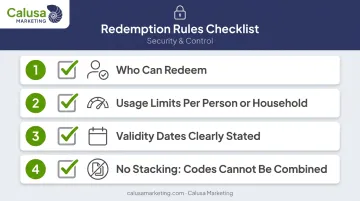
Before launch, lock down these rules:
- Who can redeem the offer (new customers only, top-tier members, etc.)
- Usage limits per person or per household
- Validity dates, clearly stated
- Stacking restrictions, so multiple codes can't combine
Fraud is a real cost of skipping this step. A single federal case involved 13,000 distinct counterfeit coupon designs and $31.8 million in losses to retailers and manufacturers, according to a Department of Justice press release on the scheme. These redemption rules protect margin and keep a promising campaign from turning into a liability.
5 Advanced Tips to Execute and Optimize Your Voucher Campaigns
Planning is done. Now it's about execution, distribution, and getting sharper with every campaign cycle.
Tip 6: Make Rewards Conditional, Not Constant
If a discount shows up every month, it stops being a reward and becomes the expected price. Shift to earning-based mechanics instead:
- Loyalty tier upgrades
- Order milestones (a customer's 25th purchase, for example)
- Tenure markers (an employee's one-year anniversary)
- Referral completions
Conditional rewards feel earned. Constant discounts feel owed.
Tip 7: Diversify Your Distribution Channels
Meet people where they already are:
- Email and SMS
- Digital wallets
- Employee or customer portals
- In-app messaging
- Physical mail or event handouts
For B2B programs especially, friction kills participation. Calusa's cloud-based SaaS platform delivers vouchers and gift cards without requiring an app download or a system integration, removing a common barrier to redemption across every channel listed above.
Tip 8: Use Referral and Milestone Vouchers to Extend Reach
Dual-sided referral rewards, where both the referrer and the new customer or employee benefit, turn satisfied people into active advocates. Nobody refers a friend for free if there's nothing in it for either side.
This tactic works because the trust already exists. 88% of consumers trust recommendations from people they know more than any other channel, according to Nielsen's Trust in Advertising study of more than 40,000 global respondents. A referral voucher just gives that existing trust a reason to act.
Tip 9: Personalize Offers Using Program Data
Guessing which offer someone wants is a coin flip. First-party data (purchase history, tenure, engagement level) should decide it instead.
The appetite for this is generational. In Deloitte's survey of over 5,500 US consumers, 51% of Gen Z and 53% of millennial respondents said a personalized experience would make them spend more, per Deloitte's consumer loyalty research. If your program has behavioral data sitting unused, it's leaving engagement on the table.
Tip 10: Track Performance and Continuously Optimize
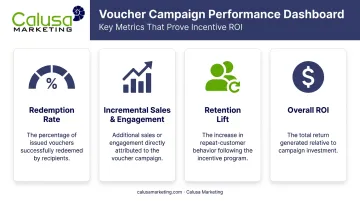
Redemption rate alone tells you almost nothing about whether a campaign worked. Track all of these:
- Redemption rate (how many people used it)
- Incremental sales or engagement (what it actually generated)
- Retention lift (did it change long-term behavior)
- Overall ROI (was the reward cost worth the result)
Then test relentlessly. Vary incentive size, channel, timing, and audience segment, one variable at a time, so you know exactly what moved the needle. This is how a single campaign becomes a repeatable system instead of a guess you rerun every quarter.
How to Advertise and Promote Your Vouchers Effectively
Promote vouchers where your audience already spends time: email and SMS for existing customers or employees, social media and dedicated landing pages for public offers, and in-app or portal placements for program members.
Whatever the channel, the creative needs three things:
- Clear copy stating the exact benefit (not "special offer," but "$25 off your next order")
- A strong call-to-action that tells people what to do next
- A visible expiration date to create real urgency
Creative alone isn't enough: scattering codes across five different channels with no central home makes tracking a mess and confuses recipients about where their reward even lives.
Centralizing vouchers, gift cards, and loyalty points in one digital wallet or member portal simplifies both the advertising message and the redemption tracking behind it. Calusa Marketing's cloud-based platforms provide exactly this kind of centralized wallet, with no app download required.
Common Voucher Marketing Mistakes to Avoid
Even well-intentioned programs stumble on the same few issues:
- Over-discounting. Running offers too frequently erodes margin and can make a brand feel unstable or perpetually "on sale."
- Skipping segmentation. Blasting the same offer to everyone means irrelevant offers reach the wrong people, and redemption rates suffer for it.
- Neglecting redemption rules. No usage limits or fraud controls leave a campaign open to code sharing, stacking abuse, and budget overruns that nobody sees coming until the invoice arrives.
Every one of these is preventable with the planning steps covered above. None of them require complicated fixes, just discipline before launch.
Frequently Asked Questions
How do I advertise a gift voucher?
Promote it through channels your audience already uses, such as email, SMS, social, or in-app messaging, paired with clear copy and a visible expiration date. Centralize the voucher in a digital wallet or member area so it's easy to find and redeem.
What is the difference between a voucher and a coupon?
The terms are often used interchangeably. A voucher typically represents broader value, such as a gift card, travel credit, or punch card, while a coupon refers to a specific discount code.
How often should I run voucher campaigns without hurting my brand?
Favor conditional, milestone-based offers over constant discounting. Tie frequency to specific goals, like a referral or an anniversary, rather than sticking to a fixed calendar schedule.
What's the best voucher type for an employee incentive program?
Flexible options like gift cards, digital punch cards, and travel rewards tend to perform well for employee recognition. They let recipients choose the value that matters most to them.
How can I prevent voucher or gift card fraud?
Unique single-use codes, redemption limits, and real-time validation rules are the primary defenses against code sharing and stacking abuse. Skipping any of these leaves a program exposed.
Do vouchers actually help with long-term customer or employee retention?
Yes, when they're milestone- or loyalty-based rather than blanket discounts. Earned rewards build a reciprocity effect that supports repeat behavior over time, unlike constant discounting, which just trains people to wait.