Nothing dramatic happened. No blowup, no formal complaint. She just quietly checked out.
This story is playing out across offices, call centers, and warehouses nationwide. Gallup's most recent U.S. data shows only 31% of employees are engaged, while 17% are actively disengaged — meaning a huge portion of the workforce is coasting somewhere in between, disconnected but still on payroll according to Gallup's 2025 workforce data.
This guide breaks down what engagement and disengagement actually look like, the early warning signs leaders miss, what's driving the drop-off, and practical strategies — including recognition programs — to turn it around.
Key Takeaways
- Engagement and disengagement exist on a spectrum, not a switch.
- Disengagement builds gradually through missed deadlines and withdrawn participation.
- Poor communication, stalled growth, and thin recognition drive most of the shift.
- Lost productivity, turnover, and absenteeism add real costs to disengaged teams.
- Structured recognition and re-engagement strategies can reverse the trend early.
What Is Employee Engagement vs. Disengagement?
Employee engagement is the emotional commitment and discretionary effort someone brings to their job beyond the bare minimum. It's the difference between an employee who does what's asked and one who looks for ways to make the whole team better.
Disengagement is what happens when that commitment erodes. It's rarely sudden. It builds slowly, usually from unresolved frustrations — a missed promotion, a manager who never gives feedback, a workload that never lets up.
The Engagement Continuum
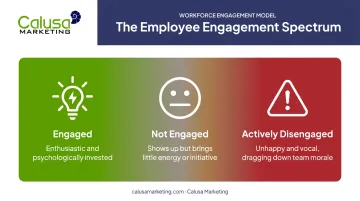
Gallup frames the workforce into three groups: engaged, not engaged, and actively disengaged. Most people don't live at either extreme.
- Engaged employees are enthusiastic and psychologically invested in their work.
- Not engaged employees show up, do the job, but bring little energy or initiative.
- Actively disengaged employees are unhappy and let that unhappiness show, sometimes dragging down the people around them.
Here's the part leaders often miss: engagement is an ongoing condition, not a one-time project. It requires continuous management because people drift along this continuum based on what's happening around them week to week. That's exactly why catching the early signs matters so much, and it's where we're headed next. (See the FAQ section below for a deeper breakdown of engagement types and disengagement levels.)
Warning Signs of a Disengaged Employee
Disengagement leaves a trail. Leaders just have to know where to look.
Performance and Behavior Shifts
- Decreased productivity and quality: Output drops, deadlines slip, and error rates climb relative to someone's own baseline.
- Increased absenteeism and lateness: Occasional missed days turn into a predictable pattern.
- Reduced participation: The once-active contributor goes silent in meetings and stops volunteering ideas.
Attitude and Ambition Changes
- Negative attitude and resistance to change: Complaints, cynicism, or quiet pushback against new initiatives surface.
- Loss of interest in growth: Someone who used to chase stretch assignments now avoids them entirely.
- Withdrawal from team culture: Skipping optional events, avoiding collaboration, and disengaging from company traditions.
These shifts often show up together, not in isolation. A single missed deadline isn't a red flag. A pattern of missed deadlines paired with silence in meetings absolutely is.
The Quiet Quitting Factor
These attitude and performance shifts often build toward something bigger, a phenomenon that finally got a name. "Quiet quitting" put a modern label on an old problem: doing only what's required, nothing more. Gallup calls this group "not engaged." According to Gallup's second-quarter 2022 workforce research, they made up at least 50% of the U.S. workforce. That's not a fringe issue. That's half the room.
What's Driving Disengagement in Today's Workplace
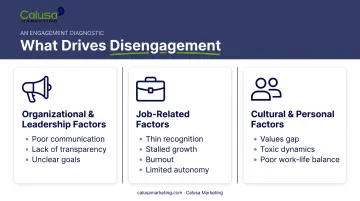
Disengagement rarely has one cause. It usually stacks up from a few directions at once.
Organizational and leadership factors:
- Poor or inconsistent communication from leadership
- Lack of transparency around company direction or decisions
- Unclear goals that leave employees guessing how their work connects to bigger outcomes
Job-related factors:
- Thin or inconsistent recognition for good work
- Stalled career growth with no visible path forward
- Burnout from sustained overwork without added support or pay
- Limited autonomy over daily decisions, leaving little room to solve problems independently
Cultural and personal factors:
- A gap between stated company values and daily reality
- Toxic team dynamics or unresolved interpersonal friction
- Work-life balance that's consistently out of whack
Notice how many of these are fixable. None of these require a total culture overhaul overnight — they require leaders paying attention and acting on what they see.
The Real Business Cost of Disengagement
Disengagement isn't just a morale issue. It shows up on the balance sheet.
Gallup estimates low employee engagement cost the global economy roughly $10 trillion in lost productivity in 2025, equal to about 9% of global GDP according to Gallup's State of the Global Workplace report. This figure represents a systemic drag on global productivity, one that touches every industry regardless of sector.
The gap between engaged and disengaged teams shows up at the business-unit level. Gallup's meta-analysis of over 3 million employee responses across 347 organizations found:
| Outcome | Engaged Units vs. Disengaged Units |
|---|---|
| Profitability | 23% higher |
| Sales productivity | 18% higher |
| Absenteeism | 78% lower |
| Turnover (high-turnover orgs) | 21% lower |
| Turnover (low-turnover orgs) | 51% lower |
Turnover alone is expensive. SHRM benchmarking puts the average cost per hire near $4,700, and that's before factoring in lost productivity, training time, and institutional knowledge walking out the door. Replacing a single employee can run anywhere from half to two times their annual salary, according to Gallup's analysis.
Retaining engaged employees costs far less than replacing disengaged ones, an economic reality that makes engagement a bottom-line priority rather than a soft metric.
How Leaders Can Re-Engage Their Teams
Re-engagement comes from stacking a handful of consistent habits over time, not from launching one big initiative.
Improve two-way communication. Regular check-ins, anonymous feedback surveys, and visible follow-through on employee concerns close the loop between "we hear you" and "we did something about it."
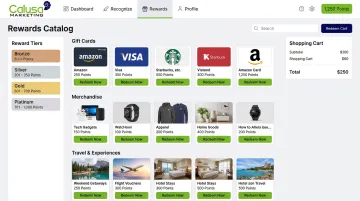
Invest in recognition and reward systems. Gallup found employees who receive meaningful feedback are 5 times more likely to be engaged, making structured incentive programs one of the fastest ways to move the needle. Platforms built for this let leaders scale rewards without building a program from scratch:
- Digital gift cards and a merchandise catalog of over 10 million items
- Hotel and cruise travel certificates for team milestones
- High-end individual incentive trips priced from $500 to $25,000
Companies like Calusa Marketing handle fulfillment, shipping, and customer service end-to-end, so leaders get the impact of a recognition program without running one themselves.
Support career growth. Training, mentorship, and a visible path forward tell employees there's a future worth staying for.
Empower employees with autonomy. Involve teams in decisions about workflows and policies. Ownership breeds investment.
Align values with leadership actions. If leaders don't model the values they preach, employees notice immediately. Town halls and open forums help close that gap.
Address individual well-being. Flexible schedules, mental health resources, and genuine empathy for personal challenges go further than any perk package.
None of these require a massive budget. They require consistency, something leaders control every day.
Frequently Asked Questions
What are the 4 types of employee engagement?
A commonly used framework identifies four categories:
- Actively engaged: Emotionally invested and proactive
- Moderately engaged: Satisfied but not deeply invested
- Passively disengaged: Mentally checked out but present
- Actively disengaged: Dissatisfied and vocal about it
What are the three levels of disengagement?
There's no single universal standard here, but many practitioners describe disengagement as a spectrum ranging from mild, situational withdrawal to chronic passive detachment to active, visible disengagement that affects team morale.
What is the difference between employee engagement and employee satisfaction?
Satisfaction reflects contentment with conditions like pay, benefits, or hours. Engagement reflects emotional investment and the discretionary effort someone brings beyond the job description — you can be satisfied and still disengaged.
How can leaders measure employee engagement?
Common methods include pulse surveys, structured one-on-ones, eNPS (employee Net Promoter Score), and direct behavioral observation, such as participation levels and initiative-taking.
What is quiet quitting and how does it relate to disengagement?
Quiet quitting describes employees who do only what's required and nothing more, without formally leaving the job. It's the visible face of the "not engaged" category on the engagement spectrum.
Can disengaged employees become re-engaged?
Yes. Gallup found managers trained in engagement practices boosted their own engagement by up to 22% and their teams' by up to 18%. Empathetic conversations and consistent recognition make re-engagement realistic, not just aspirational.