Introduction
Points show up everywhere in modern business, from employee recognition platforms that hand them out for hitting KPIs to customer loyalty apps that reward every purchase. Sales contests dangle them as bait for top performers, and even classroom management tools use them to shape behavior.
Yet adoption doesn't equal effectiveness. Deloitte's 2025 Consumer Loyalty Survey found the average U.S. adult belongs to eight loyalty programs but actively uses only five. That gap between enrollment and engagement is the real problem most organizations face.
Many companies build point programs on instinct rather than behavioral science, then wonder why engagement stalls and incentive budgets go to waste. This guide breaks down what actually happens, psychologically, when someone earns and redeems points.
Key Takeaways
- Points motivate through anticipation, not just the final payout
- Autonomy, competence, and relatedness (SDT) explain why points often beat straight cash
- Well-designed programs drive measurable retention and spending gains, not just short-term excitement
- The same psychology applies across employee, customer, and sales incentive contexts
- Programs with weak rewards or poor promotion risk abandonment despite good intentions
What Is a Points-Based Reward System?
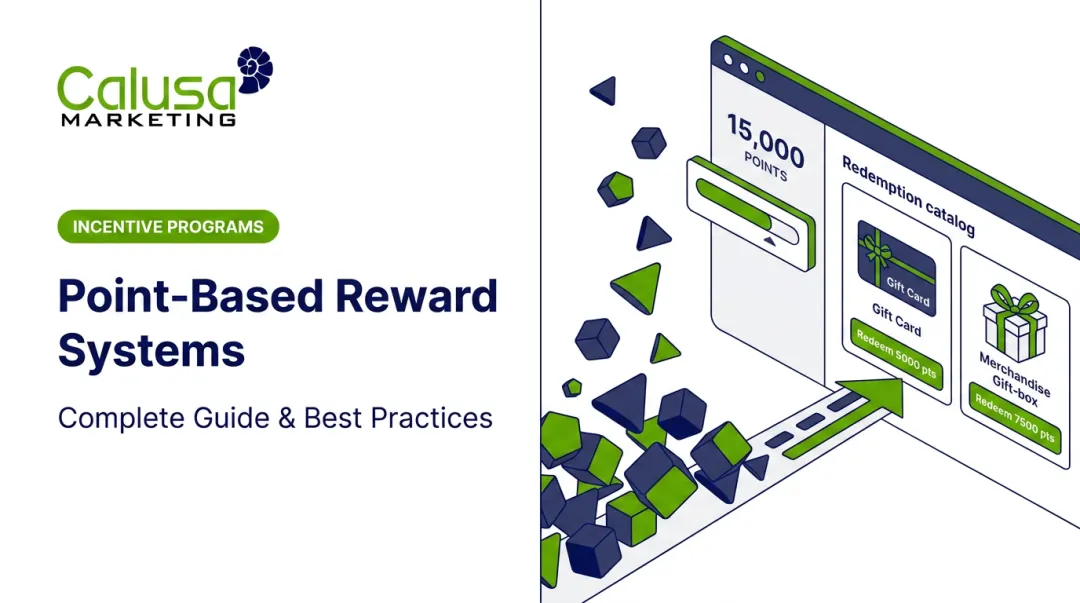
A points-based reward system is a structure where specific behaviors, like a sale, purchase, referral, or milestone, earn units of value that participants later redeem for rewards they choose. The separation between earning and redeeming is what makes it psychologically distinct from a one-time bonus.
Why it exists: Cash and generic gifts assume everyone wants the same thing. They don't. Personalization matters far more than most incentive designers assume. According to SHRM's coverage of flexible rewards research, 70% of employees say recognition feels most meaningful when it's personalized. Many leaders, meanwhile, admit they don't fully understand what their people actually want as a reward.
What it is not: A points program isn't a bonus check or a one-off discount code. Those transactions end the moment they're delivered. Points create a gap between action and reward, and that gap is where the psychology lives.
Three types dominate the business landscape:
- Employee recognition points: tied to KPIs, milestones, or peer-to-peer nods
- Customer loyalty points: earned through purchases, visits, or account growth
- Sales incentive and gamification points: linked to contest performance, often layered with separate "game tokens" for competitive mechanics
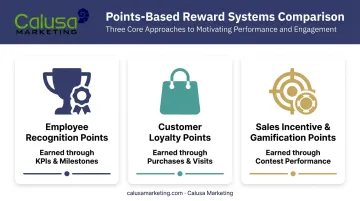
The redemption catalogs differ. The underlying psychological triggers don't.
How Does the Psychology of Points Actually Work?
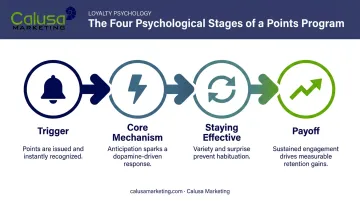
The motivational power of points doesn't come from the final prize. It comes from a sequence of psychological events that starts long before anyone redeems anything. Four stages drive that sequence.
The Trigger: Recognition and Point Issuance
Every points program starts with a behavior getting noticed. A sale closes. A referral comes through. A customer places an online order. Something happens, and a system, manager, or peer responds by issuing points.
Issuance generally falls into three buckets:
- Manual — a peer or manager awards points for a specific action
- Automated — a purchase or online order triggers points without human input
- Milestone-based — anniversaries, thresholds, or tenure markers unlock points automatically
The biggest failure point here is delay. When recognition lags behind the behavior, the brain struggles to connect the two.
Earlier rewards strengthen the perceived link between an action and its outcome, and that link, not the reward's size, drives repeat behavior. A points program that issues rewards weeks after the triggering action works against its own mechanics.
The Core Mechanism: Anticipation Beats the Reward Itself
This is the part most incentive designers get wrong. Dopamine doesn't simply spike bigger before a reward than after receiving it. Wolfram Schultz's research on dopamine neurons found something more specific: once a reward becomes predictable, the dopamine response shifts away from the reward itself and attaches to the earliest cue that predicts it.
In practice, that means the moment someone sees their point balance tick up, or spots a progress bar inching toward a redemption threshold, is doing real motivational work. The reward at the end is almost secondary to that signal.
This connects directly to Self-Determination Theory, which holds that intrinsic motivation depends on three needs:
- Autonomy — choice in how points get redeemed
- Competence — visible progress toward a goal
- Relatedness — social recognition from peers or managers
Points hit all three. Cash hits none of them particularly well. There's also a "double lift" effect: motivation gets reinforced twice, once at issuance and again at redemption, which is difficult to replicate with a single lump-sum payout.
Keeping It Effective: Avoiding Habituation and Entitlement
Points lose power when they become routine. A reward that once felt special can turn into an expected baseline, and once that happens, its motivational value drops even if the program keeps running exactly as designed.
Programs that hold up over time tend to build in:
- Variety — rotating rewards instead of a static catalog
- Accelerators — temporary point multipliers tied to specific campaigns
- Surprise elements — unannounced bonus points that break the predictable pattern
Entitlement is another risk to watch. Engagement often dips temporarily right after incentives end, though performance generally recovers. The takeaway is that framing determines whether that dip turns into lasting disengagement. Companies control how points are messaged, positioned, and refreshed far more than they'll ever control how a cash bonus is perceived.
The Payoff: Behavior Change and Measurable Results
The real advantage of points programs is breadth. Unlike commission structures that reward only the top 10%, points-based systems typically reach the "middle" performers, the largest segment of any workforce or customer base, and give them a reason to keep participating.
The retention data backs this up. Gallup and Workhuman's longitudinal study tracked nearly 3,500 employees from 2022 to 2024 and found that employees who felt well recognized in 2022 were 45% less likely to have left two years later.
That retention outcome ties directly to how recognition was delivered, not just whether it happened.
Where Points-Based Psychology Shows Up in Business
The mechanics stay constant across three main contexts:
- Employee recognition and incentive programs: built around KPI achievement, tenure, and peer recognition
- Customer loyalty programs: built around purchase frequency and account growth
- Sales and channel incentive contests: built around performance thresholds and contest wins
Programs perform best when they hit a few specific conditions:
- Participation spans the full audience, not just top performers
- Recognition happens frequently enough to stay top of mind
- Redemption options are diverse enough to match different preferences
At Calusa Marketing, this shows up in how programs get structured for distributors, sales teams, and loyalty clients. Johnstone Supply and Baker Distributing, for example, run points-based programs built around online ordering and account activity, while Midstate Tire's dealer program ties points to purchases and account growth.
Each program applies the same underlying psychology: autonomy through redemption choice, competence through visible progress. The triggers and reward catalogs differ by client, but the psychological drivers stay the same.
Conclusion
Points work because of a sequence, not a single moment. Anticipation drives more motivational weight than most people expect, choice in redemption satisfies autonomy, and recognition satisfies relatedness. None of that depends on the dollar value attached to the reward.
Getting this right on paper is one thing. Building a program that avoids habituation, keeps promotion fresh, and reaches beyond your top 10% of performers takes structure.
That's the gap Calusa Marketing fills, turning this psychology into an SaaS-based rewards platform that holds up over a year or more of real use.
Frequently Asked Questions
How much are reward points worth in dollars?
It varies by program. Most organizations set a fixed conversion rate, such as 100 points equaling $1, and that rate should be clearly communicated to participants upfront to avoid confusion.
How do I redeem my rewards points?
Most platforms let members log into a portal or app, check their point balance, and browse a catalog of merchandise, gift cards, travel, or other options to redeem against their balance.
Why do points motivate people more effectively than cash rewards in many cases?
Points trigger anticipation before redemption even happens, and they carry emotional and social value that a direct paycheck deposit doesn't generate.
Should reward points expire?
There's a tradeoff. Expiration creates urgency to redeem, but many participants prefer accumulating points toward a bigger reward. The right answer depends on your program's goals and audience.
What's the difference between employee recognition points and customer loyalty points?
Both run on the same psychological principles, but the triggers differ: employees earn points for performance and recognition, while customers earn them through purchases. The redemption catalogs are tailored to match each group's preferences.
Can a small business benefit from a points-based reward system, or is it only for large enterprises?
Points programs scale. A small business can start with a simple structure and expand it over time, making the model effective for motivating employees or retaining customers regardless of company size.