Generic gestures like pizza parties don't move the needle on retention or morale the way they once did. Employees can smell a box-checking exercise from across the Slack channel.
This guide breaks down 25 employee engagement activities for 2026, organized into five practical categories, plus guidance on choosing the right mix and measuring whether it's actually working.
Key Takeaways
- Engagement activities boost retention and morale only when tied to a clear purpose, not novelty alone
- The strongest 2026 programs blend recognition, fun, wellness, and growth, not one-off events
- Match activities to your team's format (remote, hybrid, in-office) and budget constraints
- Pairing recognition with a rewards platform drives participation that outlasts the initial buzz
Why Employee Engagement Activities Matter in 2026
Employee engagement activities are structured programs and moments designed to build connection, motivation, and recognition into everyday work life, not just annual events.
As hybrid arrangements become permanent fixtures rather than pandemic-era workarounds, the old playbook of occasional in-office perks leaves remote and distributed employees out entirely.
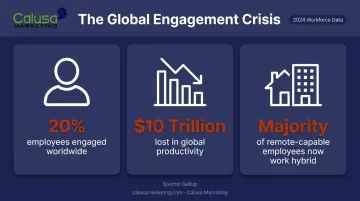
The cost of getting this wrong is steep. Gallup's State of the Global Workplace 2026 found that only 20% of employees worldwide were engaged. The firm estimates that low engagement costs the global economy $10 trillion in lost productivity, equal to roughly 9% of global GDP.
Hybrid work isn't a fringe case anymore, either. Most remote-capable employees now split time between home and office, meaning any engagement calendar built exclusively around in-person events automatically excludes a large share of the workforce.
The good news: you don't need a massive budget to fix this. Below, the 25 activities are grouped into five categories so you can build a calendar that actually fits your people:
- Recognition
- Team-building
- Wellness
- Remote inclusion
- Growth
25 Fun Employee Engagement Activities for 2026
Each activity below was selected for variety: some cost nothing, some require a modest budget, and all can flex between remote, hybrid, and in-office formats.
Recognition & Rewards Activities
Peer recognition wall/Slack channel – A dedicated space where employees publicly shout out colleagues for living company values. Real-time, visible appreciation reinforces the behaviors you want repeated.
Spot bonuses and instant incentive rewards – Small, immediate rewards, gift cards, points, or bonus pay, delivered the moment great work happens. Speed matters here: Gallup and Workhuman found employees who received high-quality recognition were 65% less likely to be job hunting, and well-recognized employees were 45% less likely to have left two years later. Digital reward platforms like Calusa Marketing's ANY-Card program let managers issue that recognition instantly, without waiting on inventory or fulfillment delays.
"Employee of the Month" with a twist – Ditch the single generic title. Rotate fun, personalized categories like "Most Helpful Teammate" or "Best Problem Solver" so more people get recognized for what they actually do well.
Milestone and work-anniversary celebrations – Mark tenure and big wins with personalized moments, not a form email. A five-year anniversary deserves more than a company-wide Slack GIF.
Handwritten thank-you notes from leadership – Low-cost, high-impact. A short, specific note from a manager or executive often lands harder than a bigger, impersonal reward.
Team-Building Games & Challenges
Trivia competitions – Run company-wide or department tournaments mixing industry knowledge with pop culture. Easy to host virtually or in person.
Scavenger hunts – In-office or virtual hunts that force collaboration and creative problem-solving, especially effective for mixed remote/in-office teams working together toward a shared goal.
Escape room challenges – Physical or virtual escape rooms test communication under time pressure. A small pilot study of emergency-medicine teams rated the format as an effective debriefing and communication exercise.
Two Truths and a Lie – A quick, zero-prep icebreaker for meetings, onboarding, or offsites. Simple, but it consistently surfaces surprising things about coworkers.
Themed dress-up/office days – Rotate themes, decades, sports jerseys, pajama day, to break routine and give people something to look forward to on an otherwise ordinary Tuesday.
Wellness & Well-Being Activities
Mindfulness or meditation breaks – Short guided sessions before meetings to reset before diving into work. Preliminary field research links workplace mindfulness training to lower stress and better team climate.
Step-count or movement challenges – Gamify wellness goals with friendly team competition using a shared app or leaderboard. Movement challenges work best when framed as fun, not mandatory fitness tracking.
Flexible "choose your workday" scheduling – Give employees autonomy over hours or focus blocks. A 2024 APA survey found a third of employees lack enough flexibility to balance work and life, making this a genuine pain point worth solving.
Walk-and-talk meetings – Swap sit-down meetings for walking conversations. It reduces screen fatigue and often produces looser, more honest conversation than a conference room does.
Mental health days – Normalize dedicated time off for emotional well-being, separate from sick days or vacation, without requiring justification.
Remote & Hybrid Engagement Activities
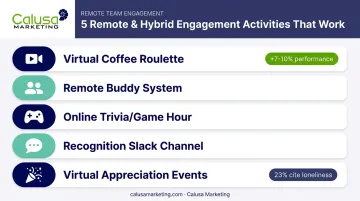
Virtual coffee roulette – Randomly pair remote employees for informal 15-minute chats. A Harvard Business School field experiment with 1,370 remote interns found that structured informal video meetings improved performance by roughly 7-10%. The same study noted a small dip in reported work-life balance, so watch for meeting overload.
Remote buddy system – Pair new hires with a peer buddy during onboarding to reduce the isolation that often comes with starting a job from a home office.
Online trivia/game hour – Host short virtual games via Zoom or Slack for distributed teams. Keep it under 30 minutes so it feels like a break, not another meeting.
Recognition Slack/kudos channel – A dedicated async space for peer appreciation that works across time zones, so nobody misses a shoutout because they were offline.
Virtual appreciation events – Themed online celebrations that recognize remote team wins. Buffer's 2023 survey found 23% of remote workers cite loneliness as a major struggle, and structured virtual events directly counter that.
Growth & Community Activities
Lunch and learn sessions – Short midday talks from internal experts or guest speakers. Low lift, high perceived value, and easy to repeat monthly.
Company book club – Rotate picks tied to leadership, industry trends, or personal growth. LinkedIn's 2025 research found 84% of employees agree learning adds purpose to their work.
Volunteer or community give-back days – Offer paid time for team volunteering. Deloitte's 2024 pulse survey found 91% of employees say volunteer opportunities positively affect their connection to their employer.
Skill swap sessions – Peer-to-peer teaching exchanges that surface hidden talents, the finance analyst who's a great public speaker, the engineer who paints.
Mentorship and career check-ins – Pair employees with mentors and run regular development conversations. Gallup reports only 40% of employees currently have a workplace mentor, leaving plenty of room to close the gap.
How to Choose the Right Activities (and Avoid Common Mistakes)
Picking activities at random rarely works. Start with purpose instead.
- Diagnose before you plan. Tie every activity to a specific driver, recognition, wellness, or growth, rather than grabbing whatever's trending on LinkedIn.
- Know your people. Survey remote versus in-office staff, and introverts versus extroverts, before finalizing a calendar—a scavenger hunt that energizes your sales team might exhaust your engineers.
- Respect cadence and workload. Schedule activities monthly or quarterly, and never launch a new initiative during a crunch period. Timing kills more programs than bad ideas do.
Common mistakes to avoid:
- Skipping follow-up after events, letting momentum die within a week
- Leaving leadership on the sidelines instead of participating (Gallup attributes 70% of team engagement variance to the manager)
- Treating engagement as a single event rather than an ongoing habit
Finally, measure what matters. Track participation rates and run short pulse surveys before scaling any activity company-wide. Gallup's own research warns that collecting feedback without visible action erodes trust faster than not asking at all.
How Calusa Marketing Powers Your Recognition & Rewards Programs
Recognition activities, spot bonuses, milestone celebrations, and appreciation events hit harder when they're backed by a real rewards platform instead of a scramble for gift cards on payday.
Calusa Marketing's cloud-based SaaS reward platform lets HR teams launch digital rewards fast. The ANY-Card gives recipients:
- No app download or system integration required to launch
- Over 100 gift card options across national retailers, restaurants, grocery, gas, and entertainment brands
- International gift card options for global teams
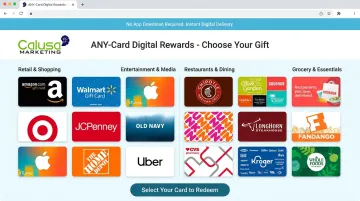
Employees pick what actually matters to them instead of receiving a card they'll never use.
For bigger moments—work anniversaries, President's Club trips, top-performer recognition—Calusa's white-glove fulfillment handles group travel, hotel certificates, and Royal Caribbean cruise certificates from booking through guest support. HR gets the credit; Calusa manages the logistics.
That same follow-through extends into daily operations. Companies like Alorica and Inktel already rely on Calusa's recognition tools to support agent retention and KPI achievement in call center environments, proof the model scales across industries.
The track record backs it up: 1,000+ programs, 500,000+ members, and a 99% client retention rate. If you're ready to build a recognition and rewards strategy that fits your 2026 engagement plan, talk with Calusa Marketing about a tailored program.
Conclusion
Lasting engagement in 2026 doesn't come from a single splashy event. It comes from a consistent mix of recognition, fun, wellness, and growth woven into the rhythm of normal work.
Start small: pick one or two activities per category, gather feedback, and scale what actually resonates with your team. Not every idea on this list will land, and that's fine.
When you're ready to strengthen the recognition and rewards side of that strategy, Calusa Marketing can help, with digital rewards, gift cards, and branded merchandise programs built to keep employees engaged year-round.
Frequently Asked Questions
What are engagement activities?
Employee engagement activities are programs and experiences designed to build connection, motivation, recognition, and morale at work. They range from quick daily touches, like a kudos channel, to bigger quarterly events.
What activities for an engagement party?
An engagement party in the relationship sense differs from workplace engagement, though the planning principles overlap. Teams celebrating milestones can borrow the same approach: personalized recognition and genuine appreciation instead of a generic gathering.
How often should companies run employee engagement activities?
A mix works best: small recognition touches weekly or monthly, paired with larger quarterly events like team offsites or appreciation celebrations. Let team feedback guide the exact rhythm.
How do you measure the success of an employee engagement activity?
Track participation rates, run short pulse surveys, watch retention trends, and monitor productivity shifts over several months. One well-attended event doesn't prove impact; sustained patterns do.
Are employee engagement activities effective for remote and hybrid teams?
Yes, when adapted into async and virtual formats. Virtual coffee roulette and digital kudos channels give distributed teams the same connection in-office employees get informally.
How can small businesses run engagement activities on a limited budget?
Free or near-free options work well: peer shoutouts, flexible scheduling, walk-and-talk meetings, and a simple recognition Slack channel. Consistency matters more than budget size.