Introduction
Retaining a strong CFO or VP of Sales costs more than a paycheck bump these days. Companies are locked in a real fight for talent, and long-term incentive plans (LTIPs) have become one of the sharpest tools for winning it.
The practice is nearly universal among public companies. In a recent Pearl Meyer survey, 100% of public-company respondents said they offer senior executives LTI opportunities, compared with 76% of private companies.
LTIPs get discussed in dense legal and tax language — vesting schedules, performance metrics, plan documents. But the real payoff shows up in more practical places.
It shows in who stays through a leadership transition, how executives behave when quarterly numbers get tight, and whether company goals and individual incentives actually point the same direction.
This article covers what LTIPs are, the vehicles and vesting mechanics companies use most, the core advantages, and how to build a plan that delivers real value instead of sitting untouched on a spreadsheet.
Key Takeaways
- LTIPs use vesting periods, typically 3-5 years, tied to performance or tenure
- Common vehicles include stock options, RSUs, performance shares/units, and cash-based awards
- Well-designed plans boost retention, align interests, and curb short-term decision-making
- Vague metrics or unrealistic targets can backfire and demotivate participants
- Pair LTIPs with short- and mid-term rewards to keep participants engaged during vesting
What Is a Long-Term Incentive Plan?
A long-term incentive plan is a compensation program with a multi-year vesting period, typically three to five years, that rewards employees, most often executives, for hitting performance or tenure milestones tied to company value. Think of it as compensation with a delay button: the payout only fully lands if the person sticks around and the company hits its marks.
LTIPs remain most common at public companies, where equity is liquid and easy to value, and among senior leadership roles with direct influence over results. That said, usage keeps expanding. Many organizations now push grants below the VP level to widen the retention net.
Types of LTI Vehicles
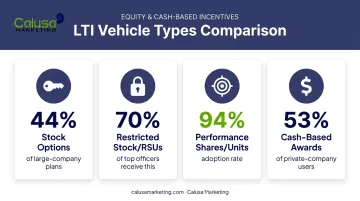
Four vehicles show up most often, and most large companies don't rely on just one. 84% of large companies grant two or more LTI types.
| Vehicle | How It Works | Prevalence |
|---|---|---|
| Stock Options | Right to buy shares at a fixed exercise price; value depends entirely on stock appreciation | Declining, now around 44% of large-company plans |
| Restricted Stock / RSUs | Full-value award that vests on a set schedule, regardless of stock performance | Nearly 70% of top officers receive restricted stock |
| Performance Shares/Units | Vesting tied to metrics like TSR, EPS, or ROI over multiple years | 94% of large companies now use performance awards |
| Cash-Based Awards | Non-equity long-term cash grants, common where equity valuation is difficult | 53% of private-company LTI users rely on cash plans |
Vesting: How and When LTIPs Pay Out
Vesting determines when ownership actually transfers, and it's the retention lever that makes the whole plan work. Two structures dominate:
- Cliff vesting: 100% of the award vests on one date, such as the three-year anniversary of the grant. Nothing before that.
- Graded/ratable vesting: portions vest annually. A four-year grant might release 25% each year.
Example: an executive granted 4,000 RSUs on a four-year graded schedule receives 1,000 shares annually, contingent on staying employed. Leave in year two, and the remaining 2,000 shares never vest.
Three-year vesting periods are the most prevalent schedule for both performance shares and restricted stock. Stock options typically carry a 10-year term with vesting spread over three to five years.
Who Typically Receives Long-Term Incentives?
LTIPs concentrate among executives and senior leaders with direct line-of-sight into company performance: the people whose decisions move the stock price or hit multi-year targets. Still, the pool keeps widening: 97% of companies now grant restricted stock below the top-officer level, and only 3-5% of tech firms have plans to cut back LTI for senior professionals.
Public-versus-private remains the sharpest dividing line. Public companies lean on LTI because shares are liquid and easy to value.
Private companies increasingly use cash-based or phantom equity plans to deliver similar retention value without the valuation headache. Private firms are also expanding participation faster, with 30% increasing LTI levels compared to 15% of public firms.
Key Advantages of Long-Term Incentive Plans
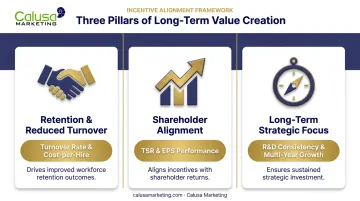
The advantages below aren't abstract theory. Each ties to a KPI companies already track: turnover rate, cost-per-hire, TSR, or profitability.
Retention of Key Talent and Reduced Turnover Costs
Vesting schedules give high performers a financial reason to stay through the full plan period, sometimes called "golden handcuffs." Walk away early, and unvested equity stays on the table.
Why it matters: replacing a senior employee costs anywhere from 0.5x to 2x their annual salary, and voluntary turnover costs U.S. businesses $1 trillion a year, according to Gallup.
For a $200,000 executive role, that's a $100,000-$400,000 hit: recruiting fees, lost productivity, onboarding time, and institutional knowledge walking out the door.
KPIs impacted: turnover rate, cost-per-hire, time-to-fill for leadership roles.
When it matters most: competitive talent markets, leadership transitions, or industries facing skill shortages where a single departure creates a real gap.
Alignment of Employee and Shareholder Interests
Stock-based LTI vehicles turn employees into shareholders. Their compensation moves with the stock price, so their incentives point the same direction as the people who own the company.
This is standard practice now. The 2024 Top 250 Report found that 73% of companies use total shareholder return (TSR) as an LTI metric, and 98% of those measure it on a relative basis against a peer group or index. That's near-universal adoption of a metric built specifically to connect pay with shareholder outcomes.
KPIs impacted: total shareholder return, stock price performance, earnings per share.
When it matters most: publicly traded companies, major strategic transformations, or periods of heightened investor scrutiny on executive pay.
Encourages Long-Term, Strategic Decision-Making
Multi-year vesting discourages short-termism. When rewards depend on sustained performance rather than one strong quarter, leaders have less reason to cut R&D or delay a needed investment just to hit a near-term number.
One analysis found accelerated vesting is associated with a median $14 million decline in company investment, suggesting longer vesting horizons help sustain the spending that builds long-term value.
KPIs impacted: multi-year revenue growth, R&D/investment consistency, strategic project completion rates.
When it matters most: multi-year transformations, growth-stage businesses, or capital-intensive projects with a long payoff horizon.
What Happens When LTIPs Are Missing or Poorly Designed
Skip the equity comp, and the consequences show up fast:
- Higher turnover among executives and key employees, since there's no financial reason to stay through a transition
- Weaker alignment between leadership decisions and shareholder value, with nothing tying personal comp to long-term outcomes
- Over-reliance on short-term bonuses, which can unintentionally reward decisions that boost this year's numbers at next year's expense
Poor design causes similar damage. Unclear metrics, unrealistic targets, and payout bands that are too tight all demotivate the people the plan was built to retain.
This is the "feast or famine" problem: a small miss zeroes out the entire award. Companies are increasingly widening threshold-to-maximum payout ranges to counter this, since market volatility can swing results participants don't fully control.
A badly designed LTIP actively recreates the disengagement it was supposed to prevent.
How to Get the Most Value from Your LTIP
LTIPs work best when they're actively managed, not set and forgotten.
- Define metrics clearly and communicate them. Participants should know exactly what triggers a payout. Vague or shifting targets erode trust fast.
- Review the plan on a regular cadence. Annual or bi-annual check-ins catch metrics that no longer fit the business before they become a real problem.
- Benchmark against industry data. LTI vehicles and payout structures shift as talent markets and company goals evolve. A plan competitive three years ago may not be today.
Getting the plan mechanics right solves only part of the challenge. A three-to-five-year vesting period is a long stretch to stay motivated on promise alone, and that's where short- and mid-term incentive programs earn their keep, giving people something tangible to work toward between the annual review and the eventual payout:
- Recognition rewards for hitting quarterly or milestone goals
- Sales incentives tied to shorter-term performance targets
- Loyalty programs that build engagement month over month
This is the gap a partner like Calusa Marketing fills. Instead of asking a key employee to wait three years for the big reward, companies pair their LTIP with day-to-day motivation: merchandise rewards, gift card programs, or milestone travel incentives that recognize performance along the way.

These smaller programs work alongside the LTIP instead of competing with it, giving people regular wins while the bigger payout builds in the background.
The strongest incentive strategies treat LTIPs as one layer of a broader total rewards approach, not a replacement for everything else.
Conclusion
The value of an LTIP comes down to three things: retention, alignment, and long-term strategic focus. None of these show up overnight. They compound the longer a plan stays in place and the more consistently it's managed.
But equity that vests in year four doesn't do much for morale in month six. LTIPs work best as one piece of a broader total rewards strategy, paired with short-term recognition and mid-term incentive programs that keep people engaged while the bigger payout builds. Calusa Marketing specializes in building that recognition and loyalty layer, keeping engagement steady between grants and vesting.
Get that balance right, and a long-term incentive plan stops being a line item in a proxy statement. It starts doing what it was designed to do: keep your best people invested in where the company is headed.
Frequently Asked Questions
How does a long-term incentive plan work?
Employees earn compensation, often stock or cash, that's deferred and paid out over a vesting period, typically 3-5 years. Payout is contingent on staying with the company, hitting performance goals, or both.
How are long-term incentive plans paid out?
Payouts follow a vesting schedule, either cliff (all at once) or graded (in portions over time). They're delivered in cash, shares, or a blend, depending on which vehicle the plan uses.
Are long-term incentive plans worth it?
For most public companies and many private ones, LTIPs deliver strong ROI through better retention and performance alignment. Effectiveness depends heavily on clear goal-setting and realistic, well-communicated targets.
What is the difference between short-term and long-term incentive plans?
Short-term incentives are annual bonuses tied to yearly goals, paid out shortly after the performance period ends. Long-term incentives vest over multiple years and reward sustained performance or tenure.
Who typically receives a long-term incentive plan?
LTIPs are most common for executives and senior leaders with direct influence over company results. Many companies are now extending grants to broader employee groups, including roles below VP level.
What is vesting in the context of an LTIP?
Vesting is the timeline by which an employee gains full ownership of a granted award. It's contingent on service time, performance achievement, or both, and it's what makes an LTIP function as a retention tool.