
Here's the problem: many HR teams default to bonuses and raises because that's what they know how to budget for. Non-monetary recognition often gets left to chance, handled inconsistently (or not at all) by individual managers.
This guide breaks down what intangible rewards actually are, how they differ from tangible rewards, and gives you 30+ real examples across four categories. You'll also get a step-by-step framework for building a program that doesn't fall apart the moment a manager forgets to say thank you.
Key Takeaways
- Intangible rewards are non-monetary benefits, like recognition and autonomy, that build lasting motivation
- Unlike tangible rewards like bonuses or gift cards, they cost less and create longer-lasting motivation
- Effective total rewards strategies combine tangible milestones with intangible daily recognition
- The four core categories are recognition, career growth, autonomy, and belonging
What Are Intangible Rewards? Definition and Characteristics
An intangible reward is a non-monetary, non-material incentive that carries no direct financial value but delivers a strong emotional and psychological payoff for the employee. Think public recognition, a mentorship opportunity, or the freedom to set your own schedule.
The key distinction most HR teams miss: intangible rewards should respond to a specific achievement or behavior. Saying "great job, team" in a Friday email is a courtesy, not a reward. Calling out that Sarah caught a costly billing error before it reached a client, in front of her peers, is a reward that validates real effort.
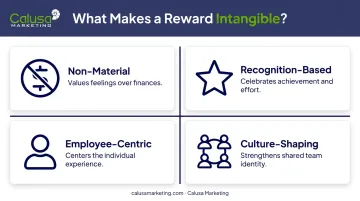
Core characteristics of intangible rewards:
- Non-material — no cash, gift card, or physical item changes hands
- Recognition-based — tied to something the employee actually did
- Employee-centric — designed around what motivates the individual, not a one-size-fits-all policy
- Culture-shaping — reinforces the behaviors you want repeated across the team
You'll also see intangible rewards called intangible benefits, non-monetary incentives, or emotional salary. These terms overlap heavily and are often used interchangeably in HR literature, so don't get hung up on picking the "correct" one.
Intangible Rewards vs. Intrinsic Rewards: Avoiding a Common Confusion
These two terms get mixed up constantly, and the distinction matters for how you design a program.
An intangible reward is something your organization deliberately provides: recognition, mentorship, flexibility. An intrinsic reward is the internal feeling an employee experiences as a result, like pride, satisfaction, or a sense of belonging.
Here's a simple example: a manager publicly recognizing an employee's work in a team meeting is the intangible reward. The swell of pride that employee feels afterward, and the motivation it creates to keep performing at that level, is the intrinsic reward.
HR leaders should design intangible reward systems specifically to trigger that internal response, not just to check a box that says "recognition happened." A generic shout-out rarely lands the same way as one that's specific and clearly deserved.
Intangible Rewards vs. Tangible Rewards: Key Differences
Tangible rewards have measurable financial value. Intangible rewards don't, but that doesn't make them less impactful. Here's how they stack up:
| Factor | Tangible Rewards | Intangible Rewards |
|---|---|---|
| Definition | Cash or material items with financial value | Non-monetary, psychological benefits |
| Examples | Bonuses, gift cards, stock options | Recognition, mentorship, flexibility |
| Cost to organization | Direct budget line item | Little to no direct cost |
| Motivation type | Primarily extrinsic | Extrinsic delivery, intrinsic effect |
| Duration of impact | Often short-lived | Builds cumulatively over time |
Wage-satisfaction research from Germany's Socio-Economic Panel found that job-satisfaction gains from pay increases tend to fade over time, a pattern often described as hedonic adaptation. That doesn't mean every bonus is worthless. It does mean cash alone rarely sustains engagement on its own, which is where intangible recognition earns its keep.
Examples of Tangible Rewards
The most common tangible rewards HR teams use:
- Cash bonuses tied to performance metrics
- Pay raises or merit increases
- Gift cards for milestones or spot bonuses
- Free company merchandise or swag
- Gym membership stipends
- Stock options or equity grants
Quick scenario: An account manager blows past their quarterly sales target. Give them a $500 bonus, and they'll appreciate it, deposit it, and move on. Publicly recognize the deal in the next all-hands meeting and pair it with a stretch assignment, and you've reinforced the behavior in a way that outlasts the paycheck.
When to Use Tangible vs. Intangible Rewards
Neither reward type wins outright. The decision comes down to what you're trying to reinforce:
- Use tangible rewards for measurable, one-time achievements, meaning sales targets, project completions, or safety milestones with a clear finish line
- Use intangible rewards for ongoing behaviors and culture, like mentorship, values alignment, or day-to-day collaboration
- Combine both when possible: tangible rewards mark the milestone, intangible recognition sustains engagement in between
For the tangible side of that equation, many HR teams don't want to manage gift card fulfillment, merchandise shipping, or travel logistics in-house. Partnering with an incentive marketing firm like Calusa Marketing solves that problem.
Handling the fulfillment and logistics behind gift cards, branded merchandise, and travel incentives (including group trips for teams as large as 10,000 people) frees internal HR teams to focus on what actually needs a human touch: building the culture-driven, intangible side of recognition.
Types and 30+ Examples of Intangible Rewards
Intangible rewards fall into four categories, each addressing a different psychological need. Use this list as an internal audit: which categories does your organization actually cover, and which are you ignoring?
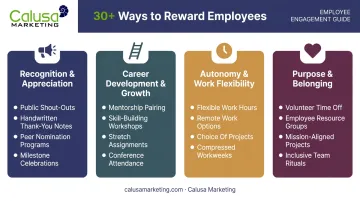
Recognition and Appreciation
- Public shout-outs during team meetings
- Peer-to-peer recognition programs
- Handwritten thank-you notes from leadership
- Employee spotlight features shared company-wide
- Recognition walls or shared channels for wins
- Personalized feedback tied to specific projects
- Milestone anniversary celebrations
- Real-time recognition through digital badges
Career Development and Growth Opportunities
- Mentorship pairings with senior leaders
- Conference or tuition sponsorship
- Stretch assignments outside an employee's usual scope
- Transparent, documented promotion pathways
- Cross-departmental shadowing opportunities
- Access to internal skill-building workshops
- Executive coaching for high-potential employees
- Certification or licensing reimbursement
Career investment isn't just goodwill—it shows up in retention numbers. A Cigna analysis of roughly 31,000 employees, including about 4,400 tuition-program participants, found that participants were 8% more likely to be retained than comparable nonparticipants, alongside higher promotion and internal transfer rates.
Autonomy and Work Flexibility
- Flexible working hours around core availability
- Remote or hybrid work options
- Compressed workweeks (four 10-hour days, for example)
- No-meeting days that protect focus time
- Choice over project assignments where feasible
- Self-directed scheduling for deep work blocks
- Trust-based paid time off policies
Purpose, Belonging, and Inclusion
- Volunteer time off for causes employees care about
- Support for employee resource groups (ERGs)
- Team rituals and milestone celebrations
- Psychological safety practices that let people speak up without fear
- Transparent communication about company direction and decisions
- Onboarding buddies to build early belonging
- Employee-led town halls and feedback sessions
- Recognition of major life events like weddings or new babies
Why Intangible Rewards Matter: Benefits for Retention and Engagement
Intangible rewards address root causes of disengagement, not just the symptoms a bonus temporarily masks. Employees don't leave because they're underpaid alone; they leave because they feel invisible, stuck, or disconnected from purpose.
Gallup followed 3,447 U.S. employees from 2022 to 2024. Those who felt well-recognized at the study's start were 45% less likely to have moved to another organization two years later. That's an association, not proof recognition alone caused the outcome, but it's a strong signal worth acting on.
Practical benefits include:
- Deliver instantly, with no payroll delay or approval chain
- Require little to no budget to implement
- Strengthen peer bonds through visible, shared recognition moments
One caution: Intangible rewards should never fully replace fair compensation. An employer that offers only "thank yous" while lagging on pay risks signaling it isn't financially committed to its people.
Balance matters more than either extreme.
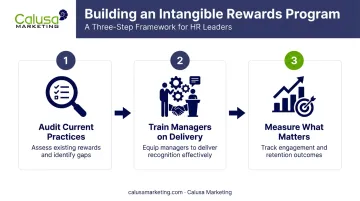
How to Build an Effective Intangible Rewards Program
Building this well doesn't require a massive budget. It requires consistency, which is where most programs actually fail.
- Audit current practices. Survey employees, review exit interview data, and identify which categories (recognition, growth, autonomy, purpose) are underserved across teams.
- Train managers on delivery. Recognition should be specific, prompt, and tied to an actual behavior or value, not generic praise like "nice work."
- Measure what matters. Track recognition frequency per employee, manager participation rates, eNPS, and voluntary turnover to see what's working.
The most common pitfall: inconsistent recognition across managers. A well-designed program still fails for employees whose manager rarely bothers to use it. Standardize expectations instead of just publishing guidelines and hoping for the best.
Frequently Asked Questions
What is an intangible reward?
An intangible reward is a non-monetary benefit with emotional or psychological value rather than direct financial worth. Public recognition, mentorship, and career growth opportunities are common examples.
What are examples of intangible rewards?
Examples span several categories: public recognition, flexible schedules, mentorship pairings, and volunteer time off. Each targets a different employee need, from appreciation to purpose.
What is the difference between tangible and intangible rewards?
Tangible rewards carry measurable financial value, like bonuses and gift cards. Intangible rewards are non-monetary and build intrinsic motivation and longer-term engagement.
What are examples of tangible rewards?
Common examples include cash bonuses, pay raises, gift cards, and branded merchandise. These typically reward specific, measurable achievements.
Are intangible rewards more effective than tangible rewards?
Neither is inherently more effective. Tangible rewards drive short-term motivation for measurable goals. Intangible rewards sustain long-term engagement, so the strongest programs use both together.
How can HR start implementing intangible rewards today?
Start with a quick recognition audit, train managers to give specific and timely praise, and track a simple metric like recognition frequency. Small, consistent steps build momentum faster than a big program launch.