Merchandise incentives take a different approach. They give people something to want, work toward, and remember. Yet despite consistent evidence of their effectiveness, many organizations default to cash simply because it feels simpler to administer.
This article breaks down the concrete, operational reasons merchandise incentives belong in any serious incentive program — what they actually do for behavior, business outcomes, and the relationships that drive revenue.
Key Takeaways
- Non-cash rewards, including merchandise, outperform cash in driving sustained effort and goal commitment
- Physical rewards carry trophy value — they get displayed, discussed, and associated with the brand that gave them
- Merchandise programs tie payouts to verified performance, giving budget owners real cost control
- One catalog can serve HVAC technicians, call center agents, and office staff — no separate programs required
- Adding merchandise rewards gives businesses a differentiation tool that price alone can never provide
What Are Merchandise Incentives?
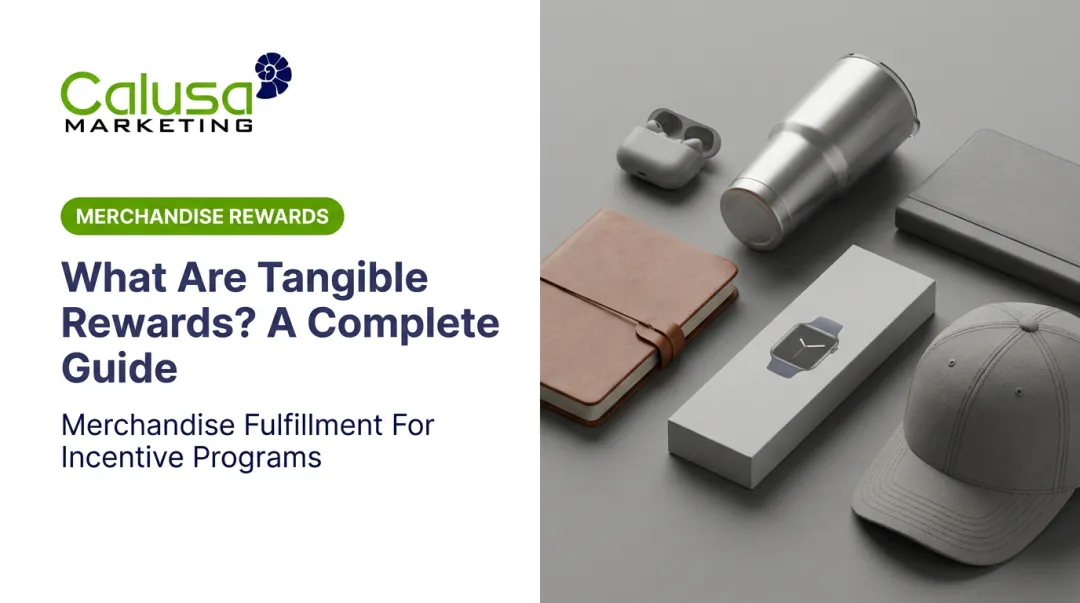
Merchandise incentives are physical rewards — electronics, home goods, tools, appliances, branded items — offered to employees, channel partners, or customers when they hit a defined performance milestone or behavior target.
These programs span nearly every industry and audience type:
- Sales acceleration — quota attainment, units sold, new accounts opened
- Channel partner loyalty — purchase consolidation, brand preference, stocking programs
- Employee recognition — tenure, safety, performance, and retention
- Customer acquisition and retention — repeat purchases, referrals, enrollment campaigns
- Donor and participation programs — recurring engagement in healthcare or community contexts
Unlike cash bonuses, merchandise incentives are designed to drive behavior — not simply acknowledge it. A physical reward creates lasting motivational pull that a deposit into someone's bank account rarely does.
Top 10 Reasons to Use Merchandise Incentives
The reasons below focus on real-world impact — on behavior, on business outcomes, and on the relationships between a business and the people who drive its results.
Reason 1: They Outperform Cash in Motivating Behavior
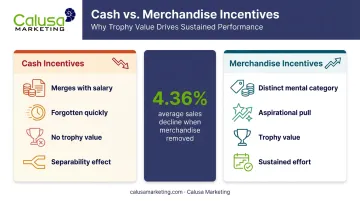
Cash has a well-documented problem in incentive design: it disappears into general income almost immediately. Behavioral economists call this the "separability effect" — cash is interchangeable with salary, so it merges with salary and is mentally classified as compensation, not reward.
Merchandise works differently. A specific, desirable item creates a distinct mental category tied to achievement. People visualize it, anticipate it, and work harder to get it.
Research published in the Journal of Marketing Research tracked 580 salespeople at a frozen-food manufacturer. When an equivalent all-cash plan replaced a mixed cash-and-merchandise-points program, average sales fell 4.36% — with the steepest declines among top performers. Across a large sales force, that decline translates directly into significant lost revenue.
Reason 2: They Carry Lasting Trophy Value
A check cashed on Friday is forgotten by Monday. A piece of home electronics, a set of tools, or a branded item sitting on someone's desk is a daily reminder of what they earned and who recognized them for it.
The Incentive Research Foundation defines this as trophy value: tangible non-cash rewards create visibility and social-signaling opportunities that cash simply cannot. Recipients discuss merchandise without the awkwardness of disclosing a bonus amount. They show it to colleagues. They post about it.
Every conversation becomes organic reinforcement of the sponsoring brand, building credibility at no additional cost.
Reason 3: They Drive Measurable Sales and Performance Gains
Merchandise incentives are most powerful when tied to specific, trackable metrics: units sold, visits completed, accounts opened, quotas hit. That structure makes ROI measurement straightforward — you know exactly what behavior the reward is connected to.
The frozen-food manufacturer study cited above also illustrates how the effect concentrates among high performers. Top salespeople showed the largest sales decline when merchandise was removed, suggesting that aspirational earners respond most strongly to non-cash incentives. For sales-driven organizations — HVAC distributors, electrical supply chains, call centers — that is precisely the segment worth influencing.
One IRF distributor case study put real numbers behind this:
- A combined merchandise-and-travel program produced $1.44 million in incremental net sales
- Gross margin improved from 30.4% to 35%
- Merchandise rewards were central to engaging counter-level staff who influence daily purchasing decisions
Reason 4: They Build Stronger Channel Partner Loyalty
A points-based merchandise program gives channel partners a compelling reason to consolidate purchasing with one supplier. Every transaction earns toward a reward — meaning every competitor's pitch has to overcome not just price, but the accumulated progress a partner would abandon by switching.
That dynamic is fundamentally different from a discount. Discounts train partners to evaluate each transaction in isolation. Merchandise programs create cumulative investment that grows stickier over time.
Among channel-focused incentive programs, nearly 60% of North American respondents expected physical merchandise use to increase in 2025, according to IRF's 2025 industry outlook — a signal that program operators have found merchandise effective for partner engagement.
Reason 5: They Enable Better Budget Control and ROI Visibility
Merchandise programs have a cost structure that finance teams tend to appreciate quickly. Rewards are only paid out when a participant hits a performance threshold — which means program costs are directly tied to revenue-generating behavior. No results, no payout.
This is the opposite of a salary increase or a flat cash bonus, both of which are paid regardless of incremental performance.
Additional budget efficiency comes from the platform side. The CM Rewards dashboard used by Calusa Marketing clients displays real-time data including current point balances, year-to-date spending, and pending points — giving program administrators a live view of accrued liability at any time. That kind of visibility makes forecasting straightforward and prevents budget surprises.
Reason 6: They Offer Flexibility Across Industries and Goals
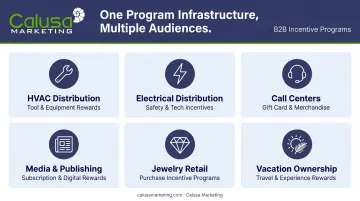
A well-structured merchandise catalog can serve meaningfully different audiences without requiring separate programs. An HVAC technician earning points toward power tools and a call center agent earning toward home electronics are participating in the same mechanics — the catalog simply offers categories relevant to each.
Calusa Marketing's CM Rewards platform serves clients across HVAC distribution, electrical distribution, call centers, media and publishing, jewelry retail, and vacation ownership under the same program infrastructure. The reward mix can shift by segment, season, or business priority without rebuilding the program from scratch.
Industry practitioners surveyed by the Incentive Marketing Association gave programs with fresh or seasonally updated reward options a 4.27 out of 5 effectiveness rating — suggesting that catalog relevance directly influences participant engagement.
Reason 7: They Open Direct Communication Channels with Partners and Customers
Calusa Marketing's cloud-based platform launches with no software integration required and no app for participants to download. That removes two of the most common friction points in program rollout — IT involvement and participant adoption — and puts the program in front of participants faster.
Reason 9: They Reduce Price-Based Competition
Businesses that compete on price alone compress their margins every quarter. A merchandise incentive program gives distributors, partners, and customers a reason to stay that has nothing to do with who is cheapest this month.
When a competitor cuts price but offers no loyalty program, the business running a well-managed merchandise incentive program holds an advantage that is genuinely difficult to match with a simple discount. Price cuts are instantly visible and easily matched. A reward program that partners have been building points in for six months is not.
This shifts the supplier conversation from "who has the lowest price" to "what additional value does this relationship give me" — which is a much better position to defend.
Reason 10: They Reinforce Brand Association Long After Redemption
Cash spent is forgotten within days. A quality merchandise item can remain in daily use for months or years.
PPAI research surveying more than 1,000 consumers found that nine in ten recalled the branding on a physical product they received, 82% reported a more positive impression of the brand, and most kept items for one to five years. That is repeated, unsolicited brand exposure with genuine emotional resonance — at zero additional cost after the initial redemption.
Every time a recipient uses an earned item, the brand relationship is reinforced. For organizations making the case for non-cash incentives internally, that kind of measurable, lasting recall is hard to argue with.
What Happens When Merchandise Incentives Are Ignored
Organizations that rely solely on cash or discounts to motivate tend to run into the same problems:
- Price sensitivity increases — partners and customers learn to evaluate every transaction independently, waiting for the better deal
- Incremental effort plateaus — when rewards feel indistinguishable from standard compensation, there is no motivational premium for extra effort
- No behavioral data — without a structured program, there is no way to track what motivates your audience, what is working, or what needs adjustment
- Reactive, expensive fixes — instead of proactive engagement, organizations end up with retention problems that are expensive to solve after the fact
The JMR field study makes the cost of inaction concrete: removing merchandise from a mixed incentive plan coincided with a 4.36% average sales decline across 580 salespeople. Across a distributed sales force or channel network, that number compounds quickly.
Meanwhile, competitors running merchandise programs build preference and loyalty with shared partners — and once that preference takes hold, it rarely shifts back.
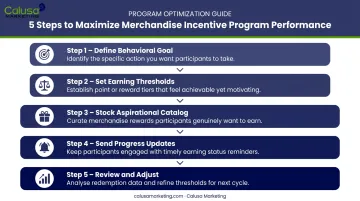
How to Get Maximum Value from Your Merchandise Incentive Program
The programs that perform best share a few structural traits:
- Start with a specific behavioral goal: Define what change you want — more units sold, higher order frequency, reduced churn — before selecting rewards.
- Set earning thresholds that require effort but feel achievable. Too easy and the reward loses its pull. Too difficult and participants drop out before they start.
- Stock the catalog with rewards participants actually want, not items the program operator finds easiest to source.
- Send regular progress updates and new reward announcements. Participants who know where they stand stay engaged between redemption events.
- Review redemption patterns and adjust. Real data — not assumptions — should drive catalog refreshes and threshold changes.
The operational side matters as much as the design side. Calusa Marketing's fully managed programs handle end-to-end fulfillment and participant support, so administrators are not buried in logistics — and participants stay focused on earning, not troubleshooting. A frictionless experience for program members reflects directly on the sponsoring brand.
Frequently Asked Questions
What are merchandise incentives in marketing?
Merchandise incentives are tangible reward programs where participants — employees, customers, or channel partners — earn physical goods such as electronics, home products, or tools in exchange for achieving specific performance or engagement goals. They are used to change behavior, not simply to acknowledge it.
What are the 4 types of incentives?
The four main types are monetary (cash, bonuses), merchandise (physical goods), experiential (travel, events), and recognition (awards, public acknowledgment). Most effective programs blend two or more types, using merchandise to complement financial rewards rather than replace them.
How do merchandise incentives differ from cash bonuses?
Cash bonuses merge into general income and are typically forgotten within days. Merchandise rewards carry trophy value — they are visible, shareable, and emotionally connected to the achievement that earned them, making them stronger long-term motivators — especially among high performers who already expect cash compensation.
What industries benefit most from merchandise incentive programs?
Merchandise programs work across a broad range of industries including HVAC and electrical distribution, call centers, media and publishing, vacation ownership, jewelry retail, and donor recruitment.
How do you measure the ROI of a merchandise incentive program?
ROI is measured by comparing the revenue or behavior change generated against the cost of rewards distributed. Programs built on sales benchmarks keep this straightforward: costs are only incurred once specific performance thresholds are met, so every payout is linked to a verified outcome.
What makes a merchandise incentive program successful?
Success depends on five elements: an aspirational reward catalog, achievable earning thresholds, intuitive redemption, and consistent communication with participants. Reliable fulfillment — with responsive customer service to handle questions quickly — ties it all together.