Most businesses have no formal plan for this. They notice the drop-off in a quarterly report, long after the customer has mentally moved on. By then, a generic "we miss you" email won't cut it.
Re-engaging an existing customer costs far less than acquiring a new one, yet few companies treat win-back campaigns with the same rigor as new customer acquisition. This guide covers what a re-engagement strategy actually looks like, how to spot inactive customers before they're gone for good, which tactics reliably bring them back, and why incentives are often the deciding factor.
Key Takeaways
- A re-engagement strategy is a structured, ongoing plan for reconnecting with lapsed customers, not a single email.
- Warning signs show up early: no recent purchases, fading email engagement, unused loyalty points
- Personalized outreach paired with real incentives beats generic messaging every time
- Track reactivation rate, redemption rate, and recovered revenue — not just opens and clicks
What Is a Re-engagement Strategy?
A re-engagement strategy is a deliberate campaign or program built specifically to reconnect with customers who've gone quiet or stopped transacting. Unlike a newsletter blast or seasonal promotion sent to your entire list, it targets one specific segment: people who used to engage and now don't.
Why Re-engagement Beats New Acquisition
Acquiring a new customer can cost 5 to 25 times more than retaining an existing one, according to Harvard Business Review. That ratio shifts by industry, but the direction never changes: the person who already knows your brand is a cheaper conversion than a stranger you're introducing to it for the first time.
A dormant customer already trusts you enough to have bought once. That's a head start no cold prospect gives you, and it holds true no matter what industry you're in.
It's Not Just an Ecommerce Problem
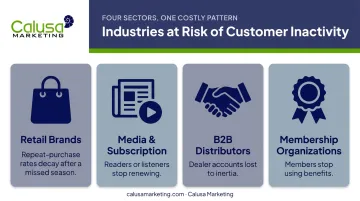
Customer inactivity shows up everywhere:
- Retail brands watch repeat-purchase rates decay after a single missed season
- Media and subscription companies see readers or listeners stop renewing
- B2B distributors lose dealer or contractor accounts to inertia, not necessarily to competitors
- Membership organizations lose members who simply stop using their benefits
Whatever industry you're in, someone on your list has gone quiet. The question is whether you have a plan to bring them back.
How to Identify Inactive or At-Risk Customers
You can't win back someone you haven't flagged as gone. The mistake most businesses make is treating "inactive" as a single bucket. A customer who bought 35 days ago behaves very differently than one who hasn't purchased in a year.
Signals Worth Tracking
Look for these inactivity indicators:
- No purchase or interaction within a defined window (30, 60, or 90+ days, depending on your typical buying cycle)
- Declining email opens or site visits compared to their previous baseline
- Unredeemed loyalty points or rewards sitting untouched in an account
- Reduced app or platform logins for subscription or membership-based businesses
These signals rarely appear alone. A drop in email opens often precedes a missed purchase by several weeks, giving you an early warning before revenue actually drops.
Segment by Dormancy Stage, Not Just "Active vs. Inactive"
Pull this data from your CRM, loyalty platform, and email analytics, then split customers into tiers:
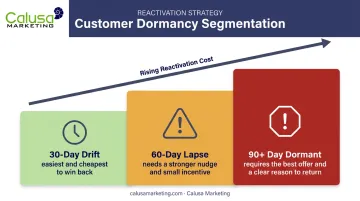
- 30-day drift: recently quiet, still warm, easiest and cheapest to win back
- 60-day lapse: needs a stronger nudge, maybe a small incentive
- 90+ day dormant: requires your best offer and a clear reason to return
Catching disengagement at the 30-day mark is dramatically easier than waiting until day 90. Early-stage drift is often just a scheduling gap — a reminder is enough. By day 90, you're often competing against a customer who's already found a substitute. The cost of winning them back rises with every week you wait.
Proven Re-engagement Strategies That Win Back Customers
Generic "we miss you" emails underperform because they treat every dormant customer the same. The strategies below work because they don't.
Personalized Outreach and Segmentation
Tailor the message to what you actually know: past purchase history, engagement level, and how long they've been gone. A customer who lapsed after one purchase needs a different pitch than a five-year regular who suddenly stopped ordering.
Multi-Channel Campaigns
Email alone isn't enough anymore. Layer in SMS, direct mail, or retargeting ads to catch attention where the customer actually is.
A Return Path study of win-back programs at 33 major retailers found that the initial win-back email had a modest 12% read rate, yet 45% of those recipients went on to read a later message from the same sender. A sequence across channels catches the people the first message missed.
Time-Limited Offers and Urgency
A deadline gives someone a reason to act today instead of "someday." Phrases like "expires Friday" or "last chance to use your points" work without sounding pushy, provided the deadline is real.
Feedback and Preference Requests
Sometimes the fix is simply asking why they left, not offering another discount. A short survey ("What made you stop shopping with us?") combined with a preference reset can re-engage customers who drifted because your content stopped feeling relevant.
Social Proof and Testimonials
Skeptical, disengaged customers respond to peer validation. A short testimonial or review reminds them why they trusted you the first time.
Structured Win-Back Sequences
Don't rely on one email. Build a short sequence:
- Value reminder: what they're missing
- Offer: a concrete incentive to return
- Final urgency message: last call before you stop reaching out
Why Incentives Are the Missing Piece in Most Re-engagement Campaigns
Message-only campaigns get read. Campaigns with a real incentive get acted on.
Piano's win-back test on churned digital-publishing subscribers found that a 20%-off offer converted at 0.71%, compared to 0.38% for a full-price message, nearly double. The discounted branch also generated 78% more total revenue overall. Reward-based triggers move people further down the funnel than words alone.
Loyalty Point Boosts
Offering bonus or double points for a return purchase within a set window, such as 30 days, gives lapsed loyalty members a concrete reason to come back before the offer expires. It works because it taps into value members have already banked in the program, rather than asking them to start over like a stranger.
Flexible Reward Options
Not every dormant customer wants the same thing. That's the logic behind Calusa Marketing's ANY-Card platform, which offers 100+ digital gift card options ranging from national retailers to restaurants to VISA cards as a cash alternative.
Instead of guessing what a lapsed customer values, they pick their own reward from a catalog you control the budget on. Clients like McClatchy, Houston Chronicle, and Advance Local use this exact model for subscriber retention, which mirrors the win-back use case closely: the reward feels personal, not generic.
Experiential and Travel Incentives
For high-value or long-tenure dormant accounts, particularly in B2B and membership settings, a bigger reward can justify itself. Calusa Marketing's high-end travel incentives run from $500 to $25,000 for two adults, and its group travel program scales from 10 to 10,000 people for reactivating entire dealer networks or advertiser bases at once.
APG Media's Jim Normandin credited this approach with generating "millions of dollars of incremental revenue" by giving both sales teams and clients something worth coming back for.
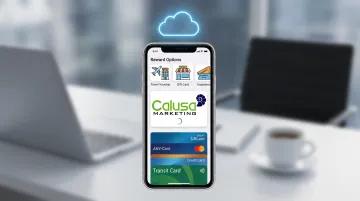
This is where Calusa Marketing fits into a re-engagement plan: designing, launching, and fully fulfilling the incentive side of the program. Its cloud-based SaaS platform requires no integration and no app download, with loyalty cards landing straight in a customer's Apple or Google Wallet.
Its white-glove customer service team handles fulfillment questions seven days a week. That combination has helped the company maintain a 99% client retention rate across more than 1,000 programs and 500,000+ members.
Measuring the Success of Your Re-engagement Campaign
Opens and clicks tell you people noticed. They don't tell you whether the campaign paid for itself.
Metrics That Actually Matter
| Metric | What It Tells You |
|---|---|
| Reactivation rate | % of targeted dormant customers who took action |
| Offer redemption rate | % who actually used the incentive offered |
| Revenue recovered | Dollar value generated from previously inactive customers |
| Open/click rates | Early signal, but not proof of a win-back |
Once you've identified the right metrics, compare them against realistic benchmarks. Don't expect one universal number: reported ranges differ by channel and industry.
- Email customer-reactivation automations average around a 0.54% conversion rate, based on Omnisend's analysis of more than 27,000 brands
- SMS win-back messages in ecommerce typically convert between 0.4% and 1.6%, per Postscript data cited by Omnisend
- Discounted offers can roughly double conversion versus full-price messaging, as seen in Piano's publisher test
These numbers use different denominators and shouldn't be averaged together. Use them as directional benchmarks, not a universal target.
Test, Then Double Down
Run A/B tests on subject lines, offer types, and send timing. Once one variation consistently outperforms, shift your budget there rather than splitting resources evenly across every option.
Frequently Asked Questions
What is re-engagement?
Re-engagement is a targeted effort to reconnect with customers who've stopped purchasing or interacting with a brand. Unlike general marketing, it's built specifically around win-back messaging and offers for a dormant segment.
What are examples of re-engagement strategies?
Common examples include personalized win-back emails, loyalty point bonuses, exclusive time-limited offers, and multi-channel outreach combining email, SMS, and direct mail.
What is the success rate of re-engagement?
Success rates vary by industry and channel. Email reactivation automations average roughly 0.54% conversion, while SMS win-back campaigns in ecommerce typically fall between 0.4% and 1.6%.
How long should a re-engagement campaign run before giving up on inactive customers?
A typical sequence runs 2-3 touchpoints over a few weeks: a value reminder, an offer, and a final urgency message. Contacts who don't respond should move to a suppressed or opt-out list.
Should every re-engagement campaign include a discount or incentive?
Incentives boost response rates significantly, but they work best paired with personalized, value-driven messaging rather than used alone. A discount without context often underperforms a well-timed, relevant offer.
How often should businesses run re-engagement campaigns?
A quarterly cadence works for most businesses, though the right frequency depends on your typical purchase or engagement cycle. Faster-cycle businesses may need monthly reviews of dormant segments.