Employee referrals cut through that noise. CareerPlug's 2024 Recruiting Metrics Report, based on data from more than 60,000 small businesses, found that referrals produced 11% of all hires from just 2% of applicants — a conversion rate no other sourcing channel comes close to matching.
Here's the catch: most companies already have a referral program. Few have one that actually works. Generic $100 gift cards and a forgotten intranet page don't move the needle.
This article breaks down why referral programs deliver outsized results, what real incentive structures and bonus ranges look like, and the best practices that separate high-performing programs from the ones gathering dust in an employee handbook.
Key Takeaways
- Referral programs cut time-to-fill and beat job boards and agencies on cost-per-hire
- Travel, gift cards, and choice-based rewards outperform cash-only bonuses for engagement
- Bonus size scales with role seniority, difficulty, and time-to-fill
- Simple tools, steady communication, and reliable payouts drive program success
What Is an Employee Referral Incentive Program?
An employee referral incentive program is a structured system where current staff recommend candidates from their personal or professional networks and receive a reward when that person gets hired. The reward might be cash, reward points, a gift card, extra PTO, or a travel certificate.
The word "incentive" matters more than it looks. A company can have a referral policy (a passive statement that employees are welcome to suggest candidates) without ever generating meaningful volume. It's the incentive layer that turns a dormant policy into an active recruiting channel employees actually use.
These programs show up across nearly every industry:
- Distribution and logistics: filling warehouse and driver roles fast
- Media and broadcasting: sourcing sales and content talent through existing networks
- Call centers: replacing high-turnover frontline agents with pre-vetted candidates
- Healthcare: closing hard-to-fill clinical and nursing positions
Wherever quality hiring and retention matter, companies lean on well-structured referral incentives to get there.
How Does an Employee Referral Program Work?
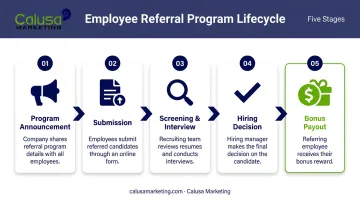
Most programs follow a predictable lifecycle, whether they run on a spreadsheet or dedicated software.
- Program announcement: HR communicates open roles eligible for referral, often with bonus amounts attached
- Submission: the employee refers a candidate through a portal, form, or mobile-friendly tool
- Screening and interview: the candidate enters the normal hiring pipeline
- Hiring decision: if the candidate is hired, the referral is logged as successful
- Bonus payout: the referring employee receives their reward, usually tied to a retention milestone
That last step is where design gets serious. According to a WorldatWork survey of 957 U.S. organizations, 53% of employers using a single payout required 1.5 to 3 months of service before paying out, with another 20% waiting 4 to 6 months.
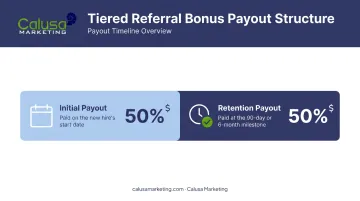
SHRM recommends a two-stage structure: a small payment on the new hire's first day, followed by a larger retention payment at the 90 or 120-day mark.
Why the wait? Paying out immediately rewards the referral, not the outcome. A 90-day gate confirms the new hire is actually sticking around before the company writes a check.
Tracking milestones like this gets complicated fast once a program scales, which is why referral tracking software has become the backbone of larger programs. Platforms like Calusa Marketing's cloud-based reward systems automate submission intake, flag payout eligibility once milestones are hit, and generate reporting on referral-to-hire ratios. This removes the manual tracking that causes most in-house spreadsheets to fall apart within a year.
Benefits of Employee Referral Incentive Programs
Faster Time-to-Hire
Referred candidates skip a lot of the usual vetting friction because they arrive with a built-in reference. Jobvite reports an average hiring time of 29 days for referrals compared to 39-55 days for candidates sourced through job boards and career sites, roughly a 40% reduction in time-to-fill.
Higher Quality and Better Retention
A 13-month randomized controlled trial covering more than 10,000 workers at a European grocery chain found that referral hires outperformed non-referred hires on several fronts:
- 45% lower attrition than non-referred hires
- 19% less likely to be absent
- 48% drop in attrition within the first five months alone
The researchers estimated only about 5% of the total savings came from the referred employees themselves. The rest came from improved retention across the whole team, referred or not.
Lower Cost-Per-Hire
Referral programs reduce reliance on paid job boards and staffing agency fees, both of which carry markup costs that scale with urgency. The same grocery-chain study found the referral program cut overall labor costs by up to 2.8% and lifted operational profit by 2.0-2.3% at the store level.
Culture Fit and Employer Brand
Employees who refer successfully tend to feel more invested in outcomes: they've put their name behind a hire, so they root for that person's success. This same dynamic extends outward: engaged employees become informal brand ambassadors, reaching passive candidates in networks that a paid job ad will never touch.
Employee Referral Incentives and Typical Bonus Amounts
Bonus size isn't random. It generally scales with how hard the role is to fill and how much seniority or specialization it demands.
| Role Category | Common Average Bonus Band |
|---|---|
| Production/warehouse | $500-$999 |
| Customer service/frontline | $500-$999 |
| Administrative support | $1,000-$2,499 |
| IT and technical | $1,000-$2,499 |
| Management and executive | $1,000-$2,499 |
Source: WorldatWork, 2021 Bonus Programs and Practices survey
Bonus size isn't the only variable. Eligibility works as a separate lever, skewing sharply by seniority: WorldatWork found only 26% of surveyed organizations let executives participate in referral bonuses at all, versus 96-97% for professional, IT, and production roles.
Tiered Payout Structures
Many programs split the bonus instead of paying it all at once, releasing a smaller amount at the new hire's start date and the remainder after they clear a retention milestone, such as 90 days or six months. This structure discourages referrers from disengaging once the first paycheck clears, since part of their reward still depends on the hire actually staying.
It also shields the company from paying a full bonus on hires who leave within weeks, tying the payout to genuine retention value rather than a single placement event. This split also protects the budget on roles with high early turnover.
Beyond Cash: What Actually Drives Participation
Flat cash bonuses work, but they plateau fast. Non-cash incentives often outperform pure cash because they carry a perceived value higher than their dollar cost:
- Travel packages and experiences
- Gift cards across retail, dining, and entertainment brands
- Extra PTO days
- Digital punch-card point systems that let employees accumulate rewards over multiple successful referrals
There's also a growing shift toward choice-based reward platforms, where employees pick from a menu instead of receiving one fixed prize.
Incentive marketing firms like Calusa Marketing build flexible gift card and travel reward platforms, such as its ANY-Card program, specifically to support this kind of menu-driven structure. A single reward rarely resonates with an entire workforce.
Recognition should complement incentives, not replace them. Leaderboards, shout-outs, and spotlight features keep the referral top of mind between payout cycles, reinforcing the behavior even when a check isn't imminent.
A Mixed-Incentive Example
The same principle shows up elsewhere, too. Postmedia's incentive program, run with Calusa Marketing, combined employee recognition rewards, gift cards for subscriber acquisition, and travel incentives for advertising performance, all within one coordinated structure targeting different stakeholder groups at once.
Similarly, APG Media's Regional President Jim Normandin credited a blended incentive approach with generating "millions of dollars of incremental revenue" by motivating both sales teams and clients at the same time.
The lesson translates directly to referral programs: matching incentive type to what actually motivates a given group of employees beats a one-size-fits-all bonus every time.
Best Practices for Building a High-Performing Referral Program
Simplify the submission process. If referring a candidate takes more than a few minutes, or requires printing anything, participation drops. A dedicated portal or mobile-friendly form removes that friction entirely.
Communicate consistently, not once. A single launch email gets forgotten within a month. Effective programs repeat the message through onboarding materials, internal newsletters, team meetings, and manager champions who bring it up in casual conversation.
Set clear, written eligibility rules covering:
- Who can refer (all employees, or excluding certain levels)
- Payout timing and retention milestones
- Disclosure requirements when referring a relative
- What counts as a valid, trackable referral
Track performance metrics on a regular cadence, including referral-to-hire ratio, retention rate of referred hires, and cost savings compared to other channels. Use that data to adjust bonus levels and communication frequency rather than guessing at what's working.
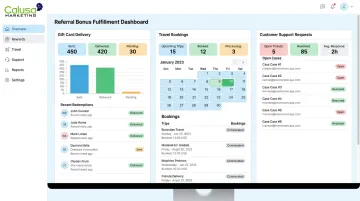
Consider partnering with an incentive program provider to handle reward fulfillment. Firms like Calusa Marketing handle the entire logistics chain, including gift card delivery, travel bookings, and customer support. That leaves HR teams free to focus on hiring instead of chasing down unredeemed rewards or fulfillment complaints.
Frequently Asked Questions
What is a typical employee referral bonus?
Bonus amounts vary by role difficulty and seniority, ranging from $500-$999 for frontline roles to $1,000-$2,499 for professional, technical, and management positions. Many companies pay in tiers tied to hire milestones rather than a single lump sum.
How does the employee referral program work?
An employee refers a candidate through a submission portal, and the candidate goes through the standard interview process. The referrer receives their reward after the new hire clears a retention period, often around 90 days.
What incentives work for employee referrals?
A mix of cash bonuses, travel rewards, gift cards, and public recognition tends to outperform a single flat-cash incentive. Programs that let employees choose their reward from a menu generally see stronger, more sustained participation.
When do employees receive their referral bonus?
Most programs pay out after the new hire passes a probationary period, commonly around 90 days, to confirm the hire is a lasting fit rather than an early departure.
Can employees refer candidates for any open position?
Most programs allow referrals for the majority of open roles but often exclude positions the referrer would directly manage. Referring a relative typically requires formal disclosure to HR.
How do companies measure the success of a referral program?
Key metrics include the referral-to-hire ratio, time-to-hire, retention rate of referred employees, and cost-per-hire compared against job boards or staffing agencies. Tracking these regularly helps fine-tune bonus levels and program communication.