That second scenario is a non-contingent reward, a concept that started in behavioral psychology and now shows up everywhere from ABA therapy rooms to customer loyalty apps. This article breaks down what non-contingent rewards actually are, how they differ from the contingent kind, and where businesses and clinicians use them to build trust instead of just driving performance.
Key Takeaways
- Non-contingent rewards are given on a schedule or by membership status, independent of specific behavior
- Removing the "earn it" requirement reduces attention-seeking behavior in clinical and educational settings
- Spontaneous recognition builds workplace loyalty in ways that pure commission structures cannot
- Unconditional gifts can increase customer spending and gratitude when used strategically alongside other loyalty tactics
- The strongest incentive programs combine both contingent and non-contingent rewards deliberately
What Are Non-Contingent Rewards?
Non-contingent rewards are reinforcement or recognition delivered on a fixed or variable schedule, regardless of what the recipient does.
The term comes from Applied Behavior Analysis (ABA), where researchers Hagopian, Fisher, and Legacy first described "noncontingent reinforcement" as a response-independent delivery schedule. The reward shows up because of timing, not because of a specific action.
Here's the mechanism behind why this works. When attention or reinforcement is tied to a behavior, people (and children especially) learn that acting out gets a response. Remove that link, and the incentive to misbehave for attention often disappears with it.
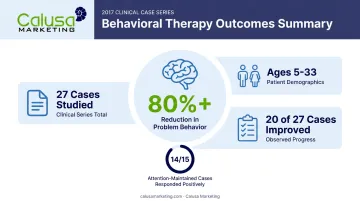
The clinical evidence backs this up. A 2017 case series in the Journal of Applied Behavior Analysis examined 27 noncontingent reinforcement applications across patients ages 5 to 33.
Initial NCR reduced problem behavior by at least 80% in 20 of the 27 cases (Phillips et al., 2017), including 14 of 15 cases where the behavior was maintained by social attention.
Beyond Therapy: Business and Everyday Life
The same logic extends far outside clinical settings. Businesses use it constantly:
- Surprise employee bonuses given with no KPI attached
- Welcome gifts sent the moment someone joins a loyalty program
- Birthday rewards unlocked by membership, not spend
- Re-engagement credits dropped into dormant loyalty accounts to spark renewed activity
A common misconception is that "non-contingent" means "no strategy." It's the opposite. The strategy is psychological: build trust and lower pressure before asking for anything in return.
Picture a few real contrasts. A therapist offers a scheduled five-minute break no matter how the session goes.
A manager surprises a stressed employee with a gift card during a rough week, and a loyalty program drops a free coffee into a member's account on their sign-up anniversary. None of these require the recipient to "do" anything specific; they just have to show up.
Non-Contingent vs. Contingent Rewards: Key Differences
The distinction comes down to what triggers the reward.
| Factor | Contingent Rewards | Non-Contingent Rewards |
|---|---|---|
| Trigger | Specific behavior or performance metric | Time, schedule, or membership status |
| Purpose | Drive a target outcome or skill | Build trust, reduce pressure, strengthen relationship |
| Typical example | Sales commission, completion bonus | Surprise gift, welcome perk, birthday reward |
Contingent rewards work best when you need someone to build a skill or hit a measurable target: think sales quotas or a therapy goal like completing a task independently. Non-contingent rewards work best when the goal is relationship-building: reducing burnout, preventing entitlement, or making someone feel valued without conditions attached.
Recipient sentiment differs too, and it's not always intuitive.
Research findings include:
- Unconditional gifts (given with no strings attached) generate greater feelings of gratitude and obligation than earned rewards of similar value, according to Fombelle et al. in the Journal of the Academy of Marketing Science
- One lab study found children given a choice preferred earning their reward through a specific behavior over receiving it automatically, showing that preference and effectiveness aren't always the same thing
Benefits of Non-Contingent Rewards
Psychological & Behavioral Benefits
Non-contingent rewards reduce the incentive for problem or attention-seeking behavior simply by making attention predictable. In one demand-based study, delivering edible reinforcers noncontingently before tasks increased compliance to roughly 80% without requiring escape extinction, a gentler intervention path than traditional methods.
There's also a security element. When a reward or a break is guaranteed on a schedule, recipients stop having to "test" the environment to get their needs met. That predictability matters most in:
- Caregiving relationships with young children
- Therapy settings involving anxiety or behavioral disorders
- High-stress workplaces where morale is fragile
Business & Workplace Benefits
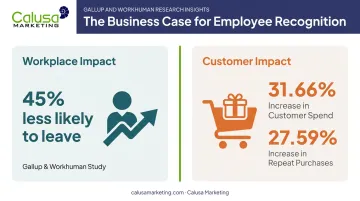
Spontaneous recognition changes how people feel about their employer, independent of whether it's tied to a bonus structure. A joint Gallup and Workhuman study tracking nearly 3,500 employees from 2022 to 2024 found that workers who received high-quality recognition were 45% less likely to have left their organization two years later (Gallup, 2024).
On the customer side, "surprise-and-delight" tactics produce measurable financial results. Field experiments found unconditional gifts led to spending increases of 31.66% in one retail setting and 27.59% in another. Customers didn't just spend more — they reported higher gratitude and loyalty toward the brand.
Blending both reward types into one strategy also solves a quieter problem: reward fatigue. Programs built entirely around KPIs can create entitlement, where employees or customers start expecting a payout for every action and disengage when it's missing. A mix of earned and unearned recognition keeps the relationship from feeling purely transactional.
Real-World Applications of Non-Contingent Rewards
In Behavioral Therapy, Education & Caregiving
Therapists and teachers use scheduled attention, breaks, or preferred activities delivered independent of behavior to reduce disruption. A classic example is a fixed-time break from a demanding task.
Research shows this approach lowers self-injurious or disruptive behavior in children with developmental disabilities. Speech therapists without extensive behavior-analytic training have implemented it successfully.
In the Workplace: Employee Engagement & Retention
Practical, non-KPI examples include:
- Spontaneous "just because" bonuses
- Wellness days unconnected to performance
- Holiday gifts sent to the whole team, not just top performers
These build longer-term loyalty than commission-only structures because they signal the relationship isn't purely transactional. An employee who only ever gets rewarded for hitting numbers eventually starts to see the job as a series of transactions rather than a place they want to stay.
In Customer Loyalty & Incentive Marketing Programs
Common applications include birthday or anniversary rewards, welcome gifts sent at sign-up, and milestone perks unlocked by tenure rather than a spend threshold.
Delivering these at scale used to require manual tracking and separate fulfillment systems. That's where cloud-based reward platforms change the equation.
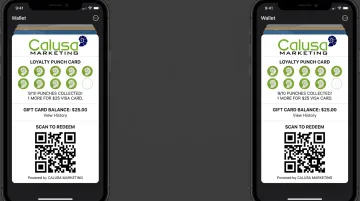
Calusa Marketing, for instance, runs digital loyalty and punch card programs that require no app download and no system integration. Cards land directly in a member's phone wallet within seconds of enrollment via QR code, link, or text.
Combined with a configurable gift card program offering over 100 digital options across US and international retailers, businesses can automate a welcome gift or a membership-anniversary reward without adding operational overhead.
That kind of frictionless delivery matters because non-contingent programs only work if they're consistent. A "surprise" that arrives late or inconsistently stops feeling like appreciation and starts feeling like an oversight.
Best Practices for Implementing Non-Contingent Reward Programs
Successful programs balance three core principles:
- Balance, don't replace: Non-contingent rewards work best alongside contingent ones, not instead of them. Use contingent rewards to drive specific outcomes, and non-contingent rewards to sustain the relationship in between.
- Personalize based on real preferences: A generic reward misses the point of building an emotional connection. Individual preference assessments (in clinical settings) or simple surveys (in workplace and customer programs) go a long way toward making the gesture land.
- Partner with an experienced provider: Consistent execution separates a meaningful surprise from a forgotten promise. Calusa Marketing has managed 1,000+ incentive programs for 500,000+ members, maintaining a 99% client retention rate.
Frequently Asked Questions
What is an example of a non-contingent reward?
In therapy, it's a scheduled break given at set intervals regardless of behavior. In business, it's a surprise gift card or a birthday reward triggered by membership, not by hitting a target.
What is the difference between contingent and non-contingent rewards?
Contingent rewards require a specific behavior or performance level to be earned. Non-contingent rewards are delivered on a schedule or by status, with no behavioral condition attached.
What is non-contingent reinforcement in ABA therapy?
It's a proactive strategy where reinforcement is delivered on a fixed or variable time schedule instead of after a target behavior. This meets the person's needs predictably, which reduces the motivation behind problem behavior.
Can non-contingent rewards backfire or reduce motivation over time?
Used exclusively, they can fail to build specific skills or behaviors since nothing is being reinforced directly. Most experts recommend combining them with contingent rewards for balance.
How can businesses implement non-contingent rewards for employees or customers?
Schedule spontaneous recognition, use a flexible digital reward platform for automated delivery, and personalize rewards using employee or customer preference data.
Are non-contingent rewards effective for adults as well as children?
Yes. Clinical case series spanning ages 5 to 33 show reduced problem behavior across age groups [source needed], and workplace recognition research confirms similar retention benefits for adult employees [source needed].