This isn't a rare story. Low engagement cost the global economy roughly $10 trillion in lost productivity in 2025, equal to 9% of global GDP, according to Gallup's 2026 State of the Global Workplace research. This article breaks down what motivation actually is, why it drives your bottom line, which techniques work, the psychology behind them, and how to keep the momentum going long after the initial push fades.
Key Takeaways
- Motivation blends intrinsic drivers like purpose and autonomy with extrinsic rewards like pay and recognition
- Motivated teams show higher productivity, stronger retention, and lower absenteeism
- Recognition and incentive programs offer scalable, trackable ways to boost motivation
- Sustaining motivation requires ongoing measurement and adjustment, not a single kickoff event
What Is Employee Motivation?
Employee motivation is the energy, commitment, and creativity someone brings to their work. It's the internal "why" behind effort. This differs from engagement, which describes the emotional attachment and enthusiasm that results from sustained motivation over time. Think of motivation as the fuel and engagement as the running engine.
Intrinsic vs. Extrinsic Motivation
Intrinsic motivation comes from within: personal satisfaction, a sense of purpose, mastery over a skill. Someone who loves solving problems doesn't need a bonus to dig into a tough project. Intrinsic drivers create more sustainable, longer-lasting engagement because the reward is baked into the work itself.
Extrinsic motivation relies on external factors: pay, bonuses, recognition, prizes. It's excellent at prompting short-term action, but the research is mixed on its staying power. A 1999 meta-analysis of 128 experiments found that expected tangible rewards can actually reduce free-choice behavior and self-reported interest once the reward disappears.
Neither approach wins alone:
- Pure extrinsic strategies risk creating employees who only perform when watched or paid
- Pure intrinsic strategies can leave high performers feeling undervalued financially
- Blended strategies (meaningful work paired with fair, consistent rewards) tend to outperform either extreme
Why Employee Motivation Matters
Motivation isn't a soft metric. It shows up directly in the numbers leadership actually tracks.
Gallup's Q12 meta-analysis, spanning 456 studies and roughly 2.7 million employees across 96 countries, found that top-quartile engagement units consistently beat bottom-quartile units:
| Business Outcome | Top-Quartile Advantage |
|---|---|
| Production productivity | 14% higher |
| Sales productivity | 18% higher |
| Customer loyalty | 10% higher |
| Profitability | 23% higher |
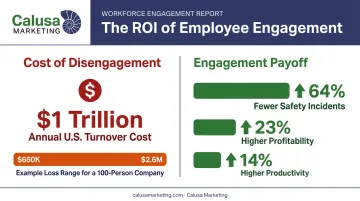
| Safety incidents | 64% fewer |
| Quality defects | 41% fewer |
Source: Gallup, "The Benefits of Employee Engagement"
That last row matters more than most leaders realize. Distracted, unmotivated employees make more mistakes — and those mistakes get expensive fast in industries with safety or compliance stakes.
Turnover tells a similar story. Voluntary turnover costs U.S. businesses an estimated $1 trillion annually, with replacement costs running 0.5 to 2 times an employee's salary. A 100-person company with a $50,000 average salary can lose $660,000 to $2.6 million a year just cycling through disengaged staff.
Beyond the balance sheet, motivated employees:
- Deliver noticeably better customer interactions that fuel repeat business and referrals
- Speak up more often with process improvements and new ideas
- Show up more consistently, reducing the ripple effects of chronic absenteeism
Top Employee Motivation Techniques That Work
Theory only helps if it translates into practice. Here's what actually moves the needle, starting with the fastest to implement.
Recognition and Incentive Programs
Recognition might be the single highest-ROI motivation lever available. In an APA survey, 93% of U.S. workers who felt valued at work said they were motivated to do their best, according to the American Psychological Association's 2012 well-being survey.
Structured incentive programs — bonuses, gift cards, points-based systems, travel rewards — formalize that recognition and tie it directly to business goals rather than leaving it to chance or manager mood.
This is where a company like Calusa Marketing fits in, offering a cloud-based incentive platform with no app to download and no IT integration project required.
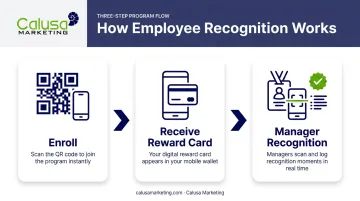
The process runs in three steps:
- Employees enroll through a QR code or text link
- They receive a digital reward card directly in their phone wallet
- Managers issue recognition on the spot through a scanner app that logs who gave what, when, and why
Autonomy and Empowerment
Giving employees real decision-making authority over how they do their work builds ownership that no bonus can replicate. A conjoint study of 1,180 employees and 9,440 assessments found that work-method autonomy, scheduling autonomy, and decision autonomy all significantly predicted innovative work behavior, with work-method freedom showing the strongest effect.
Career Development Opportunities
Growth satisfies the need for mastery, one of motivation's core intrinsic ingredients. SHRM reports that 86% of HR managers say training helps retain talent, and 76% of employees say they're more likely to stay with an employer offering continuous training and development.
Communication, Feedback, and Psychological Safety
Ambiguity kills motivation faster than almost anything else. Clear expectations and regular feedback keep people focused on what actually matters. Psychological safety — the sense that speaking up won't get you punished — carries a meaningful performance link too. One meta-analysis of 136 samples found a corrected correlation of roughly 0.43 between psychological safety and task performance.
Flexibility and Work-Life Balance
Flexibility has become a bargaining chip on par with salary. 40% of respondents said they'd take a pay cut to work remotely, and 30% wanted fully remote arrangements, per SHRM research on job seeker priorities. For many teams, a predictable, flexible schedule now outweighs a modest raise.
Employee Motivation Theories Every Leader Should Know
Three frameworks explain most of what's driving employee behavior on the job.
| Theory | Core Idea | Practical Takeaway |
|---|---|---|
| Maslow's Hierarchy of Needs | Needs progress from physiological and safety through belonging, esteem, and self-actualization | Employees can't focus on growth if they're worried about job security or basic pay |
| Herzberg's Two-Factor Theory | Hygiene factors (pay, conditions, policy) prevent dissatisfaction; motivators (achievement, recognition, growth) create actual motivation | Fixing pay complaints won't motivate anyone — it just stops the bleeding |
| Self-Determination Theory | Motivation depends on satisfying three needs: autonomy, competence, and relatedness | A meta-analysis of 192 studies and over 93,000 participants found autonomy and competence generally carry the strongest links to sustained motivation |
The practical thread across all three: pay and conditions stop people from leaving, but they rarely inspire people to excel. That takes purpose and recognition, plus real room to grow.
Measuring and Sustaining Motivation Long-Term
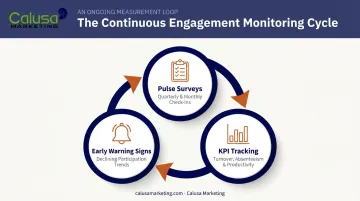
A single engagement survey once a year tells you almost nothing about what's happening in month four or month nine. Motivation needs regular, lightweight tracking:
- Run quarterly or monthly pulse surveys instead of relying solely on annual reviews
- Tie every technique to a measurable KPI, such as turnover rate, absenteeism, or productivity per unit, so leadership sees the ROI, not just anecdotes
- Watch for early warning signs like declining participation in recognition programs, which often precede turnover spikes
Sustaining a program also means handling the unglamorous back-end work: tracking redemptions, managing fulfillment, keeping reporting accurate. This is exactly why many companies partner with an experienced incentive marketing firm rather than building it in-house.
Calusa Marketing, for instance, provides dedicated account management, reporting on program activity, and full fulfillment support, so HR teams can focus on strategy instead of logistics.
Frequently Asked Questions
What is the conclusion of employee motivation?
Motivation is a critical, ongoing driver of productivity, retention, and culture, not a one-time fix. Lasting results require blending intrinsic purpose-driven strategies with consistent extrinsic rewards.
What are the objectives of employee motivation?
The core objectives are boosting productivity, improving retention, encouraging innovation, and aligning individual effort with company goals. Every technique should tie back to at least one of these.
What are the main types of employee motivation?
Intrinsic motivation comes from purpose, growth, and autonomy — the internal reasons employees care about their work. Extrinsic motivation relies on external factors like pay and recognition. Most effective strategies combine both types together.
How do you measure employee motivation?
Common tools include pulse surveys, engagement scores, turnover and absenteeism data, and performance metrics. Tracking trends over time matters more than any single snapshot.
What is the difference between employee motivation and employee engagement?
Motivation is the internal drive to act. Engagement is the emotional commitment and enthusiasm that develops from sustained motivation. One feeds the other.
Do incentive and rewards programs really improve motivation long-term?
Well-designed programs sustain motivation when they combine meaningful recognition with fair, consistent delivery. Financial incentives work best when distributed equitably and paired with genuine appreciation, not treated as a one-time transaction.