
Introduction
Your best account manager just walked in with a competing offer in hand. Or maybe you're three months from closing an acquisition, and the one engineer who understands your legacy codebase is updating her resume. What do you do?
For a lot of employers, the answer is a retention bonus.
The stakes are real. According to a 2025 Gallup analysis, replacing an employee costs 40% of salary for frontline workers and up to 200% for managers and leaders, once you factor in recruiting, lost productivity, and training time. Losing the wrong person at the wrong moment costs far more than a paycheck.
This guide breaks down what a retention bonus is, how it works, what companies typically pay, and how to build it into a retention strategy that outlasts the bonus check itself.
Key Takeaways
- A retention bonus pays employees to stay for a set period, not to hit performance targets
- Employers typically pay bonuses as a lump sum after the retention period or in installments
- Retaining a critical employee is almost always cheaper than replacing one
- The IRS taxes retention bonuses as supplemental wages, typically at a flat withholding rate
- Pairing retention bonuses with a broader engagement strategy delivers stronger results than a standalone fix
What Is a Retention Bonus?
A retention bonus (sometimes called a stay bonus) is a lump-sum or installment payment offered in exchange for an employee's commitment to remain with the company for a set period. It's a written agreement: stay through the date, get the money.
Unlike a performance bonus, you don't earn a retention bonus by hitting a sales target or shipping a project. You earn it by staying. That distinction matters: it's why HR teams treat retention bonuses as a separate tool from annual incentive pay, and why the IRS classifies them as supplemental wages rather than regular compensation.
Situations Where Companies Use Retention Bonuses
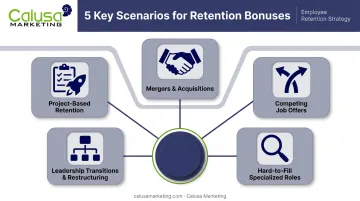
Retention bonuses tend to show up in five recurring scenarios:
- Mergers and acquisitions: keeping key people through the transition when uncertainty runs highest
- Competing job offers: a counteroffer to keep a valued employee from walking
- Hard-to-fill specialized roles: positions where a replacement search could take months
- Leadership transitions or restructuring: stabilizing teams during a reorg or executive change
- Project-based retention: holding onto talent through a product launch or major client implementation
M&A is the biggest driver by far. In WTW's 2024 M&A retention study, 72% of companies tracked or set aside fixed retention payments, with cash used for 86% of senior-leader awards.
Retention Pay vs. Retention Bonus
The terms get used interchangeably, but there's a practical difference worth knowing:
- Retention bonus usually means a one-time lump-sum payout, paid after the employee completes the agreed period
- Retention pay refers to the same incentive, spread across installments during that period
Why spread it out? A single lump sum only holds someone's attention until they cash the check. Installments, paid quarterly or at project milestones, keep the incentive to stay active for the entire window, not just the final day.
How Does a Retention Bonus Work?
At its simplest: the employer and employee sign an agreement, the employee commits to a service period, and the company pays out cash if the employee follows through.
Typical Amount and What Influences It
Retention bonuses vary widely by role and context. Rather than one universal number, think in tiers:
| Scenario | Typical Bonus Range |
|---|---|
| C-suite/executives (M&A) | 75%-100% of base salary |
| Other senior leaders (M&A) | ~50% of base salary |
| Salaried employees (M&A) | ~30% of base salary |
| Hard-to-fill specialists | 10%-25% of salary |
| Seasonal or hourly workers | Flat amount, often $500-$5,000 |
These figures reflect WTW's 2024 M&A retention survey, which also found companies are selective: 44% of acquirers offered agreements to at least half their C-suite, but only 19% extended them to more than a fifth of the broader salaried workforce.
What drives the number up or down:
- Role criticality — how much damage the departure would cause
- Retention period length — longer commitments often command bigger payouts
- Market demand for the skill set — scarce talent costs more to hold onto
- Company budget — what leadership is willing to allocate given the risk
Payment Methods: Lump Sum vs. Installments
Lump sum is the simpler structure. The employee stays through the full retention period, then receives the full payout at once. Easy to administer, easy to explain.
Installments pay out at intervals — quarterly, or tied to project milestones. This keeps the incentive fresh throughout the retention window instead of front-loading all the motivation into a single future date. Median retention periods in M&A deals run 13-18 months, so an installment structure often makes more sense over that stretch.
What's Included in a Retention Bonus Agreement
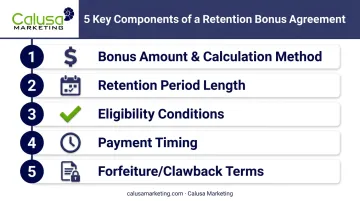
A solid agreement spells out:
- Bonus amount and calculation method: flat dollar figure or percentage of salary
- Retention period length: the exact start and end dates of the commitment
- Eligibility conditions: what "staying" means (active employment, good standing, etc.)
- Payment timing: lump sum at the end, or installment schedule
- Forfeiture or clawback terms: what happens if the employee leaves early
Skipping any of these leaves room for disputes later, especially around forfeiture.
Who Typically Qualifies
Companies don't hand these out company-wide. Eligibility usually comes down to:
- Specialized or hard-to-replace skills
- Consistently high performance
- Deep client or institutional knowledge
- Elevated flight risk (recent competing offers, market demand for their role)
Benefits of Retention Bonuses
Cost savings top the list. Replacing an employee costs 40%-200% of their salary, according to Gallup's research.
A 15% retention bonus is often cheaper than a six-month vacancy, recruiting fees, and the ramp-up time for a new hire.
Beyond the direct dollar comparison, retention bonuses deliver:
- Reduced turnover and disruption: fewer departures mean less workflow interruption and lower recruiting spend
- Preserved institutional knowledge means tenured employees keep client relationships and proprietary know-how in-house
- Improved morale: a bonus tells recipients leadership values them, lifting morale across their team
- Business continuity during high-stakes periods — bonuses stabilize teams through mergers, restructuring, or major projects, reassuring clients and stakeholders
That said, the evidence here is directional rather than a guaranteed ROI. WTW found that 59% of M&A respondents expected more than 80% of senior leaders to stay through the retention period (a strong signal of confidence, though it's an expectation, not a measured outcome).
Tax and Legal Considerations
The IRS treats retention bonuses as supplemental wages, not regular pay, which changes how they're taxed.
- Employers can generally apply a flat 22% federal withholding rate on supplemental wages up to $1 million per year, provided regular wages were already taxed
- Amounts over $1 million get hit with a mandatory 37% withholding rate on the excess
- Retention bonuses are also subject to Social Security and Medicare taxes, same as regular wages
- If a bonus isn't separately identified from regular wages, employers may instead use the aggregate method, combining both amounts into one regular paycheck for withholding
These figures come straight from IRS Publication 15. Note that 22% and 37% are withholding rates, not the employee's final tax rate. Actual tax liability gets reconciled at filing.
State supplemental-wage rules vary, so don't assume federal rates cover everything. Get a written agreement reviewed by legal counsel to confirm state compliance and to make forfeiture terms enforceable if an employee leaves early.
Beyond the Bonus: Building a Complete Retention Strategy
A retention bonus solves an urgent problem: keeping a specific person through a specific window. It doesn't fix the underlying reasons people leave in the first place.
Handing the same bonus to every employee as a blanket policy erodes its impact. Instead of feeling like recognition, it starts to feel like an entitlement.
The stronger approach pairs a bonus with ongoing recognition and engagement programs that keep people invested after the bonus period ends.
This is where a partner like Calusa Marketing fits in. Based in St. Petersburg, Florida, Calusa Marketing designs and manages employee engagement and loyalty programs that extend well past a one-time payout, such as:
- 90-day onboarding programs that reduce early attrition
- Ongoing recognition programs for tenured employees carrying institutional knowledge
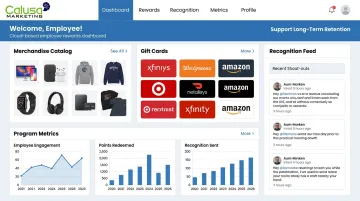
- Cloud-based rewards platform offering 10 million+ merchandise items, plus gift card and travel options
Calusa Marketing has managed 1,000+ programs serving 500,000+ members, with a 99% client retention rate to show for it. That track record reflects an approach built on continuous relationships rather than one-off payouts, designed to complement whatever bonus structure you already have in place.
Frequently Asked Questions
What is a typical retention bonus?
Amounts vary by role and context. Salaried employees during M&A typically receive around 30% of base salary, executives can see 75%-100%, and hard-to-fill specialists usually land in the 10%-25% range.
Is it good to accept a retention bonus?
That depends on your goals. Weigh the short-term payout against your long-term career trajectory, job satisfaction, and whether better opportunities exist elsewhere.
How does a retention bonus work?
An employee agrees in writing to stay with the company for a defined period. In exchange, they receive a lump sum or installment payments, with forfeiture if they leave early.
Can retention bonuses be paid in installments?
Yes. This structure, sometimes called retention pay, spreads payments across the retention period, often quarterly or at project milestones, to keep the incentive active longer.
Is a retention bonus taxable?
Yes. The IRS classifies it as supplemental wages, subject to federal withholding (typically 22%, or 37% above $1 million) plus Social Security and Medicare taxes.
Can an employee lose their retention bonus if they leave early?
Yes, if the agreement includes forfeiture or clawback terms. Some agreements require full repayment; others use pro-rated repayment based on time actually served.