Introduction
Most companies spend their marketing budget chasing new customers while the ones they already have quietly walk away. That's an expensive habit. Acquiring a new customer can cost 5 to 25 times more than retaining an existing one, according to Harvard Business Review research.
Yet "customer loyalty" gets tossed around as a vague buzzword — something businesses want but rarely define. What actually makes a customer stay, spend more, and recommend you to others?
This guide breaks loyalty down into six measurable drivers, grounded in research rather than assumptions. We'll also cover how rewards programs fit into the picture and how to measure whether your efforts are working, for both consumer-facing and B2B relationships.
Key Takeaways
- Loyalty has two forms: behavioral (repeat purchases) and attitudinal (trust, preference)
- A 5% bump in retention can boost profits by 25% to 95%, according to Bain & Company research
- Trust, low-friction service, and emotional connection outrank rewards as loyalty drivers
- Engaged employees directly shape the customer interactions that build or break loyalty
- Rewards programs accelerate loyalty but can't create it from nothing
What Is Customer Loyalty (and Why Do Its Drivers Matter)?
Customer loyalty combines two distinct elements:
- Behavioral loyalty: repeat purchases, contract renewals, continued usage
- Attitudinal loyalty: trust, emotional preference, willingness to recommend
A customer can show behavioral loyalty without any real attachment (think: no better alternative available). True loyalty requires both. That distinction matters because retention is the outcome; loyalty is the cause.
Here's why chasing that cause pays off. Bain's research found that increasing customer retention by just 5% can increase profits by 25% to 95%, depending on the industry. That range can reshape a company's entire growth trajectory.
At Calusa Marketing, this isn't theoretical. The firm has managed 1,000+ incentive and loyalty programs for 500,000+ members, maintaining a 99% client retention rate in the process. Jim Normandin, Regional President of APG Media of Chesapeake & Florida, put it plainly:
"Alex Brown and the Calusa team have worked with our sales teams to generate millions of dollars of incremental revenue... this is a WIN for us, a WIN for our clients, and a WIN for Calusa."
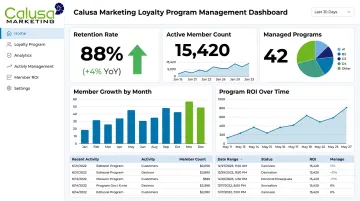
That kind of result comes from understanding which specific drivers move the needle for a given audience, not from a generic rewards catalog.
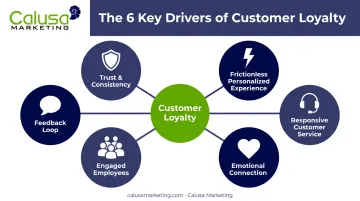
The 6 Key Drivers of Customer Loyalty
Industries differ, but the research keeps pointing to the same handful of factors that decide whether customers stay or drift toward a competitor. Here's what actually moves the needle.
Trust and Consistency
Trust is the foundation everything else sits on. 81% of consumers say trust factors into their purchase decisions — yet many brands fail to earn it consistently.
Consistency builds that trust over time:
- Stable pricing without hidden surprises
- Product quality that doesn't fluctuate between orders
- Transparent policies on returns, billing, and data use
A customer who gets the same experience on their 20th order as their first has no reason to shop around.
A Frictionless, Personalized Experience
Friction kills loyalty fast. Research shows that 96% of customers who had a high-effort service interaction became more disloyal, compared to just 9% after a low-effort experience.
Personalization works in the opposite direction. When companies use purchase history and preferences to tailor offers and communications, customers notice, and 71% of them now expect it by default. Skip it, and frustration follows quickly.
Responsive, Empathetic Customer Service
Service quality now directly shapes brand loyalty. In a global survey covering five countries, 96% of respondents said customer service quality directly influenced their brand loyalty, and 56% had already walked away from a brand over a bad service experience.
Omnichannel consistency matters here too. A customer who gets fast help on live chat but waits 20 minutes on the phone doesn't feel like they're dealing with one company. It feels like rolling the dice each time they reach out.
Emotional Connection and Shared Values
Satisfaction and emotional connection aren't the same thing. In one HBR-documented case, customers who felt fully emotionally connected to a brand were 52% more valuable on average than those who were merely satisfied.
Tactics that build this connection:
- Storytelling that reflects a genuine brand purpose
- Community-building around shared interests or values
- Recognition that treats customers as people, not transaction IDs
Engaged, Motivated Employees Behind the Scenes
Customer experience rarely outperforms employee experience. Gallup's meta-analysis of over 3.3 million employees found business units in the top quartile for employee engagement showed a 10% median advantage in customer loyalty metrics compared to bottom-quartile units.
This is why plenty of companies now run internal recognition and incentive programs specifically for frontline and sales staff. A motivated employee handling a phone call behaves differently than a burned-out one — and customers can tell.
Listening to and Acting on Customer Feedback
An NPS score alone tells you how customers feel. The follow-up "driver question" tells you why, and that's where the real value sits.
"Closing the loop" means routing that feedback to the right team and following up with unhappy customers directly. Bain's research on this practice found Allianz saw a double-digit NPS increase and a notable rise in policy renewals after implementing a structured closed-loop process.
Why Rewards and Recognition Deserve Their Own Spotlight
Rewards don't create loyalty out of thin air. They reinforce it, accelerating trust and service quality that already exist. Layer rewards onto a shaky customer experience, and they just become an expensive band-aid.
That said, they clearly matter. 72% of loyalty program members say the program makes them more likely to spend with a preferred brand, and 56% say it increases how much they spend, according to Deloitte's consumer loyalty research.
Common Program Structures
Most rewards programs fall into a few categories:
- Points-based — earn points per purchase, redeem for rewards
- Tiered — unlock better perks as spend or engagement increases
- Subscription-based — pay a fee for ongoing member benefits
- Gamified/instant — real-time recognition instead of delayed gratification
That last category is gaining ground fast. Deloitte notes younger consumers specifically favor accelerated earning and real-time tracking over waiting months for a payout.
Beyond the Punch Card: B2B Incentives
In distribution-heavy industries, incentive programs stretch well past simple punch cards. Calusa Marketing's client base illustrates this range:
- Johnstone Supply runs a points-based program that rewards customers for placing orders online and completing product education
- Baker Distributing (Watsco) uses a similar points structure to shift ordering behavior toward digital channels
- Postmedia layered employee incentives, subscriber gift cards, and advertiser travel rewards into one integrated program
That integrated approach matters. Businesses that reward both employees and customers (rather than treating them as separate initiatives) tend to see loyalty effects compound across the organization.
What to look for in a rewards platform:
- Cloud-based deployment with no app download or system integration required
- Flexible redemption (Calusa's ANY-Card model lets members choose from 100+ gift card brands)
- Digital punch cards for simple, low-lift loyalty tracking
- Fully transferable travel incentives for high-value recognition
With 75+ years of combined team experience, Calusa Marketing builds these programs to launch quickly and require minimal ongoing management from the client side.
How to Measure Whether These Drivers Are Actually Working
You can't manage what you don't measure, and these four metrics cover most of what matters here.
Net Promoter Score (NPS) asks one question: how likely are you to recommend us? Scores of 9-10 are promoters, 7-8 are passives, and 0-6 are detractors, with NPS calculated as the percentage of promoters minus the percentage of detractors.
Customer Lifetime Value (CLV) ties loyalty directly to revenue by measuring total value across the entire relationship, not just one transaction.
Churn rate and repeat purchase rate work as early-warning and reinforcement signals:
- Churn rate = (customers lost ÷ customers at start of period) x 100
- Repeat purchase rate = (customers with 2+ purchases ÷ total customers) x 100
- Track both monthly for fast-moving industries, quarterly for longer sales cycles
Combine all four into a single dashboard segmented by loyalty tier or program engagement level. Patterns emerge fast once you can see them side by side.
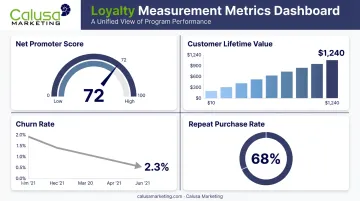
For context, here's how average NPS varies by industry, based on Qualtrics' XM Institute 2024 study of 10,000 consumers across 351 brands:
| Industry | Average NPS |
|---|---|
| Grocery | 30 |
| Retail | 29 |
| Banking | 24 |
| Software | 16 |
| Airlines | 12 |
The all-industry average sits at 18, but a score of 25 might be excellent in software and mediocre in grocery — context matters more than the raw number.
Common Mistakes That Quietly Erode Loyalty
Common Mistakes That Erode Loyalty
Even well-intentioned loyalty efforts fail when a few predictable mistakes creep in.
- Over-investing in acquisition, under-resourcing retention. By some estimates, acquisition costs up to 25x more than retention, meaning every dollar spent chasing new customers while ignoring existing ones works against the math.
- Generic, one-size-fits-all rewards. A discount that means nothing to a segment of your audience won't move behavior — segmentation matters more than the reward's dollar value.
- Inconsistent service across channels. Fast chat support paired with slow phone response undoes the trust built everywhere else. Customers remember the worst channel, not the best one.
Fixing these three issues alone resolves a surprising share of "why do customers keep leaving" problems.
Frequently Asked Questions
How do you drive customer loyalty?
Loyalty comes from consistently combining trust, responsive service, personalization, meaningful rewards, and emotional connection. No single tactic works alone — it's the combination that keeps customers engaged over time.
What are the 3 R's of customer loyalty?
The established framework is retention, related sales, and referrals. Retention keeps the customer around, related sales grow what they spend, and referrals bring in new customers through their networks.
What is the difference between customer loyalty and customer retention?
Loyalty is the underlying trust and preference a customer feels toward a brand. Retention is the measurable outcome of that trust, such as renewed contracts or repeat purchases.
How do you measure customer loyalty?
The primary tools are NPS, Customer Lifetime Value, churn rate, and repeat purchase rate. Tracking them together on one dashboard reveals trends faster than any single metric alone.
Can a rewards program alone build genuine customer loyalty?
No. Rewards reinforce loyalty that already exists through trust, service quality, and personalization. Without those foundations, a rewards program just becomes a discount mechanism.
Why does employee engagement affect customer loyalty?
Engaged, recognized employees deliver better customer interactions: friendlier calls, faster resolutions, more attentive service. Gallup research links top-quartile employee engagement to measurably higher customer loyalty outcomes.