Here's the disconnect: most conversations about motivation stay abstract — morale, vibes, culture. But the real payoff is concrete. It shows up in output numbers, retention reports, and customer satisfaction scores.
This article breaks down exactly what a motivated workforce delivers, in measurable terms, and how organizations build systems that keep that motivation from fading after the first paycheck.
TL;DR
- Motivated employees produce more, stay longer, and serve customers better
- Motivation blends intrinsic drivers (purpose, growth) with extrinsic ones (recognition, rewards)
- Top benefits: higher productivity, stronger retention, better customer outcomes
- Ignoring motivation shows up fast in absenteeism, turnover, and inconsistent quality
- Structured recognition programs, not one-off gestures, sustain motivation over time
What Is Employee Motivation?
Employee motivation is simply the mix of internal and external forces that push someone to perform, stay engaged, and work toward company goals. Nothing mystical about it.
There are two flavors:
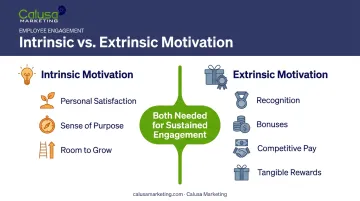
- Intrinsic motivation: personal satisfaction, sense of purpose, room to grow
- Extrinsic motivation: recognition, bonuses, competitive pay, tangible rewards
Both matter, but they work differently: a workforce running on intrinsic motivation alone burns out without acknowledgment, while one running purely on extrinsic rewards stalls the moment incentives stop.
Think of motivation as the engine and engagement as what you can actually observe: effort, initiative, and attitude on the job. This article focuses on what that engine produces operationally, not the theory behind how it runs.
Key Advantages of Highly Motivated Employees
The advantages below aren't soft-skill wins. Each one connects to a metric leaders already track: productivity, retention, or customer satisfaction. Here's how it plays out.
Increased Productivity and Performance
Motivated employees stay focused. They take initiative instead of waiting for direction, and they follow through without needing constant check-ins. Disengaged employees, on the other hand, do the minimum and stop there.
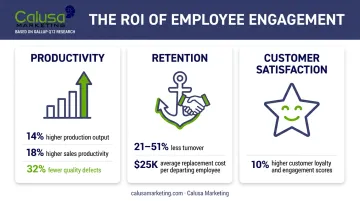
The numbers back this up. Gallup's 11th Q12 Meta-Analysis, covering over 183,000 business units and 3.3 million employees, found top-quartile engagement units delivered 14% higher productivity in production settings and 18% higher sales productivity, along with 32% fewer quality defects.
Why this matters for the bottom line:
- Less oversight needed means fewer supervisor hours spent babysitting tasks
- Fewer errors means less rework, which saves both time and materials
- Faster decision-making at the individual level speeds up entire teams
KPIs impacted: output volume, error/defect rates, project completion time, individual performance ratings.
This advantage hits hardest in high-volume, fast-paced environments (sales floors, distribution centers, call centers), where a small dip in daily effort across dozens of employees compounds into a real revenue gap by month's end.
Improved Retention and Reduced Turnover
Employees who feel recognized and invested in don't go job-hunting on their lunch break. Consistent recognition builds a sense of belonging that keeps people anchored, even when a competitor dangles a bigger offer.
The financial case is hard to ignore. The Work Institute's 2024 Retention Report recommends 33.3% of an employee's base salary as a conservative turnover-cost estimate, meaning a $75,000 employee walking out the door costs roughly $25,000 to replace. Gallup's data backs this up from another angle: top-quartile engagement units saw 21% to 51% less turnover, depending on the organization's baseline attrition rate.
Why lower turnover pays off:
- Recruiting, onboarding, and training costs stop repeating every few months
- Institutional knowledge stays in-house instead of walking out with departing staff
- Ongoing projects avoid the disruption of mid-stream handoffs
KPIs impacted: turnover rate, average tenure, cost-per-hire, time-to-fill.
This matters most in tight labor markets or high-skill roles, where replacement cost and ramp-up time are steep. It's exactly why distributors, call centers, and service organizations increasingly formalize motivation instead of leaving it to chance.
Calusa Marketing works with clients like Alorica and Inktel, both call center operations, on rewards programs built around agent recruitment, retention, and KPI achievement. The result turns what used to be an HR guessing game into a tracked, repeatable system.
Enhanced Customer Satisfaction and Company Reputation
Motivated employees in customer-facing roles bring more patience and effort to every interaction. That translates into fewer escalations, faster resolutions, and a more consistent brand experience, whether a customer calls on a Tuesday morning or a Friday afternoon.
Gallup's Q12 meta-analysis found top-quartile engagement units achieved 10% higher customer loyalty and engagement scores compared to bottom-quartile units. Motivated frontline staff simply go further to fix a problem instead of reading from a script and moving on.
Why this shows up in revenue, not just satisfaction surveys:
- Fewer escalations mean lower support costs
- Consistent service builds repeat business and referrals
- Positive word-of-mouth reduces customer acquisition costs over time
KPIs impacted: customer satisfaction scores (CSAT), Net Promoter Score (NPS), first-call resolution rate, repeat purchase rate.
Service-heavy industries — call centers, retail, hospitality — feel this most acutely. A single bad review can spread fast, but so can a great one.
What Happens When Motivation Is Missing or Ignored
Skip motivation, and the consequences show up quickly — usually as symptoms managers treat individually instead of recognizing as one root cause.
- Inconsistent output: quality swings wildly between teams and even between shifts
- Higher absenteeism: Gallup found bottom-quartile engagement units had 78% more absenteeism than top-quartile units
- Reactive management: leaders spend their time firefighting performance issues instead of preventing them
- Rising costs: repeated turnover means recruiting and training expenses that never let up
- Scaling difficulty: without employee ownership, delegating becomes risky and growth stalls
The scale of this problem isn't small.
Gallup estimated that not-engaged and actively disengaged employees accounted for roughly $1.9 trillion in lost productivity in the US in 2023 alone.
That figure represents thousands of small, daily gaps between what employees could do and what they actually do.
How to Get the Most Value from Employee Motivation
A single bonus check or an annual pizza party doesn't move the needle long-term. Motivation only pays off when it's applied consistently — as a system, not an event.
Structured recognition programs beat ad hoc gestures because they create repeatable cycles: employees know what behavior earns recognition, when they'll receive it, and what it's worth. That predictability is what sustains motivation month after month.
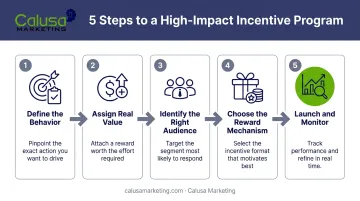
Here's what a structured approach typically looks like:
- Define the behavior worth rewarding: hitting 90-day onboarding milestones, retaining tenured staff with institutional knowledge, or reaching sales targets
- Assign it real value: figure out what that behavior is actually worth to the business before setting a reward budget
- Identify the right audience: a program for top performers looks different from one designed to get new hires through their first three months
- Choose the reward mechanism: points-based platforms, gift cards, merchandise, or aspirational incentive travel, depending on what will actually motivate that audience
- Launch and monitor: track engagement and adjust based on what the data shows
This is where working with an experienced incentive marketing partner saves time. Calusa Marketing handles this process end-to-end, from identifying which behaviors to incentivize through platform selection and ongoing fulfillment. That means HR teams aren't building a rewards infrastructure from scratch on top of running their day jobs.
Keep these considerations in mind:
- Programs built for onboarding retention look nothing like ones built for tenured "tribal knowledge" employees or sales incentive structures
- Reward variety matters: a points-based catalog with 10 million-plus items appeals across generations and roles in ways a single gift card can't
- Review outcomes regularly and adjust reward frequency or structure based on what turnover and engagement data actually shows, rather than assuming last year's program still fits
Recognition done well compounds. Gallup's longitudinal study tracking nearly 3,500 employees over two years found that those who felt well-recognized were 45% less likely to have changed organizations. That's a measurable retention outcome, built one recognized moment at a time.
Conclusion
Motivation's real value shows up in results: consistent output, customers who return, and employees who stay past their first year. Productivity, retention, and satisfaction don't improve in isolation; they compound together when recognition and rewards are applied consistently rather than sporadically.
Treat motivation as an ongoing practice: track what's working, then reinvest in it. Calusa Marketing builds this into its recognition and rewards platforms, giving leaders a repeatable system instead of one-off gestures. The payoff shows up exactly where leaders are already watching: the numbers.
Frequently Asked Questions
What are the advantages of employee motivation?
Motivated employees drive higher productivity, stronger retention, better customer service, and a more collaborative culture, with these gains showing up directly in output metrics, turnover rates, and customer satisfaction scores.
What are the 4 R's of motivation?
Recognition, Reward, Respect, and Relationships are commonly cited as core motivation drivers, though SHRM's original framework actually includes a fifth: Responsibility. Together, they cover appreciation, fair compensation, valuing employees, and building trust.
What is the difference between intrinsic and extrinsic motivation?
Intrinsic motivation comes from internal satisfaction — purpose, growth, personal fulfillment. Extrinsic motivation comes from external factors like pay, bonuses, and recognition, and long-term engagement typically requires both working together.
How can employers measure employee motivation in the workplace?
Common methods include engagement surveys (like Gallup's Q12), performance metrics, turnover and absenteeism tracking, and regular manager check-ins. Combining quantitative data with informal feedback gives the clearest picture.
What are common signs of employee disengagement or low motivation?
Watch for declining output quality, increased absenteeism, withdrawal from team activities, and a lack of initiative on tasks that used to get done proactively. These signs often show up gradually before turnover spikes.
How do incentive and recognition programs improve motivation long-term?
Structured, consistent recognition builds lasting engagement in a way sporadic rewards can't. Dedicated incentive marketing platforms, such as those Calusa Marketing manages, help formalize this into a repeatable system tied to specific goals and audiences.