
Introduction
You just got off the phone with an airline, or maybe opened an email announcing you won a travel reward through your job. Either way, you're now holding a travel voucher and wondering what to actually do with it.
Here's the catch: many travelers never capture the full value of these credits. Consumer Reports has repeatedly warned that voucher expiration rules trip up travelers, especially when the redemption clock starts ticking before anyone notices.
A missed deadline, a misread restriction, or an overlooked line of fine print can cost travelers real money every year. This guide walks through exactly how to complete a travel voucher step by step, including what to gather beforehand. It also covers the factors that determine real-world value and the mistakes worth avoiding entirely.
Key Takeaways
- Verify details, read the terms, and confirm your booking before redeeming any travel voucher.
- Expiration dates, transferability, and blackout dates limit how much "face value" you can use.
- Federal rules require certain airline compensation credits to stay valid for at least five years.
- Most redemption headaches start with skipping the terms and conditions.
- Businesses distributing travel vouchers as rewards avoid these headaches by partnering with a fulfillment expert like Calusa Marketing.
How to Complete a Travel Voucher: Step-by-Step Guide
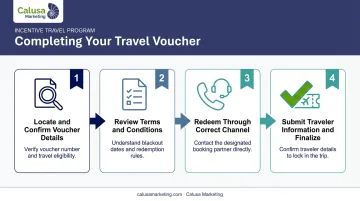
Step 1: Locate and Confirm Your Voucher Details
Before doing anything else, gather the basics:
- Voucher code or number, the issuing company, and its dollar or percentage value
- Whether the voucher is issued in your name and whether it's transferable
- The exact expiration date and any conditions tied to redemption deadlines
Skipping this step is where a lot of value disappears. If the expiration date is buried in an email you deleted months ago, you're already behind.
Step 2: Review the Terms and Conditions Before Booking
This is the step almost everyone rushes past, and it's the one that causes the most rejected redemptions.
Check for:
- Blackout dates, minimum spend requirements, or route/property restrictions
- Which services are actually covered (flights only, hotel only, or a full package)
- Whether the voucher can be combined with other discounts or must be used in a single transaction
Read this before you start booking, not while you're on hold trying to explain why your reservation didn't go through.
Step 3: Redeem Through the Correct Channel
Every voucher has a designated redemption path. It might be an airline or hotel website, a call center, a travel agent, or a program provider's own platform.
Have your voucher code and ID ready before you start. Ask upfront whether any price differences or added fees apply at booking time.
Some redemption paths are simpler than others. Calusa Marketing's incentive travel certificates, for example, are redeemed directly through its own customer service team, not through a third-party portal or app. Recipients don't need to create an account or navigate a separate login. They call or email, and Calusa's fulfillment team handles the booking from there.
Step 4: Submit Traveler Information and Finalize the Booking
Enter traveler names exactly as they appear on government-issued ID, along with accurate dates and destination. A single letter mismatch can hold up boarding.
Before finalizing:
- Review the full confirmation for errors in dates, names, or itinerary details
- Save or print the confirmation and redemption receipt
- Set a reminder if any portion of the voucher's value remains unused
What You Need Before Completing Your Travel Voucher
Having the right information ready prevents delays or forfeited value at redemption. Nothing kills momentum faster than getting halfway through a booking and realizing you're missing something the system needs.
Before you start, gather the following:
- Documentation and ID: A government-issued ID matching the traveler's name, the voucher code, and the original issuance email or confirmation.
- Account access: Have login credentials ready for the airline, hotel, or program portal if redemption requires an account. Not every voucher works this way—Calusa's travel certificates skip this step since redemption runs through a live support team instead of a self-service portal.
- Remaining value and restrictions: Confirm the current balance, whether partial use is allowed, and whether unused amounts are forfeited after one redemption—this single question saves a lot of frustration later.
Key Factors That Affect Your Travel Voucher's Value
A voucher's advertised value and its actual usable value aren't always the same number. Several variables decide the gap between the two.
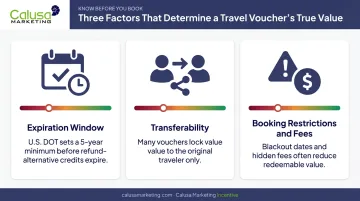
Expiration Window
Why it matters: Shorter windows raise the risk of forfeiting the voucher entirely.
Impact: Under DOT rules on refund alternatives, travel credits or vouchers airlines offer instead of a refund must remain valid for at least five years, with material restrictions disclosed upfront. That's a meaningful protection, but it applies to refund-alternative credits specifically, not every promotional or goodwill voucher an airline might hand out.
Transferability
Why it matters: A non-transferable voucher locks value to one traveler. If plans change, that value is often wasted.
Impact: Fully transferable travel incentives solve this problem. Calusa Marketing structures its incentive travel certificates so recipients can share or gift the trip to someone else entirely, meaning a work reward doesn't go to waste just because the winner can't travel that quarter.
Booking Restrictions and Fees
Blackout dates, route restrictions, and hidden redemption fees can all shrink a voucher's real-world value:
- Blackout dates and property restrictions can block booking during peak season or at your preferred destination, even on a high face-value voucher.
- Redemption fees appear when a voucher requires booking through specific call centers or portals that add hidden service charges, eroding value below the printed amount.
Always confirm these restrictions before assuming a voucher covers your trip. A centralized, single-point-of-contact redemption model, like the one Calusa Marketing uses for its certificates, tends to produce fewer surprises than juggling multiple third-party booking sites.
Common Mistakes to Avoid When Completing a Travel Voucher
Most redemption problems are avoidable. Here's what trips people up most often:
- Skipping the terms and conditions before booking — this alone causes many rejected redemptions
- Assuming a voucher is the only option when a refund may be legally required. DOT's automatic refund rule mandates refunds to your original payment method for qualifying cancellations, not just credit.
- Waiting until close to the expiration date, which risks limited availability or losing the credit entirely
- Failing to save confirmation numbers or screenshots, which matter if a redemption dispute comes up later
When to Redeem Your Voucher vs. Request a Refund
Accepting or using a voucher isn't always the smarter move, even when it's the option offered first.
Redeem the voucher when:
- Its value exceeds any cash alternative you'd realistically receive
- You'll likely fly or stay with that provider again anyway
- The expiration window gives you enough time to actually rebook
Request a refund instead when:
- Future travel with that provider is unlikely
- The voucher carries excessive restrictions that make it hard to use
- You're legally entitled to cash under DOT's refund rules for cancellations or significant changes
For businesses issuing travel vouchers as customer or employee rewards, the calculation is different. The priority is ensuring the reward actually gets used, regardless of whether it takes the form of a voucher or a refund. Partnering with a full-service incentive firm like Calusa Marketing means bookings, confirmations, and support are handled end-to-end, so recipients aren't left figuring out redemption on their own.
Frequently Asked Questions
What is a travel voucher?
Airlines, hotels, and travel providers issue travel vouchers as prepaid credits or certificates that travelers can apply toward future travel expenses. Terms, value, and eligible uses vary by issuer.
What can I use a travel voucher for?
Most vouchers apply to flights, hotel stays, car rentals, or tours, though eligible uses depend entirely on the specific voucher's terms. Some cover only one service category.
How do you get travel vouchers?
Common sources include flight cancellations or delays, voluntarily giving up a seat on an overbooked flight, promotional offers, or rewards through employee or customer incentive programs.
Do travel vouchers expire?
Most carry an expiration date. Regulated airline compensation credits offered instead of a refund must remain valid for at least five years under current DOT rules.
Can a travel voucher be transferred to someone else?
It depends on the voucher type. Certain regulated compensation credits must be transferable, while standard promotional or unused ticket credits are often locked to the original traveler.
What happens if I don't use my travel voucher before it expires?
It typically becomes invalid or loses its value entirely. Setting a redemption reminder and reviewing the terms early is the easiest way to avoid losing it.