Introduction
Gift cards top wish lists for a reason. The National Retail Federation projected $29 billion in U.S. holiday gift-card spending for 2025, with 43% of shoppers planning to buy at least one.
But here's what most businesses miss: the type of gift card you choose matters just as much as the dollar amount.
Pick a single-brand card, and you might frustrate half your audience. Pick a network-branded card, and you might overspend on processing fees you didn't need to pay.
For companies running employee incentives, sales rewards, or customer loyalty programs, this decision affects redemption rates, budgets, and how recipients actually feel about your program.
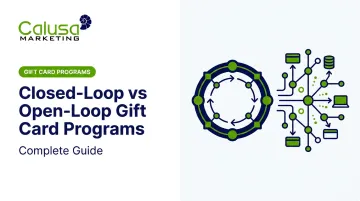
This guide breaks down closed-loop and open-loop gift cards: what they are, where each one wins, and how to decide which fits your goals.
Key Takeaways
- Closed-loop cards work at one brand; open-loop cards work wherever Visa, Mastercard, or Amex is accepted.
- Closed-loop cards deliver lower fees and richer spending data; open-loop cards offer broader appeal.
- Open-loop or "any-card" flexibility typically boosts satisfaction in incentive and reward programs.
- Brand-building favors closed-loop, while broad-audience motivation favors open-loop.
- Many programs now blend both, using flexible platforms to capture the benefits of each.
Closed-Loop vs Open-Loop: Quick Comparison
Here's how the two models compare across the factors that matter most to program managers.
| Factor | Closed-Loop | Open-Loop |
|---|---|---|
| Cost & fees | Lower transaction costs, no network fees | Higher fees due to card network involvement |
| Redemption scope | One brand or affiliated merchant group | Nearly anywhere the network is accepted |
| Data ownership | Full visibility into spend behavior | Little to no visibility after issuance |
| Recipient appeal | Strong if recipient already likes the brand | Broad, since recipients choose where to spend |
| Best fit | Retail loyalty, store credit, refunds | Employee incentives, sales rewards, acquisition campaigns |
The pattern here is straightforward: closed-loop trades flexibility for control and cost savings, while open-loop sacrifices some cost efficiency for near-universal appeal.
Neither trade-off is automatically right or wrong. It depends entirely on what your program is trying to accomplish, which is exactly what the next two sections unpack.
What is a Closed-Loop Gift Card Program?
A closed-loop gift card is a prepaid card redeemable only at one specific retailer or its affiliated merchant network. No Visa or Mastercard logo. No use anywhere else. Just one brand, one ecosystem.
Think Starbucks, Walmart, or a regional restaurant chain. The value only moves within that business's world.
Why businesses choose closed-loop:
- Lower processing costs: no interchange fees paid to card networks
- Full data ownership: you see exactly where, when, and how the funds get spent
- Stronger brand reinforcement: every redemption is another touchpoint with your brand, not a competitor's
Not all closed-loop programs look the same. Three subtypes show up most often:
- Vendor-issued programs: cards issued and managed directly by the retailer
- Merchant bank programs: a financial partner handles issuance while the merchant controls redemption
- Store-branded hybrid cards: physical and digital versions that function identically across channels
Use Cases of Closed-Loop Cards
Closed-loop cards make the most sense for businesses that want recipients walking back through their doors, not spending elsewhere.
Where closed-loop dominates:
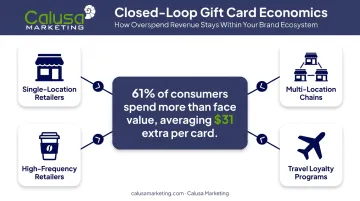
- Single-location retailers and restaurant chains driving repeat visits
- Franchise networks reinforcing brand loyalty across locations
- Coffee chains and big-box retailers with high-frequency purchase cycles
- Airline and hotel loyalty programs (Delta and Marriott both restrict redemption to their own travel and hospitality ecosystems)
The uplift potential is real, too. General gift-card research shows 61% of consumers spend more than a card's face value, averaging over $31 in extra spend per card. That overspend stays inside your ecosystem when the card is closed-loop, funneling extra revenue directly back into your business.
What is an Open-Loop Gift Card Program?
Open-loop gift cards carry a major network logo (Visa, Mastercard, or American Express) and work almost anywhere that network is accepted. The recipient decides where to spend, not the issuer.
This flexibility matters for businesses running incentive programs across diverse audiences. A sales rep in Ohio and a channel partner in Texas have different favorite stores. An open-loop card removes that friction entirely.
Core benefits for program operators:
- Higher recipient satisfaction since there's no restriction on where value gets spent
- Simplified logistics when your audience spans multiple industries or regions
- No need to guess which brand will resonate with each recipient
Common Variations
- Restricted open-loop — usable broadly, but limited to certain merchant categories or locations
- Unrestricted open-loop — usable virtually anywhere the network operates
- Branded prepaid cards — network cards with custom branding layered on top
Use Cases of Open-Loop Cards
Open-loop cards shine in incentive and reward contexts where universal appeal drives engagement more than brand loyalty does.
Where open-loop typically wins:
- Employee recognition and sales team motivation
- Customer acquisition and referral campaigns
- Channel partner and distributor rewards
- Donor incentive programs, such as blood and plasma donation centers
The data backs this up. In an IRF study of recipients comparing a $50 prepaid card option, 75% preferred an open card versus just 8.5% who preferred a closed one. That gap is dramatic, even accounting for the study's smaller, dated sample.
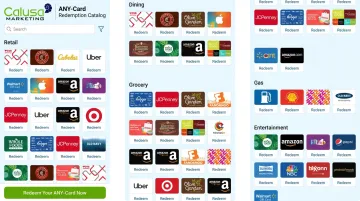
This is where Calusa Marketing's ANY-Card platform fits. Instead of locking recipients into one brand, ANY-Card delivers a digital voucher that recipients redeem from a catalog of 100+ branded gift card options, spanning retail, dining, grocery, gas, and entertainment.
There's also a Visa cash-alternative option for added flexibility, with no app download or system integration required. Program administrators can even narrow the catalog for budget control while still giving recipients real choice.
Closed-Loop vs Open-Loop: Which Is Better for Your Program?
There's no universal winner here. The right answer depends on four factors:
- Program objective : building loyalty to your brand, or motivating a broad, diverse audience?
- Budget and processing costs : can you absorb network fees, or does every dollar need to stretch further?
- Audience diversity : does everyone shop the same places, or does preference vary widely?
- Control over spend location : do you need visibility into where funds go, or is recipient satisfaction the priority?
Quick rule of thumb: Choose closed-loop if repeat visits to your specific brand are the goal. Choose open-loop (or a flexible any-card option) if maximizing satisfaction across a varied audience matters more than brand-specific redemption.
Many incentive programs now skip the either/or debate entirely. They offer a curated, multi-brand "any-card" option so recipients feel they have genuine choice, while the business still manages everything through one centralized platform.
Real-World Example: Choosing the Right Card Type for an Incentive Program
Media companies face a particular version of this challenge. Subscriber and customer bases are broad, spread across regions, and rarely share the same brand preferences.
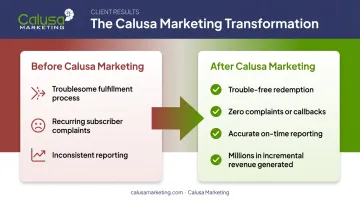
Calusa Marketing's work with the Denver Post illustrates the point. According to client feedback from Steve Johansson at the paper, gift card fulfillment for subscribers had previously been a "troublesome process."
After switching to Calusa Marketing's fulfillment approach, Johansson reported the experience became completely "trouble free," with no further complaints or callbacks from subscribers and consistently accurate, on-time reporting.
Separately, Jim Normandin of APG Media of Chesapeake & Florida credited incentive-driven programs built with Calusa Marketing for generating millions of dollars in incremental revenue by motivating both sales teams and clients simultaneously.
The common thread across both examples: rigid, single-brand redemption creates administrative headaches and recipient frustration. Flexible, catalog-based redemption removes that friction.
If your reward program needs broad appeal without added complexity, a flexible card solution may outperform a single-brand card.
Want to see how a flexible, no-integration gift card program could work for your team? Talk to Calusa Marketing about building an incentive program tailored to your goals.
Conclusion
Closed-loop and open-loop gift cards solve different problems. Closed-loop cards build repeat visits and brand affinity while keeping costs down. Open-loop cards deliver broad appeal and recipient choice, at a higher processing cost.
Choosing between them comes down to the outcome you're chasing: cost control and brand reinforcement, or maximum participation and satisfaction across a diverse audience. Calusa Marketing's ANY-Card platform lets businesses capture both benefits without adding operational burden, giving recipients real choice while keeping program management centralized and simple.
Frequently Asked Questions
What is an example of a closed loop gift card?
A Starbucks gift card is a classic example. It only works at participating Starbucks locations and can't be used anywhere else, unlike a Visa or Mastercard gift card.
What is a closed loop card?
It's a prepaid card redeemable only at a specific merchant or its affiliated network. It carries no major card network logo like Visa or Mastercard.
What is the difference between open loop and closed loop gift cards?
Closed-loop cards work at one brand only and carry lower processing costs. Open-loop cards work almost anywhere a card network is accepted but come with higher network fees.
Which is better for employee or customer reward programs, open-loop or closed-loop gift cards?
Open-loop or flexible "any-card" options perform better for diverse audiences because recipients get broader choice, which boosts satisfaction and participation.
Can a business offer both open-loop and closed-loop gift card programs?
Yes, and many do. Closed-loop cards often support brand loyalty goals, while open-loop or flexible cards handle incentive and acquisition campaigns.
Are open-loop gift cards more expensive to implement than closed-loop cards?
Open-loop cards typically carry higher network processing fees than closed-loop cards. Calusa Marketing's ANY-Card platform simplifies setup and reduces the administrative overhead tied to that added cost.