The math gets worse from there. According to Reynolds and Reynolds' 2025 report, nationwide brand retention held at just 43.9% in 2024. That means more than half of buyers who traded in a vehicle walked into a different dealership, or picked a different brand entirely, for their next purchase.
That's a lot of repeat business walking out the door. This article breaks down five practical strategies dealerships can use now to keep customers coming back for service, parts, and their next vehicle purchase.
Key Takeaways
- Retention costs far less than acquisition, yet most buyers still defect at resale
- Service customers buy their next vehicle from you roughly 30 points more often
- Loyalty programs and personalized outreach compound, turning data into repeat revenue
- A 5% retention increase can lift profits 25-95%, per Bain & Company
- Lasting retention takes technology, personalization, and cross-department coordination
Why Customer Retention Deserves Dealership Priority
Competition for repeat buyers keeps intensifying. Shoppers had nearly 450 vehicle nameplates to choose from as of 2024, according to S&P Global Mobility, a number the firm expects to keep climbing as electrified models multiply. More choice simply means more chances for a customer to drift toward a competitor.
Ownership costs aren't helping matters. AAA's annual driving-cost studies show the average cost to own and operate a new vehicle jumped from $9,282 in 2019 to $12,297 in 2024, a 32.5% increase in five years. Every extra dollar a customer spends on financing, insurance, and fuel is a dollar they're less willing to gamble on an unfamiliar dealership.
The financial upside of getting retention right is substantial:
- A retained dealership customer's lifetime value, once repeat purchases, service revenue, and referrals are counted, can reach well into five figures
- Some industry analyses place that figure near $50,000 over the life of the relationship
- A 5% increase in retention can boost profits by 25% to 95%, according to Bain & Company's research on customer economics
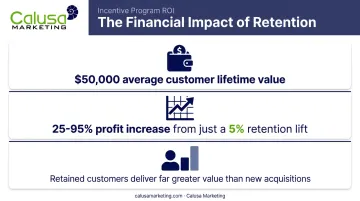
For a dealership, that kind of swing doesn't require a bigger ad budget or more floor traffic. It just requires keeping the customers you already spent money acquiring.
5 Ways to Improve Dealership Customer Retention & Loyalty
These five strategies span program design, personalization, service operations, proactive outreach, and everyday customer experience. A loyalty program without personalized follow-up feels generic. A service department without a rewards structure misses its best retention lever. Combined across sales, service, and marketing, though, these tactics compound.
Way 1: Launch a Structured Loyalty & Rewards Program
Loyalty programs work because they change customer behavior, not just customer sentiment. Customers who actively redeem rewards tend to spend meaningfully more per year than those who never engage with a program at all.
Maintenance and loyalty programs move the needle hardest in the service lane. Performance Administration Corp.'s dealer data documents complimentary-maintenance programs lifting 12-month service retention from a baseline around 25% up toward 68% once a structured program is in place. That's the difference between a customer disappearing after one visit and one who keeps coming back for years.
Flexibility matters as much as the program itself. A single discount type won't appeal to every customer. Reward menus that include gift cards, travel incentives, branded merchandise, and points redeemable across categories give customers a reason to stay engaged no matter what motivates them personally.
This is where a platform like Calusa Marketing's cloud-based SaaS reward system fits into a dealership's retention plan. Building a loyalty or digital punch card program in-house usually means IT integration, app development, and ongoing maintenance.
Calusa's model skips that: no app download for customers, no IT integration for the dealership, and a digital loyalty card that's typically live in under a week.
One more benefit worth noting: every enrollment captures contact details, purchase history, and reward preferences. That data becomes the foundation for the personalized outreach covered next.
Way 2: Personalize Every Customer Communication and Touchpoint
Generic outreach gets ignored. Epsilon research found that four out of five consumers are more likely to purchase when a brand personalizes the experience, a pattern that applies as much to a service reminder as it does to a sales offer.
Segmentation amplifies that effect further. Campaign Monitor has reported segmented email campaigns generating revenue increases as high as 760% compared with non-segmented blasts. Even if a dealership never gets close to that ceiling, the direction is clear: a targeted message beats a mass one.
Personalization doesn't require anything exotic. It means:
- Using the customer's actual name, not "Valued Customer"
- Referencing their specific vehicle make, model, and year
- Tailoring the message to ownership stage, since a first-time buyer needs different content than someone six years into ownership
SMS deserves special attention: TextUs reports automotive sales and service texts see open rates around 98%, far outpacing email. Used well, through appointment reminders, service-due alerts, and recall notices, texting keeps a dealership top of mind. Overused, it burns through the goodwill that makes the channel effective in the first place.
None of this works without clean data. Multi-touch attribution research from Cox Automotive and Clarivoy, analyzing 875,000 sales, found dealership CRMs capture only about 3.5% of actual customer touchpoints. Closing that gap, even partially, is what makes every reminder feel personal instead of automated.
Way 3: Make Service the Centerpiece of Retention Strategy
Personalized outreach keeps a dealership top of mind, but that attention only pays off if customers keep coming back for service. The service lane is the strongest predictor of repeat vehicle sales a dealership has. The 2025 Cox Automotive Fixed Ops and Ownership Study found that 74% of customers who returned to the selling dealership for service said they were likely to buy their next vehicle there too, compared with just 44% of customers who didn't return for service.
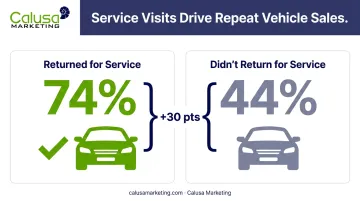
That's a 30-point gap driven largely by whether a customer keeps showing up for an oil change.
The fix starts at delivery. Schedule the customer's first service appointment before they leave the lot, not weeks later through a mailer they may never open. From there, build a maintenance cadence around:
- Mileage-based service reminders tied to the actual vehicle
- Recall notices sent as soon as they're issued
- Seasonal recommendations like tire changes, battery checks, and AC service
There's a conquest opportunity hiding here too. Cox Automotive's research shows the share of newer-vehicle owners returning to their selling dealership for service has slipped, down to 54% in 2025 from 72% in 2023. Every lost visit is either a customer drifting to an independent shop or warming up to buy their next vehicle somewhere else entirely.
Treat the service department as a retention engine, not just a profit center, and sales benefits right along with it.
Way 4: Proactively Identify and Re-Engage At-Risk Customers
Waiting for a customer to stop showing up is waiting too long. Predictive, behavior-based data, combining CRM history, DMS records, and third-party demographic or financial signals, can flag customers likely to defect before they ever start shopping a competitor.
Signals worth tracking include:
- A service visit overdue by more than a few months
- A lease approaching its end date
- A loan nearing payoff
- Declining response rates to outreach
Spotting the signal is only half the job. Cross-department coordination is what actually saves the customer: If sales doesn't know a lease is ending, and service doesn't know sales is reaching out, the customer gets an inconsistent experience, or no outreach at all. Retention breaks down in the gaps between departments just as often as it breaks down from bad service.
Automated win-back campaigns close those gaps. A lapsed service visit can trigger a reminder within days instead of months. A lease-end date can trigger an outreach sequence 90 days out instead of a single postcard.
Way 5: Value the Customer's Time and Experience at Every Visit
Even the best win-back campaign can't undo a bad experience once a customer gets a dealership on the phone. Price isn't always what sends a customer to a competitor. Friction is often the bigger culprit: long hold times, slow callbacks, and appointment waits that keep stretching. A Marchex analysis of 8 million calls to dealerships found more than 19% went unanswered or were abandoned, with over 10% of those callers dropping during automated routing or voicemail.
Wait times aren't improving either. J.D. Power's 2024 Customer Service Index found the average dealership appointment wait climbed to 5.2 days, up from 4.8 days the year before.
Practical fixes don't require a bigger budget:
- Confirm parts and bay availability before the appointment is booked, not the morning of
- Provide real-time status updates instead of making customers call in for progress
- Offer mobile service or loaner options for customers who can't afford the wait
The stakes are real. Most consumers say their service experience directly shapes whether they'll buy from that dealership again, echoing the same 74% repurchase link covered above. Every hold time and every wait-list delay chips away at that number.
How to Measure and Benchmark Your Dealership's Retention Success
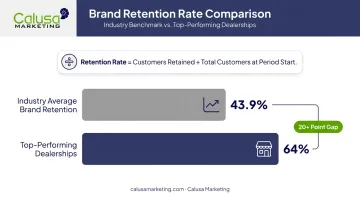
Retention rate is simple to define, even if dealerships rarely calculate it consistently: customers retained during a period, divided by total customers at the start of that period. Run it separately for sales and service, since the two behave very differently.
So what counts as "good"? The industry-wide brand retention benchmark sits at 43.9%, per Reynolds and Reynolds' most recent report. Dealerships running strong service and loyalty programs regularly beat that number by a wide margin, sometimes by 20 points or more.
A few benchmarking tips:
- Track sales retention and service retention as separate KPIs, not one blended number
- Compare service retention against the 43.9% brand-level benchmark, not against your own sales retention rate
- Re-measure quarterly, since retention drifts faster than most dealerships expect after a staffing change or a competitor's promotion
Sales retention is more exposed to manufacturer incentives, inventory availability, and market-wide shopping behavior outside a dealer's control. Service retention, by contrast, is the lever a dealership controls directly — track it consistently, and drift becomes visible before it turns into lost revenue.
Frequently Asked Questions
What is a reasonable customer retention rate?
Nationwide brand retention averaged 43.9% in 2024, per Reynolds and Reynolds. Dealerships with strong service and loyalty programs regularly perform well above that baseline.
What's the difference between customer retention and customer loyalty?
Retention measures whether a customer actually returns to buy or service again. Loyalty is the emotional preference and trust that drives that return, even when a competitor offers a better deal.
How much does it cost to acquire a new customer compared to retaining an existing one?
Acquiring a new customer typically costs five to seven times more than retaining an existing one. That gap is why dealerships get more return from focusing marketing dollars on customers already in their database.
Can a loyalty or rewards program really improve dealership retention?
Yes. Structured maintenance and loyalty programs have lifted 12-month service retention from roughly 25% up toward 68% in documented cases. Customers who actively redeem rewards also tend to spend more annually than those who don't.
How does the service department impact vehicle sales retention?
Customers who return to the selling dealership for service are 74% likely to buy their next vehicle there too, versus 44% of those who don't. Fixed ops should be treated as a retention driver, not just a profit center.
What's the fastest way to launch a customer loyalty program at my dealership?
Cloud-based SaaS platforms, like the one Calusa Marketing offers, can launch a digital punch card or rewards program in under a week, with no app download or IT integration required.