This confusion is common. Incentive management fees (IMFs) show up across hospitality, hedge funds, and private equity, all designed to align a manager's paycheck with actual results. But the mechanics behind that alignment often get lost in contract language.
Marriott alone collected $791 million in incentive management fee revenue in 2025, up from $755 million just two years earlier, according to the company's public filings. That's real money changing hands based on formulas most owners never fully unpack.
This guide breaks down what an IMF actually is, how it differs from a standard management fee, the exact math behind the calculation, and real examples from hotels and investment funds alike.
Key Takeaways
- Incentive fees only pay out when performance clears a pre-agreed benchmark
- Base fees are fixed and guaranteed; incentive fees are variable and performance-based
- Hotels typically charge 10%-20% of profit above an 8%-12% owner's priority threshold
- Funds use a hurdle rate plus high-water mark, with incentive fees near 20%
- Critics note managers share the upside but rarely absorb the downside, encouraging risk-taking
What Is an Incentive Management Fee?
An incentive management fee is compensation paid to a manager, whether that's a hotel operator, hedge fund manager, or property manager, that's contingent on financial performance exceeding a specific benchmark. Unlike a flat percentage fee, nothing gets paid if the benchmark isn't cleared.
The purpose is straightforward: align the manager's financial interests with the owner's. When the property or fund performs well, both sides benefit. When it doesn't, the manager's incentive fee disappears, even though a base fee usually still applies.
IMFs sit on top of a base fee. They don't replace it. A hotel operator still collects their base management fee for day-to-day operations regardless of profitability. The incentive fee is the bonus layer, not the entire compensation structure.
Where Incentive Management Fees Commonly Appear
Three sectors use this structure most heavily:
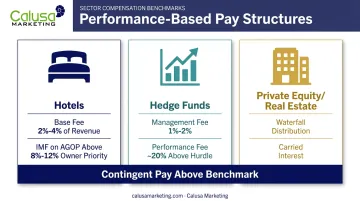
- Hotels: A base fee of 2%-4% of total operating revenue (3% typical), plus an IMF tied to Adjusted Gross Operating Profit (AGOP) above the owner's priority, typically 8%-12% of the owner's investment, per HVS
- Hedge funds and investment managers: A 1%-2% management fee plus a performance fee, commonly around 20%, tied to net investment income or NAV growth above a hurdle rate
- Private equity, real estate, and select SaaS/consulting retainers: Similar variable-pay structures, built around a distribution waterfall or carried-interest arrangement
Each version follows the same basic logic: contingent pay above a contractual benchmark. The differences lie in what that benchmark is and how it's measured.
Management Fee vs. Incentive Fee: What's the Difference?
Here's the direct answer: a management fee is a fixed, predictable charge (a percentage of revenue or assets under management) paid for ongoing services regardless of outcome. An incentive fee is variable and only paid when performance clears a defined threshold, which makes it inherently unpredictable for the owner or investor.
| Factor | Management Fee | Incentive Fee |
|---|---|---|
| Basis of calculation | % of revenue or assets | % of profit above a threshold |
| Predictability | Fixed, recurring | Variable, can be $0 |
| Purpose | Covers operating costs | Rewards outperformance |
| Typical range | 2%-4% (hotels); 1%-2% (funds) | 10%-20% (hotels); ~20% (funds) |
| Risk to manager | Low | Higher, tied to results |
Most agreements combine both fee types, each serving a distinct role:
- Base fee: keeps operations funded regardless of performance
- Incentive fee: rewards the manager for beating expectations
This layered approach balances stability with upside potential.
Here's the catch critics raise, though: this dual structure means managers share in the upside but rarely absorb the downside. A hedge fund manager who loses 15% of a portfolio still collects their base management fee. Unlike a true profit-sharing arrangement, the risk isn't symmetrical. That asymmetry is why savvy investors negotiate hurdle rates or clawback clauses before signing a management agreement.
How Incentive Fees Are Calculated
The math behind incentive fees follows a few consistent building blocks, regardless of industry.
Hurdle rate: This is the minimum return, often 6%-8% in private funds, that must be cleared before any incentive fee is earned. Preqin's data on private-equity vintages found 8% was the traditional standard. However, the actual mean across 2015-vintage funds dropped to 6.2%, partly because some funds used no preferred return at all.
High-water mark: This prevents a manager from collecting an incentive fee simply for recovering prior losses. If a fund drops 10% one year and climbs back 10% the next, no incentive fee applies until the fund exceeds its previous peak value.
A Worked Fund Example
Say a $10 million fund grows 10% in a year, hitting $11 million. The hurdle rate is 6%, and the incentive fee is 20% of gains above that hurdle.
- Hurdle amount: 6% of $10 million = $600,000
- Gains above hurdle: $1,000,000 - $600,000 = $400,000
- Incentive fee: 20% of $400,000 = $80,000
Some agreements add a catch-up clause, letting the manager gradually reach their full percentage split once the hurdle clears, rather than only earning fees on the excess above it.
A Worked Hotel Example
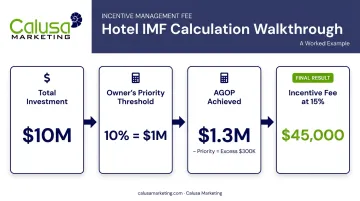
For hospitality, the formula centers on AGOP (Adjusted Gross Operating Profit) exceeding the owner's priority. Take a $10 million development with a 10% owner priority:
- Owner's priority: 10% of $10 million = $1,000,000
- If AGOP hits $1,300,000, the excess is $300,000
- At a 15% incentive management fee (IMF) rate, the operator earns $45,000
Specific percentages and thresholds are always negotiated per contract. Always have your legal and financial teams confirm the exact terms before signing.
Real-World Examples of Incentive Management Fees
Hotel IMF revenue has climbed sharply as travel demand recovered. According to public company filings and annual reports, IMF income grew across the major hotel brands between 2023 and 2025:
- Marriott: IMF revenue rose from $755 million to $791 million
- Hilton: IMF revenue grew from $224 million to $281 million
- Hyatt: IMF revenue increased from $185 million to $231 million Marriott earned incentive fees from 69% of its managed hotels worldwide in both 2024 and 2025.
That growth isn't uniform, though. CBRE's hotel sample found the share of properties paying an IMF jumped from 3.1% in 2020 to 12.2% in 2022, with resorts posting the highest incidence at nearly 53%. Convention hotels, by contrast, paid no IMF at all across that stretch, a clear sign of how much property type and demand mix matter.
Hedge funds tell a similar story of asymmetry. Under a classic "2 and 20" structure:
- Strong year: A $50 million fund grows 15%. After a 6% hurdle, the manager earns 20% of the excess gain, roughly $900,000, on top of the flat 2% management fee
- Flat or down year: The same fund posts 0% or negative returns. The incentive fee drops to zero, but the manager still collects the 2% base fee, around $1 million, regardless
This is the asymmetry critics point to constantly: the manager's downside is capped at forgoing a bonus, while the investor's downside has no floor.
Benefits, Risks & Applying the Concept to Business Incentive Programs
The core benefit is straightforward: incentive fees push managers toward stronger performance and reduce the moral hazard baked into pure flat-fee arrangements. When pay is tied to results, managers have real skin in the game.
The core risk is just as clear: because managers share in profits but not losses, one-sided fee structures can encourage excessive risk-taking. Regulators and industry bodies agree:
- The SEC has warned that performance fees can motivate hedge fund managers to take on greater risk than they otherwise would
- CFA UK compares one-sided performance fees to a call option for the manager: unlimited upside with no corresponding downside exposure
- ERISA guidance permits performance-based fees only when the formula reflects both gains and losses, with independent oversight built in
That same principle, paying for results rather than flat activity, is exactly why sales and dealer incentive programs work the way they do. A distributor who hits 110% of quota should earn more than one who just shows up.
Calusa Marketing builds programs around this same alignment-of-interest logic:
- Its work with Hajoca, spanning 800+ locations and 20+ entities, ties sales growth directly to KPIs specific to that account
- Programs for clients like Johnstone Supply and Baker Distributing use points-based structures where dealers earn more as purchases and account growth increase
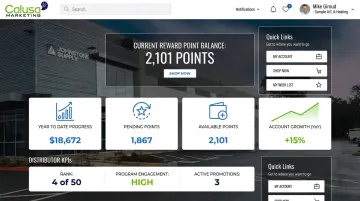
This is the same "pay for outperformance" thinking that drives incentive fees in hotels and funds, just applied to sales teams and channel partners instead.
Frequently Asked Questions
Is a 0.4% management fee high?
No. A 0.4% fee is low-to-moderate compared to actively managed funds, which often run 1%-2%. This figure is more typical of passive or index products, so context matters when comparing.
What is the difference between management fee and incentive fee?
A management fee is a fixed charge for ongoing services, paid regardless of results. An incentive fee is variable and only paid when performance clears an agreed threshold.
How do incentive fees work?
A manager earns a percentage of gains only after performance exceeds a hurdle rate or benchmark. If the benchmark isn't cleared, no incentive fee is owed, though the base fee still applies.
What is a typical incentive management fee percentage in hotel contracts?
Industry data points to 10%-20% of AGOP above the owner's priority as the typical range, with the priority itself usually set at 8%-12% of the owner's investment.
What is a high-water mark in incentive fee calculations?
It's a safeguard that prevents managers from earning a fee for recovering prior losses. Fees only apply to new gains that exceed the fund's previous peak value.
Can an incentive management fee be reduced or waived?
Yes. Fees can be negotiated, offset against other charges like transaction fees, or made subordinate to owner priorities such as debt-service coverage.