"Onboarding trends" in 2026 no longer describes a week of paperwork and a laptop handoff. It describes a connected, data-driven system that runs 90 days or longer, touches HR, IT, and managers simultaneously, and treats the first few months as the make-or-break window for retention.
HR leaders who understand these shifts can cut early attrition, get new hires productive faster, and stand out in a labor market where talent still has options. This article breaks down the five trends defining onboarding in 2026, what's driving them, and how they're reshaping HR's role inside the business.
Key Takeaways
- Onboarding is shifting from a one-time checklist to a continuous, AI-powered retention system.
- Preboarding, hybrid-friendly design, and milestone recognition are now baseline expectations, not extras.
- Manager enablement and analytics are closing the accountability gaps that drive early disengagement.
- Companies pairing technology with human touches (buddies, recognition, wellness) see the strongest results.
5 Onboarding Trends Every HR Leader Should Watch in 2026
These five shifts represent how leading organizations are rethinking new-hire integration this year — from who runs the process to how long it lasts.
Trend 1: Agentic AI Takes Over Onboarding Administration
Traditional onboarding software automates single tasks: send a form, provision a badge, schedule a training module. Agentic AI works differently. It coordinates across systems, triggering IT provisioning, scheduling manager check-ins, and flagging incomplete compliance steps without a human routing each request.
This isn't a distant prediction. Gartner forecasts that 40% of enterprise applications will feature task-specific AI agents in 2026, up from less than 5% in 2025. That's an enterprise-software-wide jump, and HR platforms are part of it.
A word of caution: Gartner also predicts more than 40% of agentic AI projects will be scrapped by the end of 2027 due to unclear ROI or poor risk controls. Adoption is fast, but not every rollout will succeed.
Why it matters: when agents handle routing and reminders, HR teams spend less time chasing signatures and more time coaching new hires and building relationships — the part of onboarding that actually predicts retention.
Trend 2: Preboarding Becomes a Non-Negotiable Retention Strategy
The stretch between a signed offer and day one used to be dead air. New hires might wait weeks with no contact, then show up unsure if the job still exists. That silence carries risk.
Leading organizations now treat this window as an active retention touchpoint:
- Sending welcome messages and manager introductions before day one
- Shipping equipment or credentials in advance so new hires arrive ready
- Sharing culture content, team bios, or a first-week agenda ahead of time
- Assigning a peer contact for informal questions before the official start date
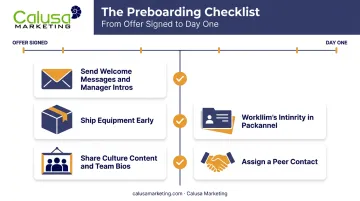
The stakes here are real: a candidate who goes quiet after signing has time to entertain a counteroffer or a second opinion. Structured preboarding keeps momentum going and reduces the chance a hire never shows up at all.
Trend 3: Hyper-Personalized Onboarding Journeys at Scale
One generic training deck for every new hire is losing ground fast. AI-driven segmentation now lets organizations build separate onboarding tracks based on role, seniority, and even generational preference.
A software engineer doesn't need the same onboarding path as a sales rep. A Gen Z hire fresh out of college often expects bite-sized, mobile-first content and frequent feedback loops.
A mid-career hire, on the other hand, may want condensed, self-directed modules that respect their existing expertise. Organizations building both tracks are seeing smoother ramp-up periods than those forcing everyone through identical training.
Why it matters: personalization reduces the overwhelm that comes from information dumps. Remote and younger employees, in particular, benefit from content that matches how they actually prefer to learn.
Trend 4: Continuous 90-Day (and Beyond) Onboarding Replaces the Week-One Model
Onboarding used to end when the orientation binder closed. Not anymore. SHRM Foundation guidance recommends structured milestones at 30, 60, 90, and even 120 days, with follow-up continuing through the first year.
The productivity payoff is real. In the same research, employees at Texas Instruments who went through an enhanced onboarding program reached full productivity two months faster than those in the traditional program.
A typical 2026 milestone cadence looks like:
- Day 7 — Confirm role clarity and early wins
- Day 14 — Check technical access and team integration
- Day 30 — Formal manager feedback session
- Day 60 — Skills and confidence assessment
- Day 90 — Full performance review and career-path discussion
The risk of skipping this: front-loaded, week-one-only onboarding creates a false sense of "we're done here." Without later check-ins, small confusions compound into disengagement right around the time turnover risk peaks.
Trend 5: Gamification and Milestone-Based Recognition Drive Engagement
Points, badges, progress bars, and small rewards are showing up in onboarding platforms to make progress visible and give new hires something to work toward beyond "finish the checklist."
In practice, this often means tying recognition to concrete markers: completing a training module, hitting the 30-day mark, or finishing the 90-day introductory period. Calusa Marketing's incentive platform supports this kind of milestone tie-in: HR teams can attach digital gift cards, punch-card rewards, or merchandise recognition to onboarding checkpoints without needing a heavy IT lift or system integration.
The company's employee recognition programs are built to help organizations get more people through their 90-day intro period, which is precisely where a lot of early attrition happens.
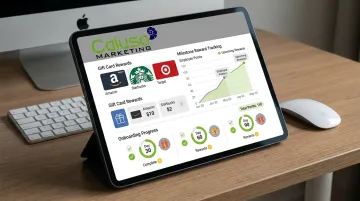
Why it matters: making progress visible and rewarding it, even modestly, gives new hires a reason to stay engaged past the initial excitement of week one — right when motivation naturally starts to dip.
What's Driving These Onboarding Trends
Several forces are converging to push onboarding toward this more continuous, tech-enabled model.
- Technology advances: Agentic AI, chatbots, and predictive analytics are mature enough now to handle real onboarding coordination, not just single-task automation.
- Talent market expectations: Gen Z and hybrid workers expect digital-first, feedback-rich experiences from day one — not a printed handbook and a shrug.
- Cost pressures: Work Institute estimates voluntary turnover cost U.S. employers nearly $900 billion in 2023, roughly 33.3% of an employee's annual salary per departure.
- Competitive dynamics: With job openings still outpacing available workers in many sectors, companies are differentiating through candidate and new-hire experience rather than salary alone.
How These Trends Are Impacting HR and the Business
These shifts are changing more than HR workflows. They're reshaping budgets, accountability, and team structure across the company.
Operational impact: Onboarding is becoming a cross-functional system instead of a siloed HR checklist. IT, facilities, and hiring managers now trigger tasks automatically based on onboarding software rather than waiting on email chains. This reduces the delays that used to leave new hires without laptop access on day three.
Business impact: Leadership is reallocating budget toward retention-focused tools: onboarding software, manager training, and incentive platforms. These are increasingly framed as measurable ROI levers against turnover costs rather than "nice to have" HR spending.
Workforce impact: Managers now carry more onboarding responsibility than ever, which means they need actual enablement, not just a checklist handed down from HR. Meanwhile, HR's own role is shifting from administrative processing toward experience design and data analysis — tracking which milestones predict early attrition and adjusting accordingly.
Future Signals for Onboarding Beyond 2026
Onboarding won't stop evolving once 2026 wraps up. A few signals are worth watching over the next one to three years.
- Convergence with skills-based hiring: Onboarding is blending with internal mobility programs, turning the first 90 days into the opening chapter of a longer career-development journey.
- Predictive attrition analytics: More platforms will flag which new hires are at risk of leaving before they actually do, based on engagement and check-in data.
- Deeper HRIS and rewards integration: Expect tighter connections between core HR systems and recognition platforms, so milestone triggers happen automatically rather than manually.
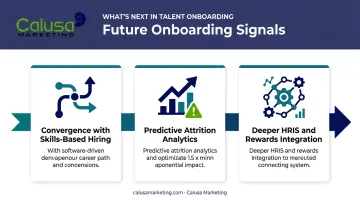
The likely endpoint: onboarding stops being a distinct HR function and becomes indistinguishable from ongoing employee engagement and recognition strategy.
Conclusion
2026's onboarding trends share a common thread. AI-driven automation, preboarding, personalization, continuous 90-day journeys, and milestone recognition all treat the first months of employment as a retention strategy, not a formality.
HR leaders who adapt now gain a real, measurable edge in retention and time-to-productivity. They're building manager accountability, extending onboarding timelines, and pairing technology with genuine human connection — including recognition platforms like Calusa Marketing's, which turn day-30, day-60, and day-90 milestones into engaging moments for new hires.
The organizations treating onboarding as strategic investment keep their best hires past year one.
Frequently Asked Questions
What are the new trends in onboarding?
2026's trends center on AI-driven automation, structured preboarding, hyper-personalized journeys, continuous 90-day programs, and milestone-based recognition. Together they turn onboarding into an ongoing retention system rather than a one-week event.
What are the 5 C's of onboarding?
The commonly cited framework includes five C's: Compliance, Clarification, Culture, Connection, and Confidence, the fifth C added by Talya Bauer's research. Some updated models also include a sixth C, Checkback, for gathering ongoing feedback.
How long should employee onboarding last in 2026?
Most organizations now treat 90 days as the minimum, with milestone check-ins at 30, 60, and 90 days. Complex or senior roles often extend structured onboarding to six months or longer.
How can HR leaders reduce new hire turnover during onboarding?
Focus on these levers: structured preboarding before day one, manager enablement so accountability doesn't fall through the cracks, and scheduled milestone check-ins at 30, 60, and 90 days.
What role does technology play in modern onboarding?
AI and automation remove administrative friction by routing tasks, tracking compliance, and flagging gaps. This frees HR teams to focus on coaching and building relationships instead of paperwork.
How can rewards or recognition programs improve onboarding outcomes?
Tying small incentives, like digital gift cards or milestone rewards, to onboarding checkpoints keeps progress visible and motivation high past the first week, when disengagement risk often rises.