That moment of confusion happens more often than most marketers realize. Many businesses use "promotional certificate," "coupon," and "gift card" interchangeably in their own internal planning, which creates messy program design and, in some cases, real compliance risk.
This guide breaks down exactly what a promotional certificate is, how it differs from similar incentive tools, where it works best, and what the law actually requires before you launch one. Whether you're building a customer acquisition offer or a sales incentive program, understanding these distinctions will save you headaches later.
Key Takeaways
- Promotional certificates reward specific triggers like sign-ups, referrals, or milestones
- They differ legally and structurally from gift cards, promo codes, and mass-market coupons
- FTC and state laws require clear disclosure of terms, conditions, and expiration dates
- Digital delivery has largely replaced print for tracking accuracy and redemption speed
- Multi-state programs carry escheatment risk that businesses often overlook
What Is a Promotional Certificate?
A promotional certificate is a document or coupon-style instrument businesses issue to encourage a specific customer action. That could be a first purchase, a product trial, a referral, or a repeat visit. Unlike a straightforward discount, it's built around a defined offer with rules attached.
The core purpose is behavioral: certificates exist to move someone from considering an action to taking it. A new subscriber gets a certificate to make that first purchase. A loyalty member gets one to come back sooner than they otherwise would.
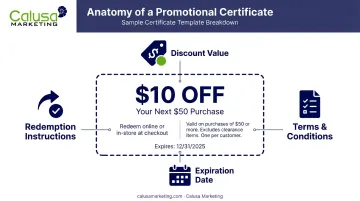
Most promotional certificates include:
- Stated value or discount (a flat dollar amount or percentage off)
- Redemption instructions (in-store, online, or via a code)
- Terms and conditions (minimum purchase, exclusions, transferability rules)
- Expiration date
How They Function in Practice
Certificates can be issued physically or digitally, and redeemed the same way. Some are single-use; others allow limited multi-use within a promotional window. A distributor might mail a paper certificate to a lapsed account, while a media company might send a digital one via email to a new subscriber.
Real-world example: A retailer sends new email subscribers a "$10 off your next $50 purchase" certificate, valid for 30 days. The offer drives an immediate first purchase while setting a clear spending threshold that protects margin. That's the mechanic behind most acquisition-focused certificate programs.
Promotional Certificate vs. Other Incentive Tools
Promotional certificates, promo codes, gift cards, and coupons get lumped together constantly, which makes choosing the right tool harder than it should be. Each one serves a different job.
Promotional Certificate vs. Promo Codes
Promo codes are simple alphanumeric strings applied at checkout, designed for an immediate sales lift and easy ROI tracking. Businesses use them to link a specific action to a specific campaign.
Promotional certificates carry more structure. They're typically tied to a trigger event, such as a milestone or sign-up, and come with formal terms attached rather than a bare discount.
Promotional Certificate vs. Gift Cards and E-Certificates
Gift cards and e-certificates hold stored monetary value that a recipient can spend across multiple purchases, often over months or years. Promotional certificates, by contrast, are condition-based discounts with a shorter, promotion-specific validity window.
This distinction matters legally too. Federal law treats loyalty, award, or promotional gift cards differently from standard gift certificates. 12 CFR § 1005.20 exempts promotional cards from the standard five-year minimum expiration rule that applies to store gift cards, provided specific disclosures are met.
Promotional Certificate vs. Coupons
Coupons are typically mass-distributed vouchers meant for broad audiences, think Sunday inserts or app-wide discount codes. Promotional certificates tend to be individualized or targeted to specific customer segments, such as new members or top-performing sales reps.
| Tool | Distribution | Value Type | Best For |
|---|---|---|---|
| Promotional Certificate | Targeted | Condition-based discount | Triggered engagement |
| Promo Code | Targeted or broad | Checkout discount | Campaign tracking |
| Gift Card | Broad | Stored monetary value | Flexible gifting |
| Coupon | Broad | Discount voucher | Mass discounting |
If your goal is targeted engagement tied to a behavior, a certificate fits. For stored-value gifting, use a gift card. For broad discounting, coupons win.
Legal Guide: Key Rules & Compliance Considerations
Promotional certificates often face the same regulatory scrutiny as gift certificates under state and federal consumer protection law. Treating them as an informal marketing freebie is a mistake that catches businesses off guard.
The FTC expects businesses to clearly state terms, conditions, and expiration dates on or alongside the certificate. Failing to disclose these upfront can trigger deceptive advertising claims, similar to past FTC actions against major retailers over undisclosed dormancy fees.
State-Level Variations
State gift certificate laws vary widely, and this is where most businesses trip up:
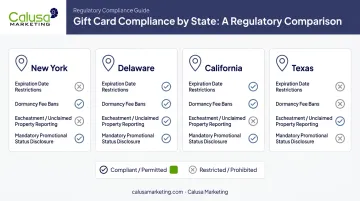
- Some states restrict or prohibit expiration dates entirely
- Others ban dormancy fees outright
- New York requires promotional gift certificates to state their promotional status and expiration date directly on the certificate face
Because rules differ state by state, verify requirements everywhere you operate, not just your home state.
Escheatment and Unclaimed Property
Unredeemed certificate value can trigger escheatment obligations, meaning businesses may need to report unclaimed value to the state after a set dormancy period. Some states, like Delaware, specifically exclude loyalty cards from reportable property, while others don't. This inconsistency is exactly why multi-state programs need a compliance review before launch.
Reduce Exposure With Clear Restrictions
Explicitly state:
- Minimum purchase amounts
- Non-transferability clauses
- Category or product exclusions
These details reduce disputes and protect you legally. For programs launching at scale, partnering with legal counsel or an experienced incentive marketing provider, such as Calusa Marketing, which manages compliance considerations across 1,000+ programs, is worth the investment.
Common Business Uses & Industries
Promotional certificates show up across a wide range of marketing goals:
- New customer acquisition offers
- Employee onboarding gifts
- Sales incentive rewards
- Loyalty program perks
- Win-back campaigns for lapsed customers
Certain industries lean on certificates especially heavily:
- Distribution companies: dealer incentive rewards
- Timeshare and vacation ownership firms: tour attendance drivers
- Media and publishing companies: subscriber acquisition and retention
- Blood donation centers: repeat donation incentives
Calusa Marketing works directly with clients in several of these verticals, including distribution, media, and blood donation centers, building certificate programs tailored to each industry's goals.
Delivery has shifted dramatically in recent years. Print certificates are giving way to email, SMS, and cloud-based platform delivery, largely because digital formats are easier to track and redeem. This mirrors a broader shift in the incentive space. According to a Blackhawk Network study, 70% of online shoppers prefer gift card rewards in loyalty programs over other incentive types.
Best Practices for an Effective Promotional Certificate Program
A well-run certificate program rests on three fundamentals: clear terms, trackable codes, and smart timing. Best practices include:
- Display clear terms and conditions. State the discount, expiration, and restrictions in the same visual space as the offer to prevent disputes and complaints.
- Use unique trackable codes. Assign a distinct code to each certificate to measure redemption rates and calculate real campaign ROI, rather than relying on rough estimates or surveys.
- Set reasonable expiration windows. Shorter windows create urgency, but must respect state-mandated minimum validity periods — review your policy against current rules before every major campaign launch.
How Calusa Marketing Helps Businesses Run Compliant, High-Impact Certificate Programs
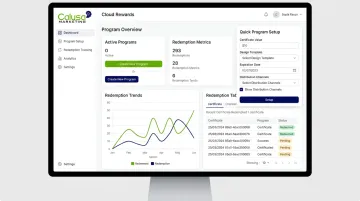
Building a certificate program that actually performs, and holds up legally, takes more than a template. Calusa Marketing's cloud-based SaaS reward platform lets businesses design, issue, and track promotional certificates and digital rewards without complex integrations or app downloads. Programs can go live quickly, without pulling your IT team into a months-long project.
Calusa's white-glove team works alongside clients to help structure program terms and conditions, which reduces both legal exposure and day-to-day operational headaches. That support is a big part of why Calusa maintains a 99% client retention rate among the businesses it partners with.
That track record spans 1,000+ incentive programs across regulated and complex industries, including:
- Blood and plasma donation centers
- Timeshare and vacation ownership companies
- HVAC, plumbing, and electrical distribution
- Media and publishing organizations
That range of experience matters when you're launching a program that needs to work across different regulatory environments and customer expectations. If you're weighing whether a promotional certificate fits your next campaign, reach out to Calusa's team to talk through the specifics of your industry and goals.
Frequently Asked Questions
What is a promotional certificate?
A promotional certificate is a document or coupon-style instrument that offers a discount or incentive to drive a purchase, trial, or loyalty behavior. Most carry specific terms and an expiration date tied to a defined promotion.
Are promotional certificates the same as gift cards?
No. Gift cards hold stored monetary value for flexible spending over time. Promotional certificates are usually condition-based discounts tied to a single promotion, with a shorter validity window.
Can promotional certificates expire?
Most do carry an expiration date. However, several states restrict or regulate how and when that expiration can legally be applied, so requirements vary by location.
Are businesses legally required to disclose certificate terms and conditions?
Yes. FTC guidelines and state laws generally require clear disclosure of terms, conditions, and expiration dates to avoid deceptive advertising practices.
How are promotional certificates typically distributed today?
Print certificates have largely given way to digital delivery through email, SMS, or cloud-based incentive platforms. Digital formats offer better tracking and faster redemption.
Can a promotional certificate program be customized for different industries?
Yes. Certificate programs can be tailored by industry, audience, and campaign goal. Working with an incentive marketing partner like Calusa Marketing helps ensure the structure fits your specific business needs.